What Is Pastoral Care? Meaning, Types and Who Gives It
What pastoral care means, who gives it, the main types, how it differs from pastoral counseling and chaplaincy, and how churches organize and record it.
By Thomas Griffin, Owner and CEO
Published
Pastoral care is the support a faith community gives its people in the hard and important moments of life. It includes visits, calls, cards, prayer, presence in illness and grief, and practical help. Pastors give it, and so do deacons, elders, chaplains, and trained volunteers. The goal is simple: nobody goes through a hard time alone.
If you lead care in a church, you already know the work: the phone that buzzes during dinner, the name you pray for on the drive home. Below is what pastoral care means, where the idea came from, who gives it, and the main types, each with a full guide. The last sections show how churches share the work and keep a record of it.
What Does Pastoral Care Mean?
The word "pastor" comes from the Latin word for shepherd. A shepherd knows each sheep, goes after the one that wanders, and stays with the one that is hurt. Pastoral care is that same work with people. The Bible uses the picture often, in Psalm 23, in Ezekiel 34, in John 10, and in 1 Peter 5, where elders are told to shepherd the flock in their care.
In practice, pastoral care has three parts:
- Presence. You show up. You sit with someone in the hospital, at the graveside, or at the kitchen table.
- Prayer and the word. You pray with people, read Scripture, and bring the sacraments or rituals of your tradition.
- Practical help. You make sure there is a meal, a ride, a call next week, and a person who remembers.
Pastoral care is not therapy, and it is not a program. It is a relationship. A good test is this question: "Does this person know that someone from our church sees them and will come back?"
Other traditions use other words for the same work. Catholic writers speak of the care of souls. In a synagogue, visiting the sick is the mitzvah of bikur cholim, and many congregations have a caring committee. Hospitals and the military call it spiritual care.
A Short History of Pastoral Care
For most of church history, care was the daily work of the parish priest or minister. In their 1964 book Pastoral Care in Historical Perspective, historians William Clebsch and Charles Jaekle studied that history and named four functions of care: healing, sustaining, guiding, and reconciling. They argued that every age of the church did all four, but each age leaned on one. In the earliest centuries, care meant sustaining people through hardship. Under persecution, it meant reconciling people to God and the church. Stanley Hauerwas summarizes their work in a Vancouver School of Theology essay, Wounded: The Church and Pastoral Care.
In the twentieth century, care moved closer to medicine and psychology. In the 1920s, Anton Boisen began training ministers at the bedside of patients, which grew into clinical pastoral education (CPE). Seward Hiltner wrote of healing, sustaining, and guiding in the 1950s, and Clebsch and Jaekle added reconciling. Today, most pastors learn from both streams: the old care of souls and the modern skills of listening.
| Function | What it means | An example today |
|---|---|---|
| Healing | Help a person move toward wholeness in body, mind, or spirit | Pray with a member before surgery and visit during recovery |
| Sustaining | Help a person endure a loss or a situation that will not change | Call a widow each month through the first year |
| Guiding | Help a person make a hard choice | Talk with a family about moving a parent into memory care |
| Reconciling | Help repair a broken relationship with God or other people | Sit with two members who stopped speaking after a conflict |
Who Gives Pastoral Care?
In the early church, care was never one person's job. When the apostles had too much work, they asked the church to choose seven people to serve (Acts 6). The same pattern holds today.
- The senior or solo pastor. Takes deaths, crises, sacraments, and serious needs. Leads and trains the others.
- A care pastor or associate pastor. In larger churches, leads the care ministry, the hospital visits, and the volunteer team.
- Deacons. In many churches, each deacon cares for a set of households. See our deacon care ministry guide.
- Elders. Often share spiritual oversight and visit people with the pastor.
- Lay care teams and lay ministers. Trained volunteers who visit, call, write cards, and pray. Some churches use programs such as Stephen Ministry. Our guide on how to build a pastoral care team shows how to start one.
- Chaplains. Give care in hospitals, hospices, the military, prisons, colleges, and workplaces. They serve people of every faith and of no faith.
- Rabbis, cantors, and caring committees. Do the same work in a synagogue.
When the whole church shares the work in a planned way, many churches call it congregational care. More on that below.
Types of Pastoral Care
Most pastoral care falls into a few types. Each one has its own skills. Find all of our guides in one place on the care guides page.
Visitation
Regular visits at home, at work, or over coffee, when nothing is wrong. These visits build the trust that matters when something goes wrong. Read how often a pastor should visit members.
Hospital Visits
Short, calm visits before and after surgery, during an illness, or at a birth. Keep them to 10 or 15 minutes unless asked to stay. Read what to say on a hospital visit.
Grief Care
Care for a family after a death, from the first call to the first anniversary and beyond. Many churches do well in the first week. Then the casseroles stop, and the calls often stop with them. Use our 12-month grief care calendar.
Crisis Care
A sudden death, an accident, a suicide, a house fire, a job loss, or abuse. The pastor goes the same day, makes sure the person is safe, and gets other help when needed. If someone talks about suicide, stay with them and call or text the 988 Suicide and Crisis Lifeline. For money crises, see our church benevolence process.
Pastoral Counseling
Planned conversations about one problem, such as a marriage, grief, or a decision. Most pastors keep this short and know when to refer. Read when to refer someone to a counselor.
Care for the Homebound
Steady visits, calls, communion, and worship at home for people who can no longer come to church. Read our homebound ministry guide.
End-of-Life Care
Prayer, presence, and sacraments at the bedside, and care for the family. Read how to minister to someone who is dying.
Life Events
Births, baptisms, marriages, anniversaries, a move, a divorce, or the loss of a spouse. A card or a call at the right time shows that the church remembers. See how churches track milestones, how to care for new parents, and how to care for a widow or widower.
Follow-Up When Someone Stops Coming
Some people leave quietly after a loss or a hurt. A short, kind call often brings them back, or at least tells you why. Read how to follow up when someone stops coming to church.
Pastoral Care vs Pastoral Counseling vs Chaplaincy
People often use these words as if they mean the same thing. They overlap, but they are different.
| Pastoral care | Pastoral counseling | Chaplaincy | |
|---|---|---|---|
| What it is | Ongoing care of a congregation | Planned conversations about one problem | Spiritual care inside an institution |
| Who gives it | Pastors, deacons, elders, care teams | A pastor or a trained pastoral counselor | A chaplain, often board certified |
| Where | Homes, hospitals, church, phone | An office, at set times | Hospitals, hospices, military, prisons, schools |
| Who receives it | Members and their families | One person, a couple, or a family | Anyone there, of any faith or none |
| How long | As long as the person is part of the church | Often a few sessions, then a referral | Usually during a stay or a crisis |
| Training | Varies; volunteers get short training | Theology plus counseling training; a state license for therapy | Graduate theology and clinical pastoral education |
| Example | A deacon calls a widower each month | A pastor meets a couple three times before a referral | A hospital chaplain sits with a family in the ICU |
To become a board certified chaplain through the Association of Professional Chaplains, a person needs graduate theological study, four units of clinical pastoral education, and the endorsement of a faith group. The Board of Chaplaincy Certification lists the full requirements.
The line that matters most for a church is the line between care and treatment. A care team listens, prays, and helps. It does not diagnose or treat depression, addiction, or trauma. When a need is bigger than care, the pastor refers and keeps caring.
How Churches Organize Pastoral Care
A church of 80 and a church of 2,000 organize care in much the same way. The team is bigger in the large church, but the basics hold: keep one care list, give each need one owner and one date, and sort by urgency, so a death gets the pastor today and a birthday card can wait until Friday.
When a church divides its people among deacons, elders, or volunteers, so each household has someone who notices them, the work becomes congregational care. Our guide to what congregational care is gives six steps to start it. To agree on response times, privacy, and referrals before the hard case comes, use our pastoral care policy template.
Here is a simple rhythm that many churches use:
| When | What to do | Who |
|---|---|---|
| Same day | Respond to a death, a crisis, or a hospital admission | Pastor |
| Within 48 hours | Call or visit after surgery, a new diagnosis, or a birth | Pastor or care team member |
| Each week | Review new needs and assign an owner to each | Care team lead |
| Each month | Contact each assigned household, the homebound, and the grieving | Deacons, care team |
| Each month | Meet to pray, review the care list, and find people nobody has contacted | Pastor and care team |
| Each year | Call on the anniversary of a death, and review the care policy | Care team, board |
How Churches Record Pastoral Care
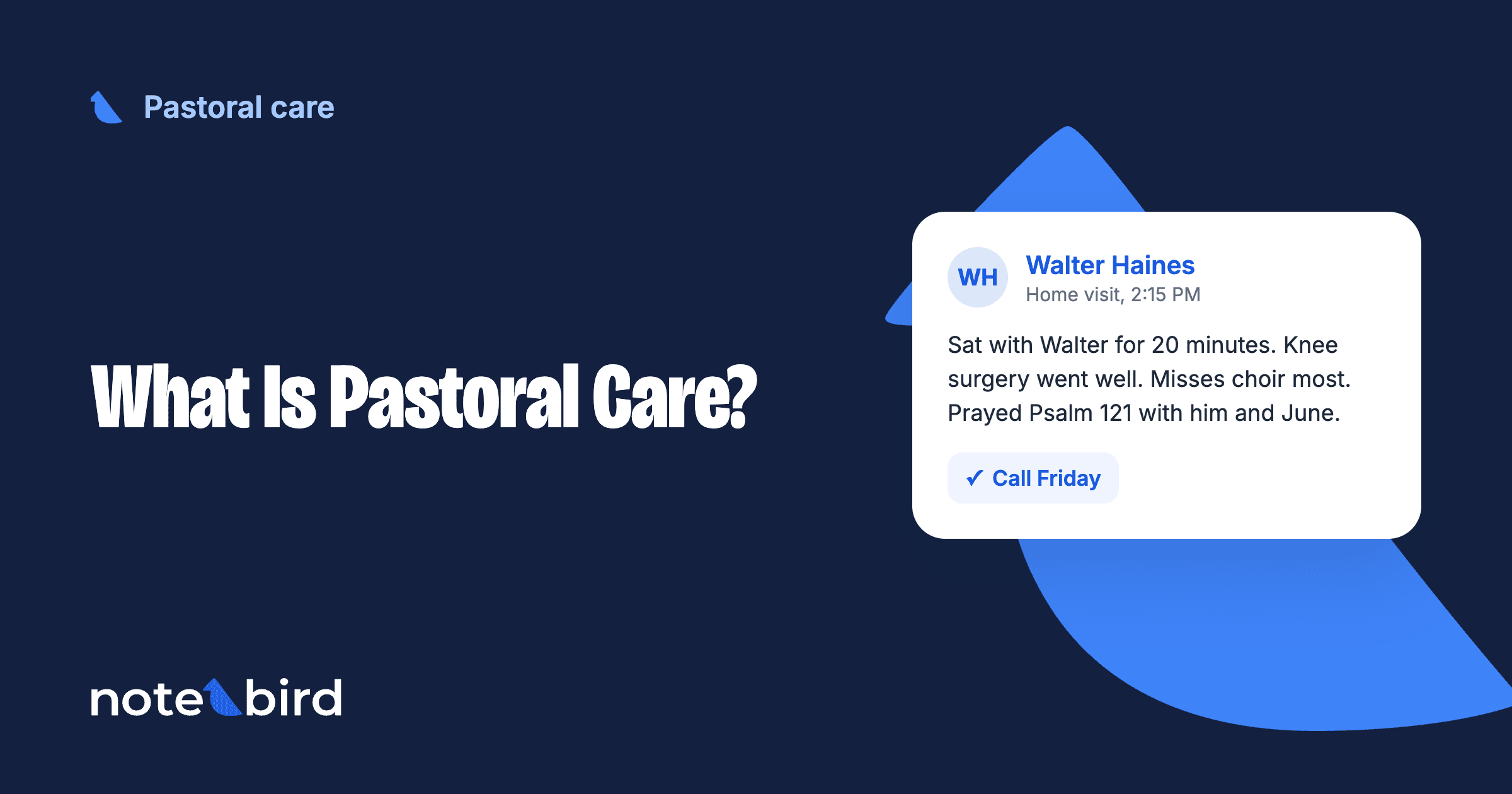
A care record is not paperwork for its own sake. It is how the second person knows what the first person did. Without it, the hospital visitor knows about the surgery and the caller does not.
The note does not need to be long. Some pastors write it in the car before they start the engine, while the details are fresh. Include:
- the date and the type of contact (visit, call, card, prayer);
- who you saw;
- one or two sentences on how they are and what they need;
- the next step and who owns it.
Write facts, not guesses. Leave out medical details that you do not need. Keep sensitive notes where only the pastor and care leaders can read them. Our guide on whether HIPAA applies to churches explains who should see what.
Many small churches start with a notebook or a spreadsheet. That works for one person. When a team shares the work, it gets hard to keep private notes private and to remember who is due for a call. See our pastoral care tracking spreadsheet for a free starting point and the signs that you have outgrown it.
How to Know Pastoral Care Is Working
You cannot measure love, but you can see who gets missed. No church gets this perfect, and the goal is not a perfect score. The goal is to find the gaps sooner. Once a quarter, ask two questions. Who went into the hospital or lost someone and did not hear from us? Who has had no contact from anyone in 90 days? If the same few people do all the care, you need more hands. If the same people get missed, you need a better list. To share the answers with your leaders, see how to report pastoral care to your board.
Start Where You Are
Pastoral care is old work. Long before spreadsheets and apps, a shepherd counted the flock at dusk and went out after the one that was missing. You do not have to carry the whole flock in your head. Start with one care list, one owner for each need, and one monthly meeting.
Notebird is pastoral care software that helps churches, synagogues, and chaplains keep that list in one shared place, so the work no longer rests on one person's memory and private notes stay private. See how it works for church follow-up, or start with our free pastoral care training.