How to Report Pastoral Care to Your Board (With a Template)
A one-page monthly pastoral care report for elders or a board: what to count, stories shared with consent, what not to report, and a quarterly review.
By Thomas Griffin, Owner and CEO
Published
To report pastoral care to your board, give them one page each month. Show counts of visits, calls, hospital and homebound care, and grief follow-ups. Show how many people you reached, how many are in active care, and how many members had no contact in 90 days. Add a story shared with consent, and say what you need.
Why Boards Ask for a Care Report
Most care work is invisible. A care pastor can spend a full day at a hospital, on the phone with a widow, and at a kitchen table with a family in crisis. At the end of that day, nothing on the church calendar shows it happened, and you may drive home too tired to write any of it down.
So the question comes. Sometimes it is kind: "We want to know how we can help." Sometimes it stings: "What do you do all week?" Either way, the board is asking a fair question. Elders and board members are responsible for the care of the church. They cannot do that job without knowing what care is happening and where the gaps are.
A good report does three things:
- It shows the work. Visits, calls, and cards are real ministry. Counting them is not bragging.
- It shows the gaps. Who has gone too long without contact? Where is the team stretched thin?
- It asks for help. The board can add volunteers, change priorities, or set a budget. They can only act on what they know.
Pastoral care also competes with everything else on a pastor's week. In a 2008 Lifeway Research survey of Protestant pastors, 12 percent said they spend an hour or less a week on visitation, while 48 percent spend two to five hours. A clear report helps a board see whether care is getting the time the church believes it should.
What to Measure: Activity, Reach, and Coverage
Most care reports count only activity: 42 calls, 11 visits, 18 cards. That shows effort. It does not show whether care is reaching everyone. Add two more kinds of numbers.
| Kind of number | What it tells the board | Example |
|---|---|---|
| Activity | How much care the team gave | 11 home visits, 42 calls, 18 cards |
| Reach | How many different people received care | 63 people received care this month |
| Active care | How many people need regular care right now | 14 people in active care (illness, grief, crisis) |
| Coverage | Who has gone too long without contact | 37 members with no contact in 90 days |
| Follow-through | Whether promises are kept | 3 follow-ups past due |
Reach matters because 40 calls to the same five people is not the same as 40 calls to 40 people. Coverage matters most of all. It answers the question every board should ask: who are we missing?
To find coverage, count members who have had no visit, call, card, or other contact in 90 days. You can pick a different window, but use the same one every month so the trend means something. Our guide on who hasn't been visited shows how to build that list.
The One-Page Monthly Pastoral Care Report Template
Copy this template into a document. Fill it in on the same day each month. It should take one side of one page.
Pastoral Care Report: [Month, Year] Prepared by: [Name]
1. Care given this month
| Type of care | This month | Last month | Same month last year |
|---|---|---|---|
| Home visits | |||
| Phone calls | |||
| Hospital visits | |||
| Homebound visits | |||
| Grief follow-ups | |||
| Cards and notes | |||
| Prayer requests received |
2. People
- People who received care this month: ___
- People in active care (illness, grief, crisis, new baby, other): ___
- New people added to active care: ___
- People moved out of active care: ___
3. Coverage
- Members with no contact in 90 days: ___ (last month: ___)
- Open follow-ups past due: ___
4. A story (shared with consent, no names)
Two or three sentences about one moment of care this month.
5. Care team
- Volunteers who gave care this month: ___
- New volunteers trained: ___
- Volunteers who need a break: ___
6. Needs and asks
What you need from the board, in one to three lines.
That is the whole report. If a number goes up or down by a lot, add one line that explains why. "Hospital visits doubled because of flu season" is enough.
A Sample Filled Report
Here is what a month might look like for a church of about 250 members. The numbers and the story are made up to show the format.
Care given: 9 home visits, 38 calls, 6 hospital visits, 12 homebound visits, 7 grief follow-ups, 21 cards.
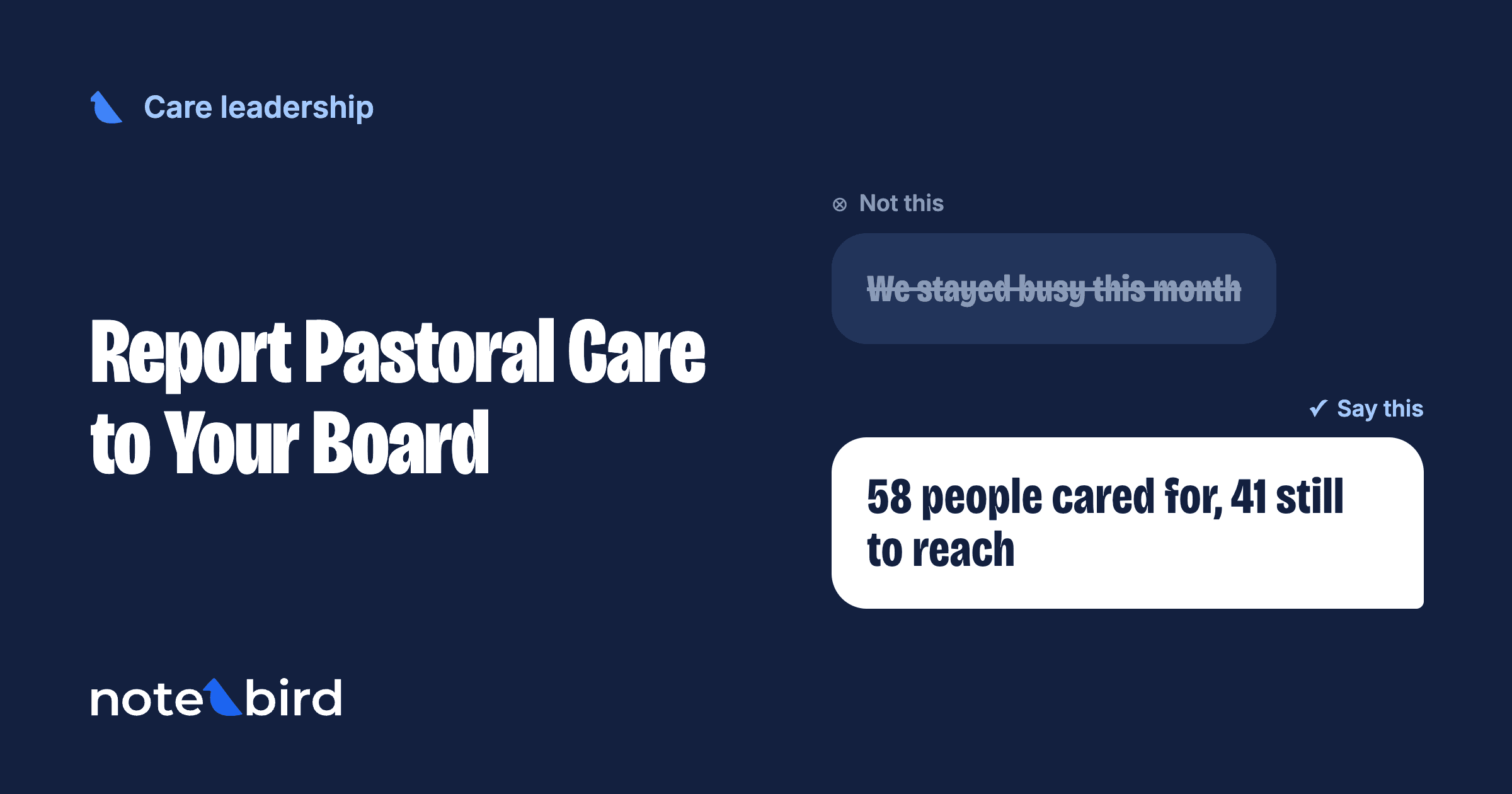
People: 58 people received care. 13 are in active care: 5 serious illness, 4 grief, 2 new babies, 2 family crisis.
Coverage: 41 members with no contact in 90 days (down from 52). 2 follow-ups past due.
Story: A member in her 80s told a volunteer that the monthly visit is "the day I put on lipstick." (Shared with her permission.)
Asks: We need two more homebound visitors for the north side of town. Please pray for the volunteers who carry our grief care.
What Not to Report (and Why)
Board reports get printed, emailed, forwarded, and kept in files for years. Board members are trusted people, but care details do not need to reach them to do their job.
Never include:
- Names of people in care. Report "4 people in grief care," not who they are.
- Diagnoses or health details. "Serious illness" is enough.
- Counseling topics. Marriage, addiction, mental health, and abuse stay with the pastor.
- Money problems or benevolence details. Report totals given, not who received help.
- Family conflict. Even without names, a small church can often guess who it is.
- Anything said in confidence. If you would need permission to say it from the pulpit, it does not go in the report.
There is one exception. If a board member must act on a safety matter, such as a threat, abuse of a child, or a legal issue, follow your church's policy and the law. That goes to the right people directly, not in a monthly report. If your church does not have a written policy for this, our pastoral care policy template shows what to include.
How to Share a Care Story With Consent
Numbers show the size of the work. A story shows what it means. One good story often does more for a board than a page of figures.
Ask first. A simple script:
"The board asked me how our care ministry is going. Something you said last week stayed with me. May I share it with them, without your name?"
Then follow these rules:
- Change or remove details that could identify the person: age, street, job, the name of a hospital.
- Keep it short. Two or three sentences.
- Tell what happened, not your part in it. "A volunteer sat with her for an hour" is better than "I made a big difference."
- If they say no, thank them and move on. Never share anyway.
In a small church, even an unnamed story can point to one person. When in doubt, share a story about the care team instead: "Two of our newest volunteers made their first homebound visits this month."
The Quarterly Care Review
Once a quarter, give the board 20 to 30 minutes for a longer look. Bring three months of reports and use these questions:
- Trends. Are visits, reach, and coverage going up, down, or flat?
- Gaps. Which groups get less care: men, young adults, newer members, people who do not come on Sunday?
- Team health. Is the load shared? Is anyone close to burnout? Who has not served in a while?
- Follow-through. How many follow-ups were done on time? What slipped, and why?
- Goals. Pick one or two targets for the next quarter. For example: "Bring members with no contact in 90 days from 41 to 25."
Some churches divide the whole membership among the elders. At one church described by 9Marks, each elder oversees about fifty to fifty-five members. If your church works this way, the quarterly review is the time for each elder to report on coverage for their own group, in numbers, without private details.
A Care Reporting Calendar
| When | What to do | Who |
|---|---|---|
| Each week | Log every visit, call, and card on the day it happens. | Pastor and care team |
| Last Friday of the month | Pull the counts and the coverage number. | Care pastor or coordinator |
| Same day | Ask for consent for one story. Write the needs and asks. | Care pastor |
| Monthly board meeting | Hand out the one-page report. Answer questions in 5 minutes. | Care pastor |
| Each quarter | Lead the 20 to 30 minute quarterly review with trends and goals. | Care pastor, board chair |
| Each year | Write a short summary for the congregation: totals, one story, thanks to volunteers. | Senior pastor |
How to Answer "Justify Your Time"
Sometimes a report request comes with pressure. A board member says, "I want you to justify your time." It is easy to feel hurt or defensive. Try to hear the real question under it. Often it is: "We cannot see this work, and we are responsible for it."
A calm reply:
"That is a fair thing to ask. Starting next month, I will bring a one-page report with what we did, who we reached, and who we are still missing. I would also like your help to decide what matters most, because I cannot do everything on the list."
Then let the numbers do the work. Three or four months of steady reports often change these conversations, because the board can finally see the load. Often the next question is not "What do you do?" but "How can we help?"
If your role is to lead others in care, not to do all of it yourself, show that too. Count visits made by volunteers. Report on the size and health of the team. The goal of a care ministry is that the whole church cares, as we explain in what is congregational care.
Common Mistakes in Care Reports
- Only counting activity. Busy is not the same as reaching everyone. Always include coverage.
- Changing the measures every month. Pick five or six numbers and keep them for a year.
- Writing a long narrative. Keep it to one page. Many board members stop reading after the first half.
- Rebuilding the report from memory. If care is not written down when it happens, the report will be a guess.
- Hiding the gaps. A report that shows only good news teaches the board not to trust it.
- Forgetting the ask. Every report should end with what you need.
How to Build the Care Report in Notebird
The hard part of a care report is not writing it. It is finding the numbers. When visits live in a pastor's phone, a volunteer's notebook, and a shared sheet, the report takes a whole evening, and it is often the evening before the board meeting.
In Notebird, the care team logs each visit, call, card, and prayer request as an update on the person, from any phone. At the end of the month:
- Run a care report for the month. Notebird charts every update by type, and you can narrow it by date, type, group, person, or who logged it. Print it or export it to CSV.
- Check Pulse to see how long it has been since each person had an update. Set a 90-day range in settings, and Pulse shows who has gone past it. Count them for your coverage number.
- Count open tasks to find follow-ups that are past due.
- Open a person's care history when you need the story behind a number.
Restricted updates stay restricted: only the Organization Owner, Organization Admins, and Care Admins can read them. The board gets the counts, and the private notes stay with the people who should hold them.
See what a report looks like on our care reports page, or start with our guide to building a pastoral care team so the report shows a whole church at work. The 14-day free trial needs no credit card, so you can try it before your next board meeting.