Church Benevolence Policy and Process: A Simple Guide
A fair benevolence process: requests, who decides, limits, paying bills directly, privacy, follow-up, and care after a job loss. Sample outline.
By Thomas Griffin, Owner and CEO
Published
A good church benevolence process is short, written, and fair. A person asks, a trained person listens, and at least two people decide within set limits. The church pays the bill directly, not in cash. The request stays private. Then someone follows up, because the money helps once but the care keeps going.
What a Benevolence Ministry Is For
Benevolence is the church's practical help for people in a money crisis. A job ends. A car breaks down. A medical bill comes due. A widow cannot pay the heating bill in January.
The early church knew this work well. In Acts 6, the apostles chose seven people to make sure the widows got their daily food. Deacons in many churches still carry this work today.
A benevolence gift meets a need. A benevolence ministry does more. It sits down with the person, prays with them, helps them make a plan, and calls them again next month. That second part is easy to skip when the office is busy, and it is where the deepest care happens.
Why Your Church Needs a Written Process
Without a process, benevolence depends on who answers the phone. A friendly pastor says yes to the first caller and no to the fifth, because the fund ran out. A quiet member who never asks gets nothing. A frequent caller gets help again and again.
A written process fixes this. It:
- Treats people fairly. The same need gets the same answer.
- Protects the pastor. "Our policy is..." is easier to say than "I don't want to."
- Protects the person. Clear rules on privacy mean they can ask without fear of gossip.
- Protects the church. Clear records show that money went to real needs.
- Makes room for care. When the money part is simple, there is time for the person.
Keep it to one or two pages. A process nobody reads does not help.
The Benevolence Process in Six Steps
1. The Request
Make it easy to ask. Name one contact person or one phone number. Many churches use a short paper or online request form. A form helps you collect the same facts each time.
Most people put off this call for weeks. Many start with "I hate to even ask." Thank them for calling, because asking took courage.
Then listen first. Ask, "What is going on?" before you ask, "How much do you need?" The story often shows a bigger need than the bill.
2. The Conversation
A trained person, often a deacon or a pastor, meets with the person or calls them. Questions to ask:
- "What is the need, and when is it due?"
- "What has happened that led to this?"
- "Who else have you asked for help?"
- "What would help you get stable over the next few months?"
- "How can we pray for you?"
This is a care visit, not an interview. Pray with them before you end.
3. Who Decides
At least two people should agree on each gift. This protects both the person who decides and the person who asks.
A common pattern:
- Small and urgent needs: the pastor or a deacon can approve up to a limit the board sets, with a second person told the same day.
- Larger needs: a small benevolence team (three to five people) decides within a few days.
- Very large or repeat needs: the board or the elders decide.
Anyone with a family or business tie to the person steps out of the decision.
4. Limits
Your board sets the numbers. Write down:
- The most the church gives to one household in one gift.
- How often one household can receive help in a year.
- What the fund pays for (rent, utilities, food, medicine, car repair) and what it does not.
- Whether non-members can ask, and how that changes the limits.
- What happens when the fund runs low for the year.
Limits are not a lack of love. They let the church help more people, and they give the team a kind, clear answer when a need is bigger than the fund.
5. Pay the Bill, Not the Person
Most churches pay the landlord, the utility, the pharmacy, or the repair shop directly. For food or gas, many use grocery or gas cards.
Direct payment:
- Makes sure the gift meets the need it was for.
- Protects the person from pressure to use the money for something else.
- Gives the church a clear record.
Ask the person for the bill or the account number, and pay it from the church's account. Tell them when you paid it.
6. Follow-Up
This is the step that is easiest to skip. Call within two weeks. Ask, "How are you doing? Did the payment go through? What is next?"
If the crisis is not a one-time event, make a simple plan with them: a budget class, a job search plan, a referral to a counselor, or a monthly call from a deacon.
Keep Benevolence Requests Confidential
People who ask for money often feel shame. In a small church, people notice whose car sat in the office lot on Tuesday morning. The person needs to know the church will not talk.
Write these rules into the policy:
- Only the people who decide know the name and the amount.
- Nobody shares a request in a prayer meeting, sermon, or group email without the person's clear yes.
- Records are kept in a locked place or a system with limited access.
- The finance team sees only what it needs to pay the bill.
If the person wants prayer from the wider church, they decide what to share. "Please pray for a family in our church facing a hard month" is often enough.
Keep Good Records (and Get Good Advice)
Benevolence uses money given to the church, so records matter. Keep the amounts, the payee, and the decision in your church's accounting system, as you do for other church spending.
IRS Publication 3833, Disaster Relief: Providing Assistance Through Charitable Organizations, is written for charities that help people in disasters and emergency hardship. It says help should be based on "an objective evaluation" of need, and that people "do not have to be totally destitute to be financially needy." It also lists the kinds of records a charity should keep, such as a description of the help, its cost, its purpose, and how the person was selected.
That publication is not written for church benevolence funds alone, and this guide is not tax or legal advice. Ask your church's accountant or attorney how the rules apply to your church before you finalize your policy.
A Sample Benevolence Policy Outline
Use this outline as a starting point. Fill in the details with your board.
- Purpose. Why the church gives help, with a short Scripture reference (for example, Acts 6:1-6 or Galatians 6:10).
- Who can ask. Members, regular attenders, and neighbors. Say if limits differ.
- How to ask. The contact person, the form, and how fast the church will reply.
- The conversation. Who meets with the person, and that the meeting includes prayer.
- Who decides. The approval limits for the pastor or a deacon, the benevolence team, and the board.
- Limits. Most per gift, most per year, and how often a household can receive help.
- What the fund pays for. And what it does not pay for.
- How the church pays. Directly to the landlord or company, or with grocery or gas cards. No cash.
- Conflicts of interest. Anyone with a family or business tie steps out.
- Confidentiality. Who may know, where records are kept, and how prayer requests are shared.
- Records. What the finance team records, and where.
- Follow-up. Who calls the person, and when.
- Referrals. Local agencies, counselors, and programs the church points people to.
- Review. The board reviews the policy and the fund each year.
For a wider care policy that this can sit inside, see our pastoral care policy template.
How to Care for Someone Who Lost a Job
Many benevolence requests start with a lost job. The bill is the first need. The person behind it may also feel shame, fear, and a loss of purpose. Think of a man who left for work at 6:30 every morning for twenty years. Now he sits at the kitchen table at 6:30 with his coffee and nowhere to go.
What to Say
- "I am so sorry. That is a hard thing to go through."
- "How are you doing, and how is your family doing?"
- "What do you need most this month?"
- "Who do you want to work for next? Let's think about who we know."
- "Can I pray with you?"
What Not to Say
- "Everything happens for a reason." It can sound like they deserved it.
- "At least you have time off now." Time off without pay is not a rest.
- "Have you tried applying online?" They almost surely have. Offer a contact, not a tip.
- "Let me know if you need anything." Offer one specific thing instead.
What to Text
- "Praying for you this week. You don't need to answer."
- "Good luck at your interview at 10. Praying for you."
- "I saw this job and thought of you. No pressure."
Practical Help
- Networking. Here a church can do what most agencies cannot. Ask two or three members in their field to meet them for coffee.
- Resume and interview help. Many churches have members who hire people. Ask one to review a resume or hold a practice interview.
- Unemployment benefits. Encourage them to apply with their state right away, if they have not.
- Local help. In the United States, 211 connects people to local help with bills, food, and housing. The call is confidential.
- Daily needs. Rides to interviews, childcare during interviews, a meal on a hard week.
- Their place at church. Keep them serving. People out of work often pull back from church because they feel ashamed. Tell them, "We need you here."
A Care Timeline After a Job Loss
| When | What to do | Who |
|---|---|---|
| First week | Call or visit. Listen. Pray. Ask what is due this month. | Pastor or deacon |
| First two weeks | If they ask, start a benevolence request. Connect them with one member in their field. | Deacon, benevolence team |
| Every two weeks | Call. Ask about the search, the family, and their spirits. | Assigned deacon |
| Month 1 | Check that bills are covered. Offer resume or interview help. | Deacon |
| Month 3 | Visit. Watch for signs of depression or strain at home. Refer if needed. | Pastor |
| New job | Call to celebrate. Send a card. Ask them to share the news only if they want to. | Deacon, pastor |
| One month after the new job | Call once more. A new job can bring new stress. | Deacon |
How to Record Benevolence Care Privately
Keep two records, in two places.
The money record goes in your church's accounting system: the amount, the payee, the date, and who approved it. Notebird does not track money or payments, and it should not. Your finance team already has the right tool for that.
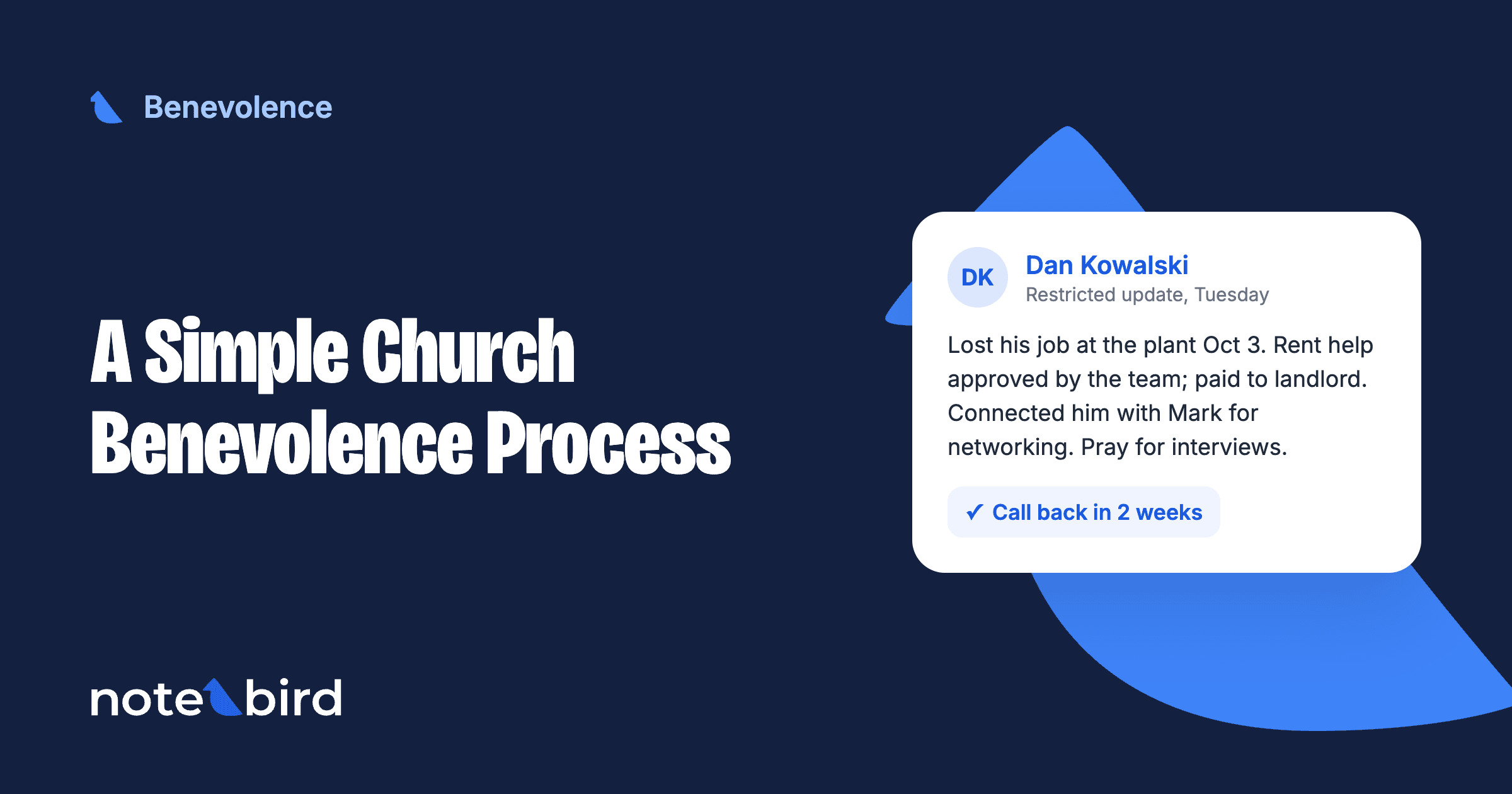
The care record goes in your care system. In Notebird, log the conversation, the prayer request, and the follow-up as an update on the person. Mark it as restricted. A restricted update can be read only by the Organization Owner, Organization Admins, and Care Admins. Other team members cannot see it, so a volunteer who leads the person's small group will not see their money trouble.
What to write in the care record:
- "Met with Dan. Lost his job at the plant on Oct 3. Rent help approved by the team (see finance). Connected with Mark R. for networking. Pray for interviews next week."
What to leave out:
- Bank details, account numbers, and dollar amounts (keep those with finance).
- Details the person asked you not to record.
A deacon who calls next month should know what happened and what to ask. They do not need the numbers.
When to Refer for More Help
A benevolence fund cannot fix every money crisis. Refer when:
- The need repeats each month. A budget class or a nonprofit credit counselor may help more than a gift.
- The person faces eviction, foreclosure, or a legal problem. Point them to local legal aid.
- The stress is causing deep sadness, conflict at home, or heavy drinking. See our guide on when to refer someone to a counselor.
- Someone talks about not wanting to live. Stay with them and get help that day. In the United States, call or text 988, the Suicide and Crisis Lifeline.
After you refer, keep calling. A referral is not the end of the church's care.
Keep the Care Going After the Bill Is Paid
The check clears in a day. The crisis behind it often lasts months. Give each person who asks for help one deacon or care team member who calls on a steady rhythm until they are stable. Months later, that person may not remember the amount. They are more likely to remember who kept calling.
Many churches give this work to deacons. Our guide to deacon care ministry shows how to assign families and keep track of who has been called. You can also see how Notebird helps churches with church follow-up.