Pastoral Care Policy Template for Churches (Free to Copy)
Copy a church pastoral care policy: response times by need, visit rules, confidentiality, safeguarding, referrals, reporting, training, and review.
By Thomas Griffin, Owner and CEO
Published
A pastoral care policy is a short document that says who your church cares for, who gives care, how fast you respond to each need, how you keep notes private, and when you refer or report. Copy the template on this page, fill in the blanks, ask your board to adopt it, and review it each year.
Most churches care well in a crisis. Where they struggle is the ordinary week: the hospital stay nobody heard about, the widow who got a card in month one and nothing after, the volunteer who was not sure whether to tell the pastor. A written policy will not make anyone care more. Your people already care. It helps that care reach everyone, because it gives the whole team the same promises to keep.
Why Your Church Needs a Care Policy
A policy does four things:
- It sets a standard. "We visit within 48 hours" is a promise people can keep and check.
- It protects people. Clear rules on privacy, visits, and reporting protect the people you care for, your volunteers, and your church.
- It makes care last. When a pastor leaves or a care leader steps down, the policy stays. See handing over pastoral care when a pastor leaves.
- It makes training simple. New volunteers read one document, not ten emails.
The Unitarian Universalist Association gives the same advice to its lay care teams. Its guide to lay pastoral care says care providers "should have clear expectations (preferably a policy) to protect people's privacy and dignity."
Policy, Guidelines, and Care Plans: What Is the Difference?
These three documents work together:
- A pastoral care policy is the church's official standard. The board adopts it. It is the template on this page.
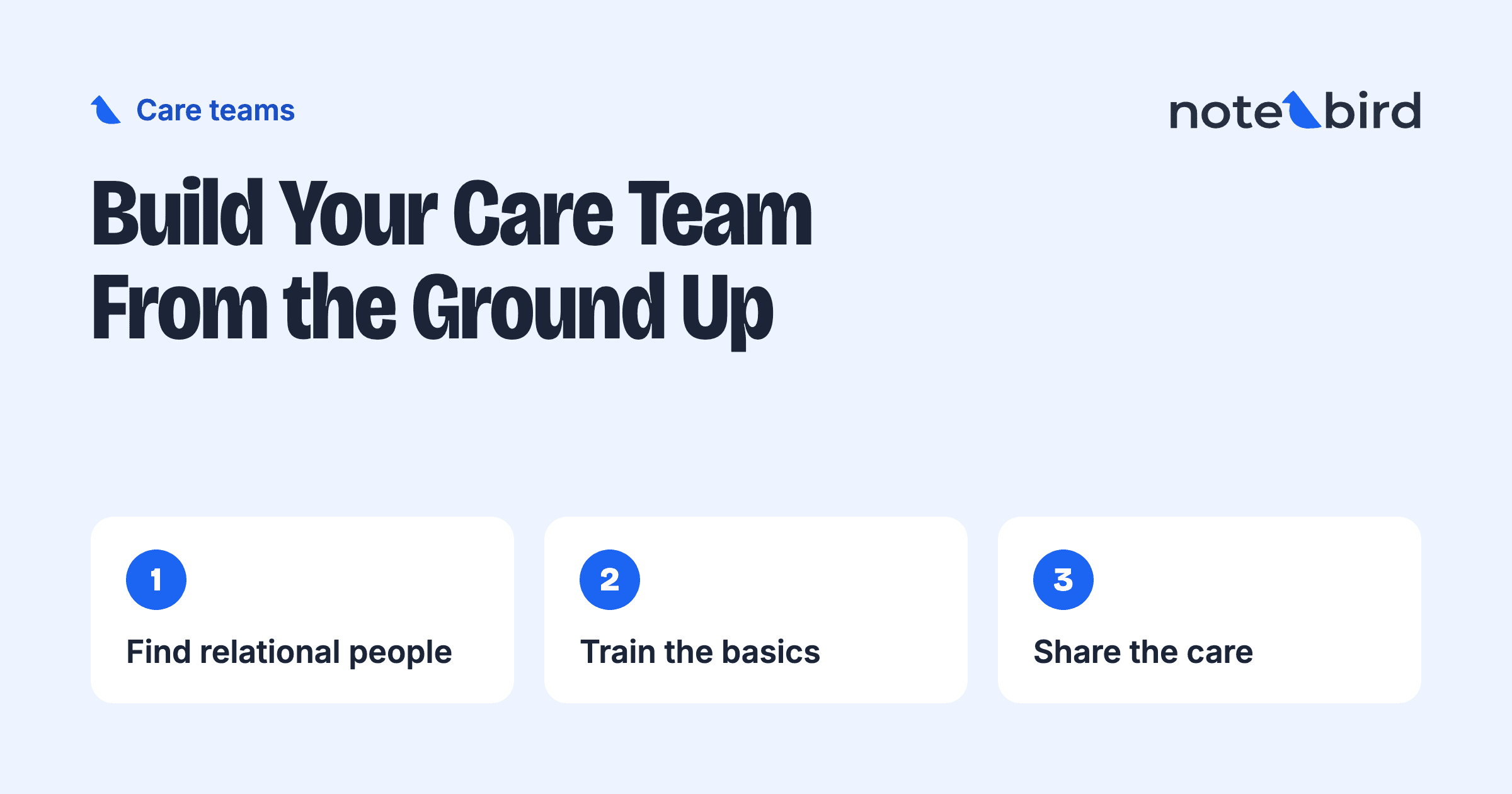
- Care team guidelines are the practical rules that each volunteer reads and signs. Get our free Care Team Guidelines Template on the free resources page, and read how to build a pastoral care team for roles and training.
- A care plan for one person is a short list of next steps for someone in a long season of need. You will find a simple one at the end of this page.
Response Times by Need
Start with this table. Most of the policy rests on it. Change the times to fit your church, but write them down.
| Need | First response | Who responds | Follow-up |
|---|---|---|---|
| Death of a member or close family member | Same day, call or visit | Pastor | Grief contacts at 1 week, 1, 3, 6, and 12 months |
| Crisis or safety concern | Same day | Pastor | As the pastor decides; referral or report if needed |
| Hospital admission | Within 48 hours | Pastor or trained visitor | Call after discharge, then weekly until recovered |
| Surgery or serious new diagnosis | Within 3 days | Pastor or care team | Call every 2 weeks during treatment |
| Hospice care | Within 2 days | Pastor | Visit weekly, more often near the end |
| Birth or adoption | Within 1 week | Care team | Meal offer, visit at 6 weeks |
| Move into a care facility | Within 1 week | Care team | Monthly visit |
| Prayer request | Within 1 day | Prayer team | Ask how they are in 2 weeks |
| Absence of a month or more | Within 2 weeks of noticing | Assigned care team member | Tell the pastor if there is a hurt |
| Homebound member | Monthly call | Assigned caller | Visit each quarter, or monthly if possible |
The Pastoral Care Policy Template
Copy everything in this section into a document. Replace each item in brackets. Delete any line that does not fit your church.
1. Purpose
[Church Name] cares for its people as Christ cares for us. This policy describes how we notice needs, respond to them, and keep care going. It applies to our pastors, staff, deacons, elders, and every volunteer who gives care in the name of [Church Name].
2. Who We Care For
We give care to:
- members and regular attenders, and their households;
- people who are homebound or live in care facilities;
- visitors and neighbors who ask for help, as we are able;
- [other groups, such as staff, missionaries, or a partner school].
We give care without regard to whether a person gives money, serves, or attends often.
3. Who Gives Care
- [Senior Pastor] oversees all pastoral care and responds to deaths, crises, sacraments, and serious needs.
- [Care Pastor or Care Team Leader] receives new needs, assigns each one, and checks that it is done.
- [Deacons, elders, or care team members] contact assigned households, visit, call, write cards, and pray.
- Every care volunteer is approved by [the pastor or the board], completes the training in Section 11, and signs the care team guidelines each year.
- Volunteers who visit children, youth, or vulnerable adults also complete [a background check] every [number] years.
4. How People Ask for Care
People can ask for care by [calling the church office at (phone)], [emailing (address)], [writing on the prayer card in the pew], or by telling any pastor or care team member. Any person who learns of a need passes it to [the Care Team Leader] the same day.
5. Response Times
We respond to needs within the times in the response table attached to this policy. If we cannot meet a time, the person who owns the need tells [the Care Team Leader] that day, so someone else can go.
Each need has one named owner and a due date for the next step. [The Care Team Leader] reviews open needs each week.
6. Visit Guidelines
- Call or text before a home visit. Do not arrive unannounced.
- Keep hospital visits to about [10 to 15] minutes unless the person asks you to stay.
- Do not visit when you are sick.
- Follow the rules of each hospital and care facility.
- [Visit in pairs when visiting a person of the opposite sex alone at home, or when visiting at night.]
- Never be alone with a minor. Follow [Church Name]'s child safety policy.
- Offer prayer. Do not insist.
- Do not give medical, legal, or financial advice.
7. Confidentiality and Records
- What a person tells a caregiver stays with the caregiver, [the Care Team Leader], and the pastor, unless the person gives permission to share it.
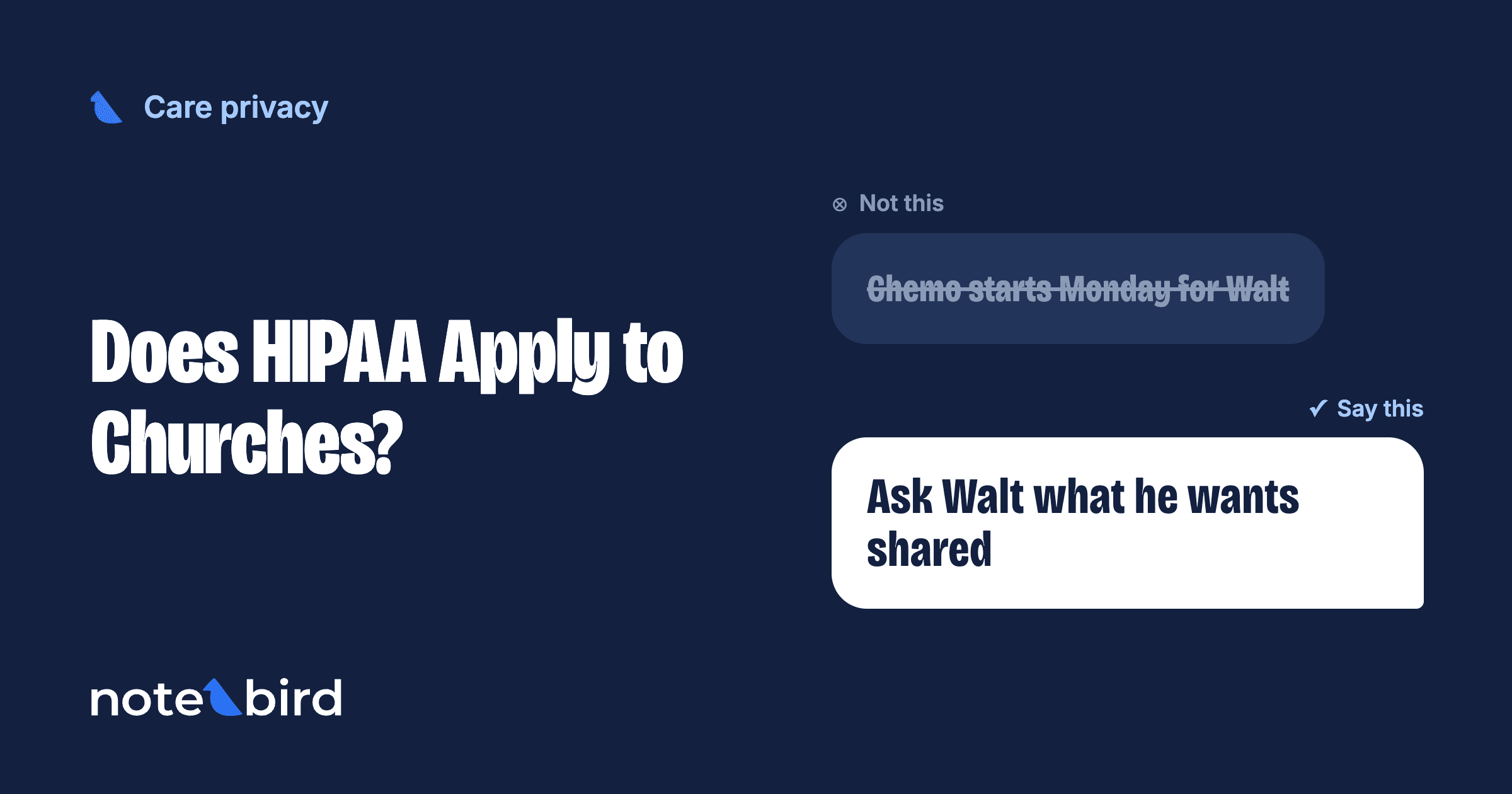
- Before we add a name to a prayer list, a bulletin, or a public prayer, we ask the person first.
- We do not put care details in group texts, emails to many people, or social media.
- After each visit or call, the caregiver writes a short note: the date, the type of contact, how the person is, and the next step. Notes state facts, not opinions or guesses about health.
- Sensitive notes (abuse, addiction, marriage, mental health, legal matters) are written by the pastor and kept where only [the pastor and named care leaders] can read them.
- We keep care records in [one shared care system], not in personal notebooks or phones.
- We do not store detailed medical records. We write only what we need to give care.
- Confidentiality is not secrecy. We share information when a person is in danger or when the law requires it.
For more on who should see care notes, read does HIPAA apply to churches.
8. Safeguarding and Boundaries
- Caregivers do not lend or give personal money. Financial needs go to [the pastor or the benevolence team].
- Caregivers do not accept gifts of more than [token value].
- Caregivers do not begin a counseling relationship. They listen, pray, and refer.
- Caregivers do not start a long care relationship on their own. They tell [the Care Team Leader], so care continues when they are away.
- Caregivers keep appropriate physical and emotional boundaries. They avoid any relationship that could become romantic, financial, or controlling.
- Caregivers are not on call at all hours. People in an emergency call 911, and church emergencies go to [emergency number].
- Any concern about a caregiver's conduct goes to [the Senior Pastor or the board chair].
9. Referrals
We refer a person to more help when a need is beyond what our care ministry can give, including:
- signs of depression or anxiety that last for weeks;
- addiction;
- abuse or domestic violence;
- severe mental illness;
- serious financial or legal trouble;
- a need that lasts beyond [number] pastoral counseling sessions.
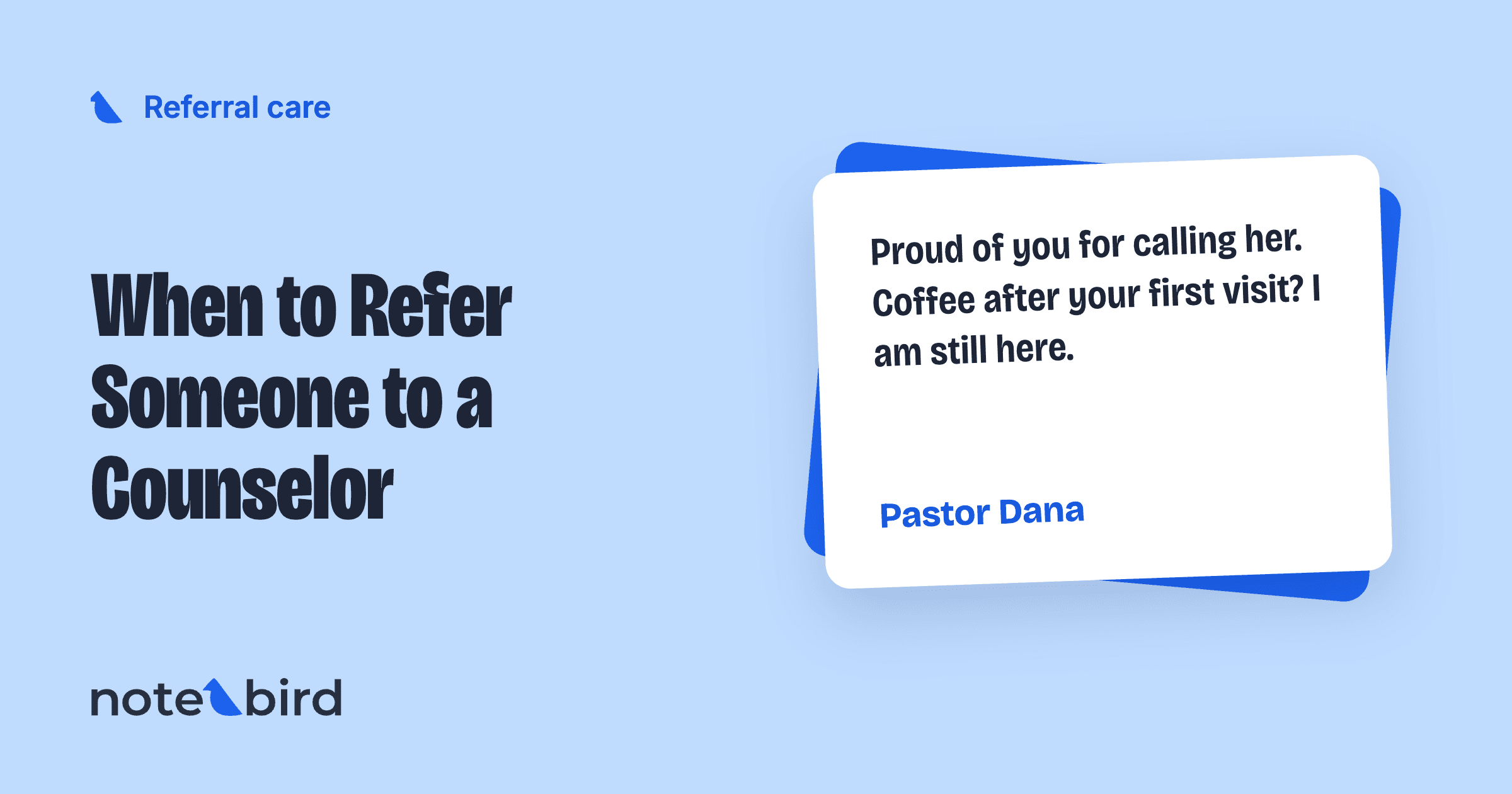
[The Care Team Leader] keeps a referral list of local counselors, doctors, agencies, support groups, and hotlines, and reviews it each year. After a referral, we keep caring. A referral does not end our care. Read when to refer someone to a counselor.
10. Crisis and Mandatory Reporting
- If a person talks about suicide or self-harm, stay with them and get help now. Call or text the 988 Suicide and Crisis Lifeline. If a person is in immediate danger, call 911.
- Any caregiver who suspects abuse or neglect of a child, an older adult, or a vulnerable adult tells [the Senior Pastor] the same day.
- Write down what you saw and heard, in the person's own words, with the date and time.
- [Church Name] follows the reporting laws of [State]. Under our state's law, [list who must report, to whom, and how fast].
- State hotline for child abuse: [number]. State hotline for elder or vulnerable adult abuse: [number].
- A report to the pastor does not replace a report to the authorities when the law requires it. If our state's law makes you a reporter, you make the report yourself, and the pastor helps you.
Reporting laws differ from state to state. Some states name clergy as mandated reporters. Some require every adult to report. Check your state's law before you adopt this section. The Child Welfare Information Gateway publishes a summary of state laws on clergy as mandatory reporters. Ask an attorney or your denomination to review this section. This template is not legal advice.
11. Volunteer Training
Every care volunteer completes training before their first visit. Training covers:
- listening and presence;
- hospital and home visits;
- this policy and the care team guidelines;
- confidentiality and how to write care notes;
- referrals, crisis response, and mandatory reporting.
New volunteers make their first [two] visits with an experienced caregiver. The care team meets [monthly] for prayer, review of open needs, and a short training topic.
12. Review
[The board] reviews this policy each year in [month], and after any serious incident. The review checks that response times are met, that the referral list is current, that reporting laws have not changed, and that every care volunteer has signed the guidelines.
Adopted by [board name] on [date]. Last reviewed on [date].
How to Adopt Your Policy
- Draft it. The pastor and the care leader fill in the blanks. Plan for about two hours over coffee.
- Ask for review. Ask an attorney, your insurance carrier, or your denomination to read Sections 7, 8, and 10.
- Adopt it. The board votes and records it in the minutes.
- Train the team. Walk through the policy at the next care team meeting. Each volunteer signs the guidelines.
- Tell the church. Share Section 4 widely, so people know how to ask for care.
- Review it each year. Put the review on the board calendar now.
A Simple Care Plan for One Person
Some needs last months: a long illness, the first year of grief, a hard divorce. For these, write a one-page care plan as a plain document, not a formal program. Keep it with the pastor and the care leader.
| Item | Example |
|---|---|
| Person | Frank Bell |
| Need | Wife died in October. Lives alone. Does not drive. |
| Care lead | Deacon Sam Ortiz |
| Contacts | Sam calls every 2 weeks. Pastor visits monthly. Card team sends cards at 3, 6, and 12 months. |
| Practical help | Ride to church each Sunday (Anne Lee). Grocery run on Thursdays. |
| Dates to remember | Wedding anniversary on June 4. First anniversary of the death on October 9. |
| Check point | Review in 3 months. Ask Frank what is helping. |
| When to refer | Tell the pastor if Frank stops eating, stops going out, or talks about not wanting to live. |
For the year after a death, our 12-month grief care calendar gives you each contact in order.
Put the Policy to Work
A policy only helps if the promises in it get kept. On a hard week, nobody rereads the policy. What helps is a list that shows what is due today and who owns it. Give every need an owner and a date, keep sensitive notes private, and check the open list each week.
Notebird helps churches keep those promises: one shared care record, tasks with owners and due dates, restricted notes for sensitive matters, and a morning report that shows what is due, so the hospital visit you promised does not wait on someone's memory. See how it works for church follow-up, and get the free Care Team Guidelines Template on our free resources page.