Deacon Care Ministry: How to Assign Families and Track Care
Set up a deacon care ministry: 10 to 15 households per deacon, a monthly contact rhythm, a sample flock plan, privacy rules, and a report to the pastor.
By Thomas Griffin, Owner and CEO
Published
In a deacon care ministry, each deacon cares for a small group of church households, often 10 to 15. The deacon contacts each household once a month, visits in times of illness or loss, keeps notes, and tells the pastor about serious needs. Every family has someone who notices them, and the pastor no longer carries the whole church alone.
If you are a pastor with more names than hours, or a deacon who was handed a list and not much else, this guide shows you how to set one up: how to assign families, what deacons do each month, what they write down, what stays private, and what they report back to the pastor.
The Biblical Basis: Exodus 18 and Acts 6
Two stories shape deacon care.
In Exodus 18, Moses sits from morning to evening to hear the people's cases. His father-in-law Jethro tells him, "What you are doing is not good," and, "The work is too heavy for you; you cannot handle it alone." Jethro's answer is to choose trustworthy people and give each one a group to serve. Moses keeps the hard cases. The others handle the rest. "That will make your load lighter, because they will share it with you."
In Acts 6, the widows of one group are overlooked in the daily distribution of food. The apostles ask the church to "choose seven men from among you who are known to be full of the Spirit and wisdom." The seven take over the care, and the apostles give their attention "to prayer and the ministry of the word." The text does not call the seven "deacons," but many churches see their office in this story.
Both stories have the same pattern: the leader cannot do it all, some people are missed, and trusted servants take a share of the care. Many pastors know Moses' long day. The call you meant to make on Tuesday is still waiting on Friday, and you go to bed thinking about it. Jethro's advice still holds: share the load with people you trust.
What Deacons Do in a Care Ministry
Deacon care is not a second pastor in every home. It is a friend with a role. A deacon:
- knows each household by name, including the children and anyone who lives with them;
- contacts each household each month by call, visit, card, or text;
- shows up in illness, grief, a new baby, or a move;
- helps with practical needs or finds someone who can;
- prays for each household by name;
- tells the pastor about deaths, crises, serious illness, and anything they are unsure about;
- writes a short note after each contact.
A deacon does not counsel, does not give money from their own pocket, and does not keep a serious need to themselves. Those go to the pastor.
How Many Families Should Each Deacon Have?
Most churches give each deacon 10 to 15 households. That is enough to matter and small enough to call every household each month in about two or three hours.
Adjust the number:
- Give fewer to a new deacon, a deacon with a demanding job, or a list with several widows, homebound members, or families in crisis.
- Give more only to an experienced deacon whose households are mostly stable.
- Stop at 20. Past that point, monthly contact quietly stops. Add deacons, or pair each deacon with a care partner, before you add households.
If your church has more households than your deacons can hold, do not spread the deacons thin. Assign the households with the greatest needs first: the homebound, the widowed, the sick, new members, and families in their first year of grief. Cover the rest as you add deacons.
How to Assign Families to Deacons
The pastor and the deacon chair can do this in one meeting.
- List every household. Use your church directory or management system. Count households, not individuals.
- Mark the high-need households. Homebound, widowed, serious illness, grief in the last year, new members.
- Spread the high-need households evenly. No deacon should get all the widows.
- Mix known and new. Give each deacon some households they already know and some they do not. Some churches make sure every deacon has at least one widow or homebound member.
- Think about distance. Households near the deacon's home are easier to visit.
- Avoid conflicts. Do not assign a deacon to a close relative, an employer, or a family in a conflict with them.
- Introduce the deacon. In the first month, each deacon calls or writes each household: "Hi, I am Dana Ruiz. I am one of the deacons, and I will be your contact at church this year. If you ever have a need, call me. I would also like to know how to pray for you."
Mike Lumpkin describes this first step at his church in a 9Marks article, How Our Elders and Deacons Work Together: they "divided up the church membership by households and assigned those households to the deacons," who then contacted them by visits, calls, emails, and texts.
Review the assignments once a year, when deacons rotate on or off.
A Sample Deacon Flock Plan
Give each deacon a one-page plan for their households. Here is an example for one deacon:
| Household | What to know | Contact rhythm | Next step |
|---|---|---|---|
| Ruth Anders | Widowed in March. Lives alone. Does not drive. | Call every 2 weeks, visit monthly | Card for the first anniversary on March 12 |
| The Okafor family | Two children. New members in September. | Call monthly | Invite to the newcomer lunch |
| George and Linda Pratt | George had a knee replacement. Linda is his caregiver. | Call weekly until he recovers | Ask Linda how she is doing |
| The Kim family | Stable. Teach Sunday school. | Call monthly | Birthday card for Grace in May |
| Harold Benson | Homebound at Maple Grove care home. | Call monthly, visit monthly | Bring communion with the pastor |
| The Diaz family | Not at church since August. | Call this week | Listen. Tell the pastor if there is a hurt. |
| Jean Moore | Single. Recently lost her job. | Call every 2 weeks | Tell the pastor about the benevolence fund |
The plan stays with the deacon and the pastor. It is not shared with the whole deacon body.
A Monthly Contact Rhythm
A steady rhythm matters more than big gestures. Here is a month for one deacon with 12 households:
| When | What to do | Who |
|---|---|---|
| Week 1 | Pray through the list. Check birthdays, anniversaries, and death anniversaries for the month. | Deacon |
| Weeks 1 to 3 | Call or text each household once. Visit the homebound and anyone sick or grieving. | Deacon |
| Same day, any week | Tell the pastor about a death, a crisis, a hospital stay, or a safety concern. | Deacon |
| Week 3 | Send cards for the month's milestones. | Deacon or card team |
| Week 4 | Log any contacts not yet written down. Send the monthly report to the deacon chair or pastor. | Deacon |
| Monthly meeting | Pray for needs. Review households with no contact. Move stuck needs to someone else. | Deacon chair, pastor |
| Each year | Review assignments. Thank each deacon. | Pastor, deacon chair |
A deacon does not need a long call. "Hi, it is Dana from church. I was praying for you this week and wanted to check in. How are things?" is enough. Most calls take five minutes. The one call that takes an hour is the reason the other calls matter.
What Deacons Log, and What Stays Confidential
A note is how the pastor and the next deacon know what happened. Keep it short:
- Date and type: "Call, Nov 4."
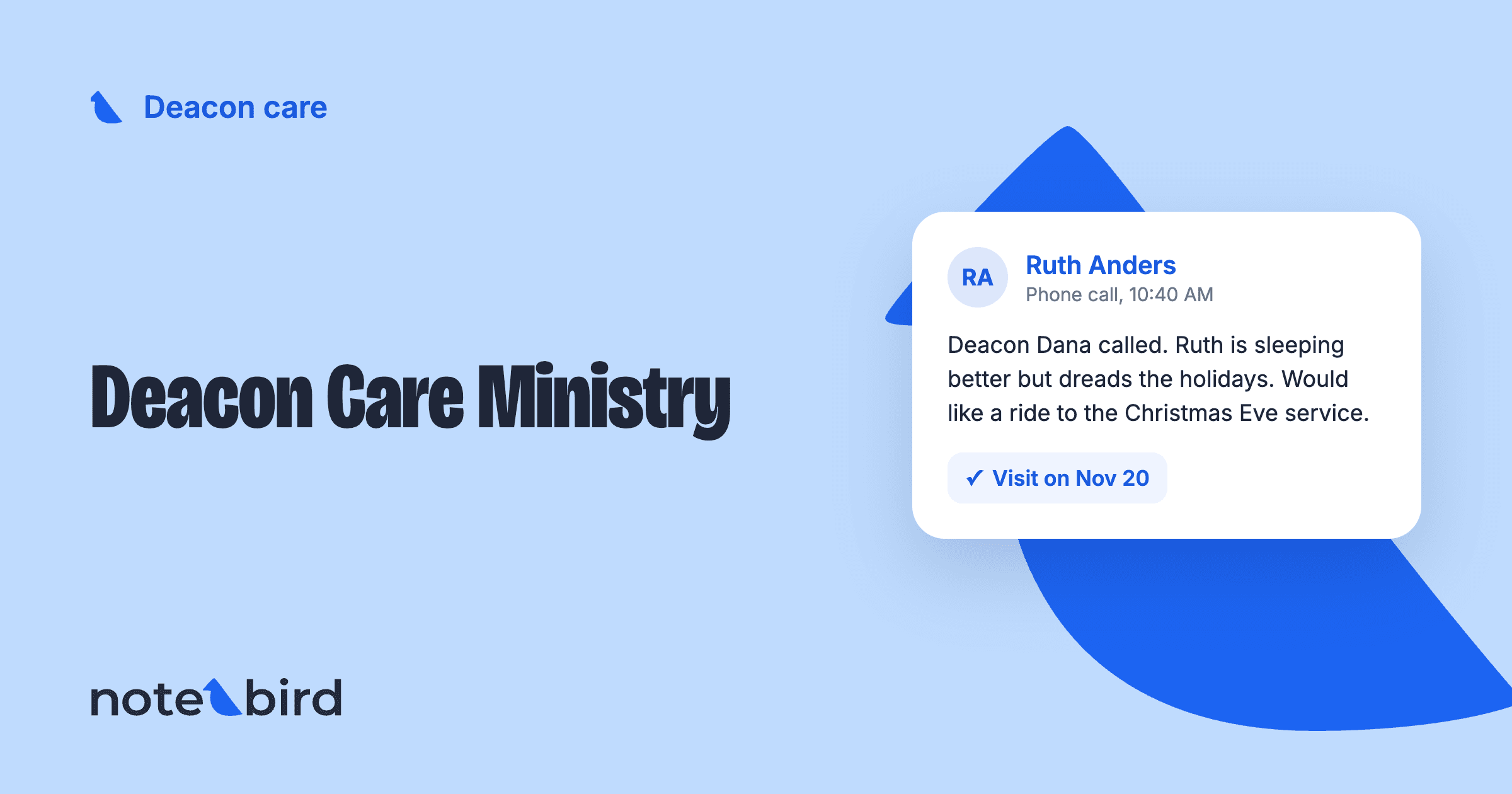
- How they are: "Ruth is sleeping better. The holidays worry her."
- Next step: "Visit before Thanksgiving. Ask if she wants a ride to the Christmas Eve service."
Leave out medical details you do not need, guesses, and opinions. Write what you would be comfortable with the family reading.
Some needs are not for the deacon's notes at all. Abuse, addiction, marriage trouble, suicidal thoughts, and legal trouble go to the pastor the same day, in person or by phone. If a record is needed, the pastor writes it as a restricted note. Read does HIPAA apply to churches for more on who should see what.
How Notebird Handles Deacon Privacy
Notebird is pastoral care software that many churches use for deacon care. It has two settings that fit this ministry well:
- The Group Member role. A deacon with this role sees only the people in the groups they are assigned to. They cannot see anyone outside their groups, or any update about those people. They can log updates on the people in their groups.
- Restricted updates. A note marked restricted can be read only by the Organization Owner, Organization Admins, and Care Admins. A deacon cannot read it, even for their own households.
A deacon chair who needs to see every household's care, but not restricted notes, can have the Care Manager role instead.
One more thing to plan for: each deacon who logs in to Notebird is a paid user seat. Some churches give a login to every deacon. Others give logins only to deacon leaders, and the other deacons report their contacts to that leader, who logs them. Both work. See pricing for the current cost per user. Every feature is on every plan, and you can try it with your deacons for 14 days with no credit card.
How to Train Deacons for Care
Many deacons were chosen for their character, not for care skills. Some feel nervous before their first hospital visit, afraid they will say the wrong thing. That is normal, and a little practice helps. A short training covers:
- Listening. Ask open questions, then be quiet. Practice in pairs.
- The first call. Role-play the introduction call and a call to a family that has stopped coming.
- Hospital and home visits. Keep them short. Read what to say on a hospital visit together.
- Boundaries and referrals. What deacons handle, what goes to the pastor, and what goes to a professional.
- Notes and privacy. What to write and what never to write.
Our guide on how to build a pastoral care team has a four-session training plan you can use with deacons. Add a 15-minute training topic to each deacons' meeting after that.
The Monthly Report to the Pastor
Ask each deacon for a short report each month. It takes five minutes to write and saves the pastor hours of guessing. A simple form:
- Households contacted this month: 11 of 12.
- Not reached: The Diaz family. Two calls, no answer. Will send a card.
- Needs for the pastor: Jean Moore lost her job and may need help with rent.
- Prayer needs, with permission: George Pratt's recovery. Ruth Anders before the holidays.
- Good news: The Okafors joined a small group.
- Help I need: A driver for Harold on the second Sunday.
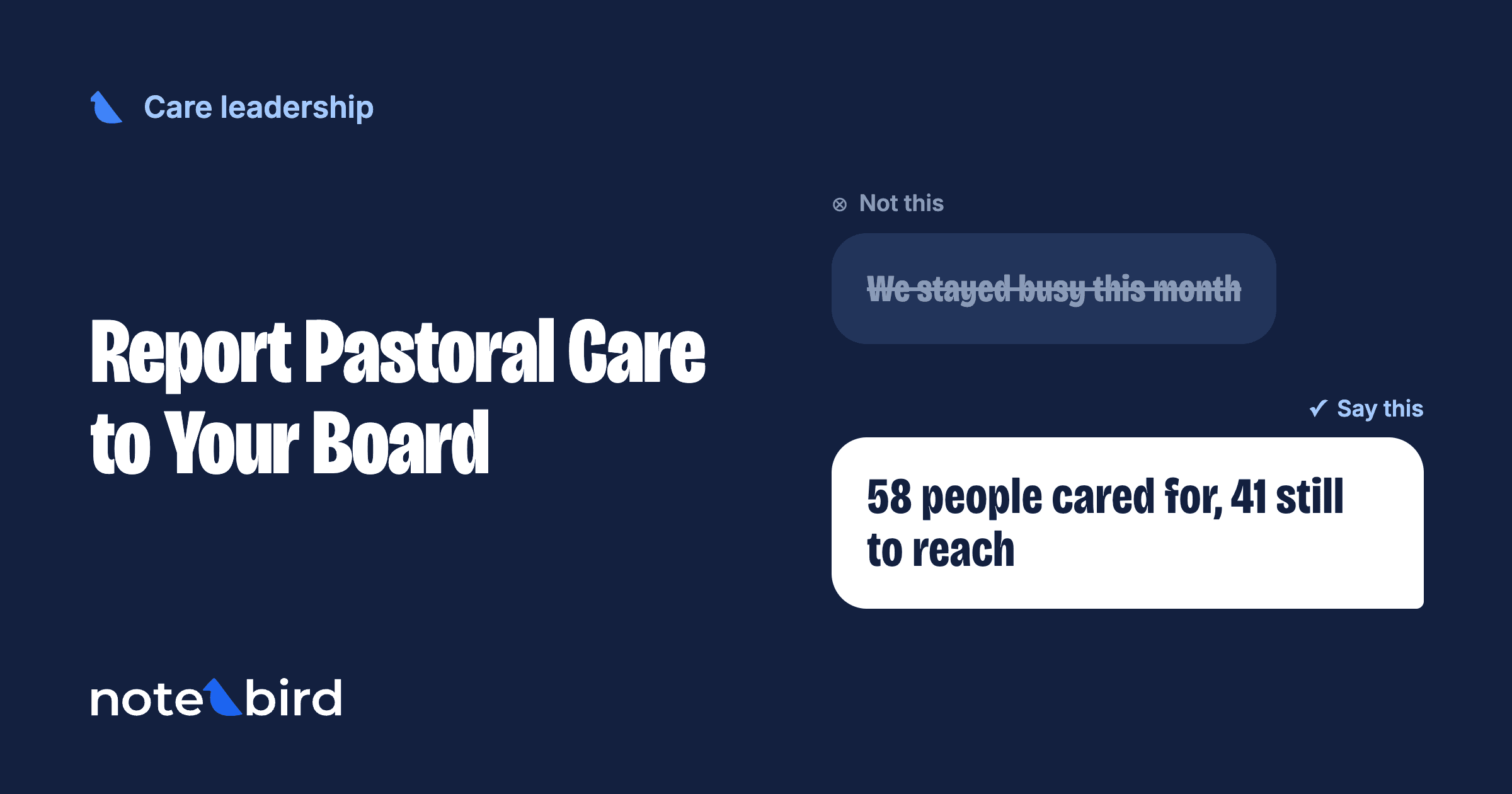
The deacon chair combines the reports for the pastor and the board. Leave out private details. Report counts and needs, not secrets. Our guide on how to report pastoral care to your board has a full template.
Common Problems and How to Fix Them
- A deacon goes quiet. Ask privately how they are. Life gets heavy. Offer fewer households or a season off, and move their families to another deacon for now.
- A family does not want contact. Respect it. Send a card at Christmas and on their birthday, and tell them the door is open.
- A crisis is too big for the deacon. That is what the pastor is for. The deacon stays as a friend while the pastor leads.
- A deacon rotates off. Hand over the households in person or with a short note on each. Do not let a household go a month without a contact.
- Deacons do the tasks but not the notes. Make logging as short as possible. A one-line note is better than none.
Share the Load
Moses could not hear every case, and your pastor cannot call every household. A deacon care ministry gives each family one person who knows them, and gives the pastor time for the needs only a pastor can meet.
Notebird gives each deacon their own households, keeps restricted notes with the pastor, and shows who has gone without contact, so a quiet family does not wait months for a call nobody owned. Read more about groups in Notebird, or see what congregational care is for more care ministry ideas.