Does HIPAA Apply to Churches? Privacy for Pastoral Care Notes
Most churches are not HIPAA covered entities. Learn the exceptions, the laws that do apply, and who should see pastoral care notes.
By Thomas Griffin, Owner and CEO
Published
For most churches, HIPAA does not apply. The law covers health plans, health care clearinghouses, and health care providers that bill electronically, plus the businesses that work for them. A church that visits, prays, and counsels is not one of these. Privacy still matters: state laws, clergy privilege, mandatory reporting, and trust shape what you write and who sees it.
This guide is general information, not legal advice. Laws differ from state to state, so ask a lawyer about your own ministry.
Why Churches Ask About HIPAA
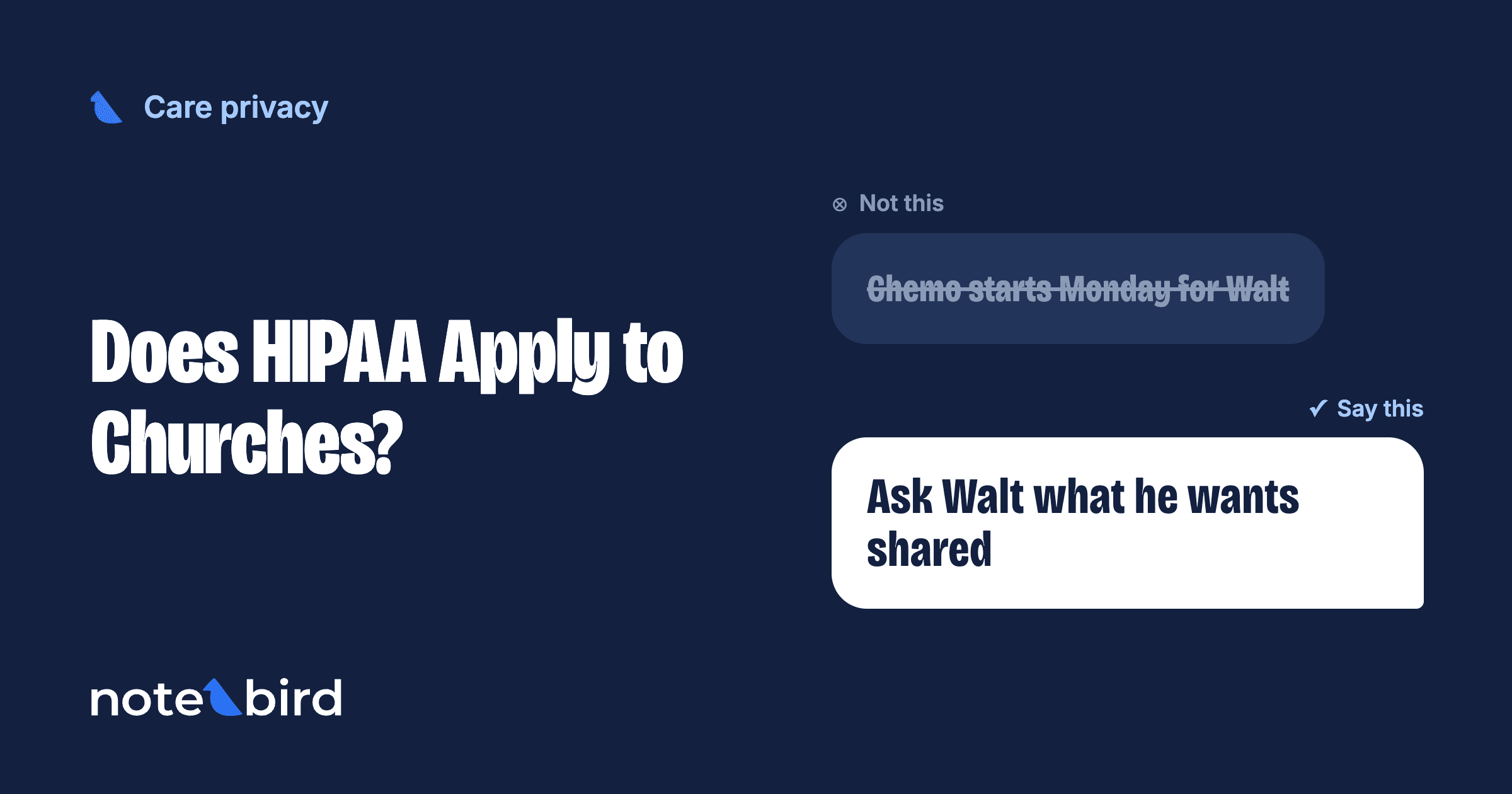
A pastor hears about a diagnosis in the lobby. A deacon writes "chemo starts Monday" in a group text. A volunteer asks the hospital for a member's room number and gets told "HIPAA." So people ask: does the same law apply to us?
It is a good question, because the stakes are real. Pastoral care notes hold the hardest days of people's lives: a diagnosis, a death, a drinking problem, a marriage coming apart, a bill they cannot pay. Picture a woman who tells her pastor about a miscarriage, then hears a volunteer mention it at the door after church. She will not bring the church her next hard thing, and then the church cannot help her.
The short answer is that HIPAA almost never applies to a church. The longer answer is that your church still needs clear privacy rules, and the sections below give you those rules.
What HIPAA Covers
HIPAA's privacy rules apply to "covered entities" and their "business associates." The U.S. Department of Health and Human Services lists three kinds of covered entities:
- Health plans. Health insurance companies, HMOs, company health plans, and government programs such as Medicare and Medicaid.
- Health care clearinghouses. Companies that turn health data from one format into another, often for billing.
- Health care providers that do certain transactions electronically. A doctor, clinic, or counselor is covered when they send health information electronically for standard transactions, such as insurance claims.
A business associate is a person or company that does work for a covered entity and needs protected health information to do it. A billing company for a hospital is one example. A covered entity must sign a contract, called a Business Associate Agreement (BAA), with each business associate.
A church that visits the sick, keeps a prayer list, and offers pastoral counsel is not a health plan, a clearinghouse, or a provider that bills insurance. So HIPAA does not apply to its pastoral care.
When HIPAA Might Apply to a Church Ministry
Some ministries do look like health care. Ask a lawyer if your church runs any of these:
- A health clinic or a free clinic with nurses or doctors, especially one that bills insurance or Medicaid.
- A counseling center with licensed therapists who bill insurance for their sessions.
- A school health office that is part of a church school. School health records often fall under other laws, such as student records law. Ask which law applies.
- A health plan for church employees. A self-funded health plan can be a covered entity, even when the church itself is not.
- A parish nurse who also works for a hospital or clinic and keeps records for them.
If one of these applies, keep those health records in a system built for HIPAA, apart from your pastoral care notes.
What Hospitals Can Tell Clergy
HIPAA does affect churches in one daily way: it controls what a hospital can tell you. A hospital can keep a patient directory with the patient's name, room, and general condition. HHS explains that a hospital may also tell clergy about patients of their faith, if the patient was told about the directory and did not object.
It can sting to drive across town and be turned away at the desk. But if the front desk will not tell you a member is there, the member may have opted out, and that choice is theirs. Respect it. Ask the family to tell you when a visit is welcome. For visit tips, see our guide on what to say on a hospital visit.
What Does Apply: State Laws, Clergy Privilege, and Mandatory Reporting
HIPAA is not the only law. Three other kinds of law matter more to most churches.
State Privacy Laws
Some states have their own health privacy laws, and some reach further than HIPAA. Texas, for example, has a medical records privacy law that can cover more groups than HIPAA does. Other state laws cover data breaches, such as a leak of names with Social Security numbers. Ask a lawyer which laws apply in your state.
Clergy-Penitent Privilege
Most states have a law that lets a person keep a private talk with clergy out of court. People call it clergy-penitent privilege, or priest-penitent privilege. The rules differ by state:
- Many states cover only a talk with a member of the clergy acting as a spiritual adviser.
- Many cover only a talk that was meant to stay private. A talk with others in the room may not count.
- A lay volunteer, such as a deacon or care team member, may not be covered.
- Written notes can be asked for in a lawsuit.
A plain rule follows: write every note as if a judge could read it one day.
Mandatory Reporting of Child Abuse
Many states name clergy as mandatory reporters of child abuse and neglect. Some states make every adult a reporter. States also differ on whether clergy must report what they hear in a confession. Many states also require reports of abuse or neglect of older or dependent adults, which matters for homebound and nursing home visits. The Child Welfare Information Gateway, a service of the U.S. government, keeps a state-by-state summary called Clergy as Mandatory Reporters of Child Abuse and Neglect.
Read your state's entry. Then write a reporting policy and train every staff member and volunteer on it. Because of these laws, never promise anyone total secrecy. Say this instead, at the start of a hard talk rather than halfway through, so no one feels tricked later:
"What you tell me stays private. The one exception is if a child or someone else is in danger. Then I may have to get help."
Who Should See What: Three Levels of Care Information
The best privacy rule is simple: share each fact with the fewest people who need it to give care. Most churches can use three levels.
| Level | Who sees it | What goes here | Example |
|---|---|---|---|
| 1. Public prayer list | The congregation, the bulletin, the prayer chain | Only what the person approved, in their words | "Please pray for Mary Hill as she recovers from surgery." |
| 2. Care team | The pastors, the deacons or care team, the volunteers assigned to the person | The facts needed to follow up: dates, needs, next steps | "Hip surgery on 3/4. Home on 3/7. Needs rides to physical therapy on Tuesdays." |
| 3. Pastor only | The senior pastor and a few named leaders | Sensitive matters: counseling, addiction, marriage problems, abuse, legal trouble | "Met with Dan about his drinking. He agreed to see a counselor. Follow up in two weeks." |
Three rules make the table work:
- Start at the lowest level. A new note goes to the smallest group first. Move it up a level only with the person's yes.
- Ask before the prayer list. "Would you like us to pray for you by name on Sunday? What would you like us to say?" Use their words.
- Mark sensitive notes on purpose. Do not leave it to memory. Decide at the moment you write it.
For a full process from request to answered prayer, see our guide to a church prayer request system.
How to Write Pastoral Care Notes
A good note helps the next person give care. A careless one can hurt the very person you wrote it about. Use these rules:
- Write facts, not opinions. "Said she has not slept well since the funeral" is a fact. "She seems unstable" is an opinion.
- Use the person's own words for health. If they say "my heart problem," write that. Do not add a diagnosis they did not share, and do not guess.
- Leave out gossip. If you heard it from someone else, it does not go in the note.
- Write the next step. "Call on Friday" or "Bring a meal on 3/10." A note without a next step is easy to forget.
- Keep it short. Two or three sentences is often enough.
- Write it the same day, while you still remember their words.
- Do not write what you would not say to their face. The person, their family, or a court may read the note one day.
A note that follows these rules:
"Visited Ruth at home. She is tired from treatment but glad for the visit. Her daughter comes on weekends. She asked for prayer for sleep. Next: call on Thursday."
Ask Before You Share
Consent is the heart of church privacy. The person decides who knows, how much they know, and when. A hard season takes a lot of control away from people. Asking first gives a little of it back.
Questions to ask:
- "Who else may I tell about this?"
- "Would you like the care team to know, so they can help?"
- "May I put your name on the prayer list? What should it say?"
- "Is there anyone you do not want to know?"
If they say no, the answer is no, even when you think a wider group could help. Ask again later if things change. When a person cannot answer, such as after a stroke, ask the family member they trust most.
How Long to Keep Pastoral Care Notes
There is no single rule for church pastoral notes, so write a policy and follow it. A simple policy:
| Kind of record | How long to keep it | Who decides |
|---|---|---|
| Everyday care notes (visits, calls, cards) | While the person is part of the church. Review each year. | Pastor or care admin |
| Notes on a person who moved away or left | Archive them. Delete after the period your policy sets. | Pastor |
| Counseling notes | As long as your policy and your lawyer advise | Senior pastor |
| Reports of abuse or safety incidents | As long as your lawyer or insurer tells you, often many years | Lawyer, insurer, board |
Two cautions. First, never delete a record after you learn of a lawsuit or an investigation. Second, notes that live in personal phones and notebooks cannot follow any policy, so keep care notes in one shared place your church controls.
What Happens When Staff and Volunteers Leave
A pastor retires. A deacon moves away. If care notes live in their email or a notebook, two bad things happen. The church loses the history, and private notes leave with a person who no longer serves.
Plan for this before it happens:
- Keep notes in a church system, not a personal one. No care notes in personal email, texts, or notebooks.
- Remove access on the last day. Turn off their account the day they leave.
- Hand over open care. Give each person they cared for a new owner and a date for the first call.
- Collect paper. Ask for any notebooks or files, and shred what the church does not need.
Our guide on handing over pastoral care when a pastor leaves has a full checklist. To put all of these rules in writing, start from our pastoral care policy template.
How Notebird Handles Pastoral Care Privacy
Notebird is pastoral care software for churches. This is what it does, and does not do, to protect care notes:
- Restricted updates. Mark a sensitive update as restricted, and only the Organization Owner, Organization Admins, and Care Admins can read it. This is the one privacy level. Notebird does not have notes that only the author can see.
- Group-only access. A team member with the Group Member role sees only the people in the groups you assign to them. They cannot see anyone else.
- Archive, do not lose. When a team member leaves, archive their account. The updates they wrote stay on each person's history for the next person.
- Not for HIPAA records. Notebird does not sign Business Associate Agreements, and its Terms ask customers not to store health information that HIPAA protects. If your ministry runs a clinic or a counseling practice that bills insurance, keep those records in a system built for HIPAA.
Read the details on our security and privacy page.
Privacy Is a Form of Care
People trust the church with their worst days. Guard that trust with a few plain rules: share less, ask first, write facts, and keep notes in one place. When a member learns that what they told you stayed with you, they come back with the next hard thing. When you are ready to keep care notes with the right limits, see how Notebird helps churches follow up without spreading private details.