When to Refer Someone to a Counselor: A Church Care Guide
Signs a need is beyond your care team, what to say so no one feels dropped, a referral list, crisis steps, and care after you refer.
By Thomas Griffin, Owner and CEO
Published
Refer someone to a counselor when a need is bigger than prayer, presence, and practical help. Signs include talk of suicide, abuse, sadness or fear that lasts weeks and stops daily life, drinking that is out of control, or no change after several meetings. Refer with a warm handoff, and keep caring after the referral.
Why a Referral Is Care, Not Failure
Pastors and care teams give something no clinic can: years of shared life, prayer, meals, and a seat that waits for you on Sunday. But a care team is not trained to treat depression, trauma, addiction, or a marriage in crisis. Trying to do that work can do harm, even with the best heart.
Many pastors feel a pang when they refer, as if they have failed the person. You have not. A referral says, "You matter enough to get the right help." It does not end your care. The person still needs the church. They need the calls, the cards, and the people who know their name. The counselor does one job. You keep doing yours.
Many pastors set a simple limit: a few meetings on one problem, then a referral if things are not getting better. Write your limit down so you do not have to decide it in the moment.
Signs a Need Is Beyond the Care Team
Use this table to decide what to do and how fast. When in doubt, move faster.
| Sign | What to do | How fast |
|---|---|---|
| Talks about suicide, has a plan, or gives things away | Stay with them. Call or text 988 together. Call 911 if they are in danger now. | Now |
| Threatens to hurt someone else | Call 911. Keep yourself and others safe. | Now |
| A child, an older adult, or a disabled adult may be abused or neglected | Follow your state's reporting law and your church policy. Tell your pastor. | Same day |
| Fears a spouse or partner, or shows signs of abuse at home | Talk in private. Give the National Domestic Violence Hotline: 1-800-799-7233, or text START to 88788. | Same day |
| Hears or sees things others do not, or is suddenly confused | Help them reach a doctor or an emergency room. Call the family. | Same day |
| Sad, hopeless, or numb most days for two weeks or more | Suggest a doctor or a licensed counselor. Offer to help make the call. | This week |
| Drinking or drug use is out of control, or they cannot stop | Give the SAMHSA National Helpline (1-800-662-4357) and AA or a treatment program. Give the family Al-Anon. | This week |
| Grief that still stops daily life many months after a death | Suggest a grief counselor or a grief support group. | Within a few weeks |
| A marriage with constant conflict, or one person wants out | Suggest a licensed marriage and family therapist. | Within a few weeks |
| Cannot pay rent, food, or utilities | Start your benevolence process. Call 211 for local help. | This week |
| A legal problem: eviction, custody, debt collection | Give the local legal aid office. | This week |
| You feel out of your depth, or meetings go on with no change | Refer, and keep giving pastoral care. | At your next meeting |
Two notes on the table. First, a person can need more than one row. A man who lost his job may need the benevolence fund, legal aid, and a counselor. Second, you do not need to be sure. "I am worried about you" is enough reason to refer.
What to Say So the Person Does Not Feel Dropped
The biggest risk in a referral is that the person hears "Go away." Say three things: why you are referring, what stays the same, and what happens next.
Scripts that help:
- "What you are carrying is heavy, and you deserve someone trained for it. I will still be your pastor. That does not change."
- "I care about you too much to be the only help you have. Can we find a counselor together?"
- "I am not a doctor, and I do not want to guess. Would you be willing to see one this week?"
- "Seeing a counselor takes courage, not weakness. Many people of faith do it."
- "Would it help if I sat with you while you make the call?"
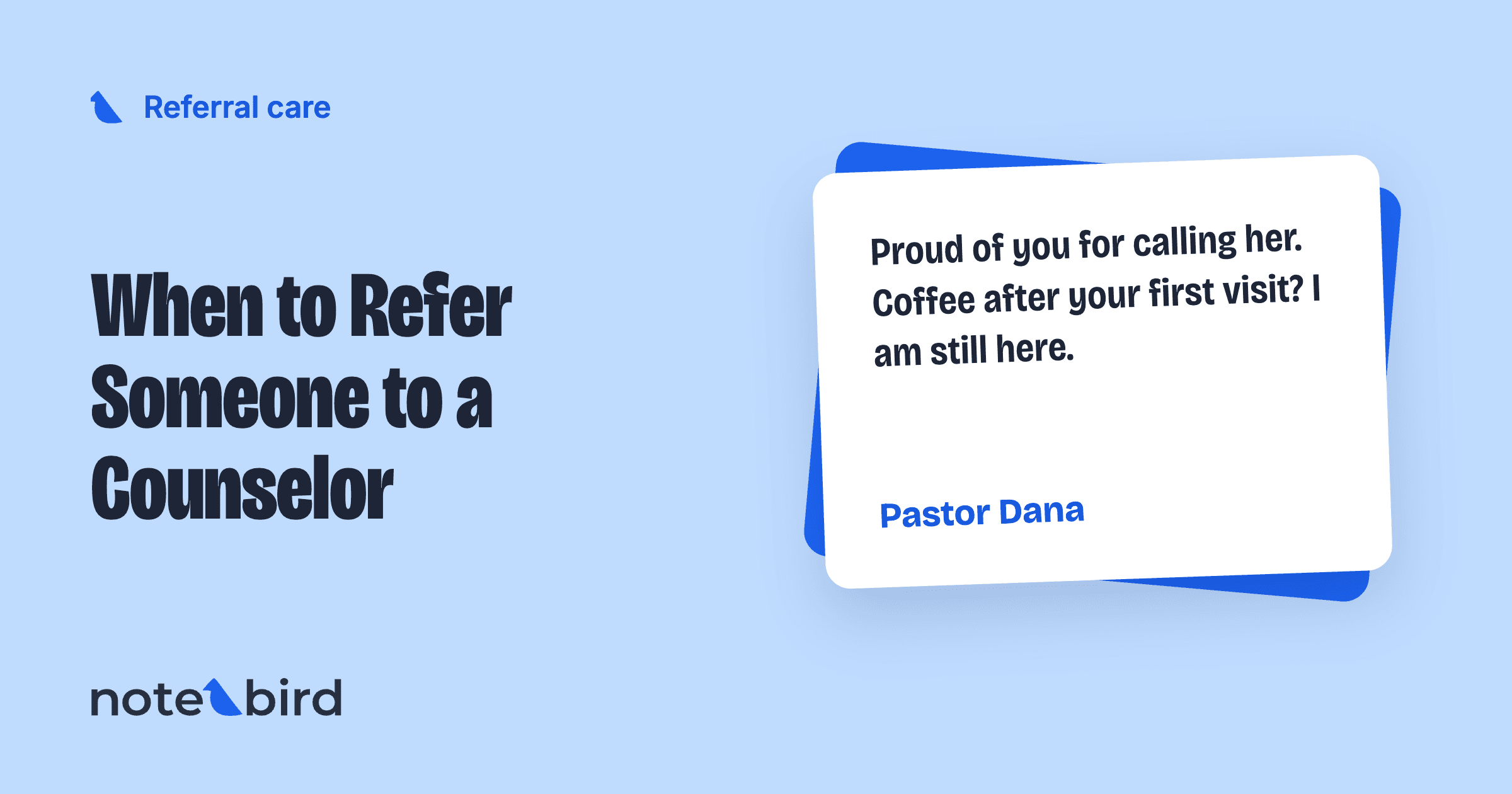
- "I will call you on Friday to see how it went."
If the person is a Christian and worries about therapy, you can say this: "A good counselor will respect your faith. You can ask them about that on the first call." Some people want a counselor who shares their faith. Keep a few of those names on your list.
Words to avoid:
- "This is above my pay grade." It sounds like they are a problem to pass along.
- "You just need to pray more." Prayer and counseling work together. This line adds shame.
- "Call me if it does not work out." Put the next call on your own calendar instead.
- "Everyone feels like this sometimes." It can make a person hide how bad things are.
Help With the First Step
A list of names helps. A warm handoff helps more, because the first call is the hardest one to make when you feel low. Small acts carry a person over that first step:
- Give two or three names, not twenty.
- Check that the counselor takes new clients and the person's insurance, or offers a sliding fee.
- Offer to sit with them while they call or fill in the online form.
- Offer a ride to the first visit, and offer to wait in the car.
- If money is the barrier, ask your board whether the benevolence fund can pay for the first few sessions. Our guide to a church benevolence process shows how to decide.
Build a Referral List Before You Need It
In a crisis, you do not have time to search. Build the list now, and review it each year. Give a copy to every pastor and care team leader.
| Need | Who to list | How to check them |
|---|---|---|
| Mental health | Two or three licensed counselors (LPC, LCSW, LMFT, or psychologist), including some who share your faith | Call. Ask about license, fees, insurance, wait times, and how they treat a client's faith. |
| Crisis | 988 Suicide and Crisis Lifeline, and your local emergency room | Put 988 on the first line of the list. |
| Grief | A grief support group at a church, a hospice, or a funeral home | Ask when it meets and whether anyone can join. |
| Addiction | AA, a local treatment program, the SAMHSA National Helpline (1-800-662-4357) | Find meetings near you. Ask the program about fees. |
| Family of someone who drinks | Al-Anon and Alateen | Find meetings near you on their site. |
| Marriage | A licensed marriage and family therapist | Ask how they work with couples in high conflict or abuse. |
| Domestic violence | National Domestic Violence Hotline: 1-800-799-7233, text START to 88788. A local shelter. | Ask the shelter how a church can refer someone safely. |
| Food, rent, utilities | A local food bank, your community action agency, and 211 | Call 211 once yourself to see how it works. |
| Legal help | Your local legal aid office | Use the Legal Services Corporation search to find an office near you. |
211 connects people to local help with housing, utilities, food, health care, mental health, and substance use. The 211 site says every call is confidential. It is a good first call when you do not know where to start.
Ask your members who are counselors, nurses, and social workers to help build the list. They know which offices answer the phone.
When Someone Is in Crisis
A crisis is not the time for a referral list. It is the time to act.
If someone talks about suicide:
- Ask directly: "Are you thinking about killing yourself?" Asking does not put the idea in their head.
- Do not leave them alone.
- In the United States, call or text 988 together, or chat at 988lifeline.org. The 988 Lifeline is free, confidential, and open 24 hours a day. It also helps people who are worried about someone else.
- If they have a weapon or pills nearby, or they are in danger now, call 911.
- Tell your pastor the same day. Then plan who will check in tomorrow.
If someone is in danger from another person, call 911. Do not confront an abuser yourself, and do not suggest couples counseling when one person fears the other.
If a child may be abused or neglected, follow your state's law and your church's policy. In many states, clergy are mandatory reporters. Do not investigate on your own. Our guide does HIPAA apply to churches explains mandatory reporting and links to each state's law. This is general information, not legal advice, so ask a lawyer to help you write your policy.
If a death by suicide has already happened, our guide on how to care for someone after a suicide loss covers the words and the care the family needs.
Keep Caring After the Referral
People often stop calling once a counselor is in the picture. They mean well: they assume the professional has it covered. But that is when the person feels most alone. A referral changes your role. It does not end it.
| When | What to do | Who |
|---|---|---|
| The day of the referral | Write down the names you gave. Set the date for the next call. | Pastor |
| 3 to 5 days later | Call. "Were you able to reach anyone?" If not, offer to help make the call. | Pastor or care team member |
| After the first session | Text: "Thinking of you today. No need to reply." Do not ask what they talked about. | Care team member |
| Every 2 weeks for 3 months | Call or visit. Talk about their life, not their therapy. Ask what would help this week. | Care team member |
| Each month | Send a card. Invite them to a meal, a small group, or to sit with you on Sunday. | Care team member |
| If they stop going to the counselor | Ask gently why. Help find a better fit if the first one did not work. | Pastor |
| At 3 months | Pastor checks in. Decide together how often to keep calling. | Pastor |
Let the person decide how much to tell you about counseling. Some will share a lot. Some will share nothing. Both are fine. Your job is to be the friend who keeps showing up.
Write a Short, Private Record
A good note helps the next person keep caring. A careless note can hurt the person you meant to help.
Write this:
- The date and the type of help: "Gave the names of two grief counselors."
- The next step and its owner: "Pastor Dana calls on 3/14."
Do not write this:
- What the person said in counseling.
- A diagnosis they did not tell you in their own words.
- Opinions such as "seems unstable."
Keep referral notes where only a few leaders can read them. In Notebird, a restricted update can be read only by the Organization Owner, Organization Admins, and Care Admins. Ask the person before you share anything with the wider care team.
Train Your Team to Refer Well
Every care team member should know three things by heart: the signs in the table above, the number 988, and the name of the person to call when they are worried. Walk through this guide at a team meeting once a year. Our pastoral care training gives you more lessons for volunteers.
Care Does Not Stop at the Referral
The counselor helps the person heal. The church helps them belong. When you refer with care and keep calling, the person learns they are not a problem passed along. They are still part of the family. To keep those follow-up calls from slipping, see how Notebird helps churches with church follow-up.