How Often Should a Pastor Visit Members? A Visitation Guide
Pastoral visitation guidelines: how often to visit homebound, new and grieving members, sharing visits by church size, safety rules, and visit notes.
By Thomas Griffin, Owner and CEO
Published
There is no single rule, but a good rhythm is this: visit homebound members monthly, people in a crisis within a day or two, new members in their first month, and every household once a year in a church of under about 150. The pastor does not make every visit. Elders, deacons and trained visitors share the load.
Many pastors carry a quiet guilt about visits. They know they should visit more. They do not know how much is enough, and the list never gets shorter. This guide gives you a clear rhythm by type of person, a table that shows how to share visits by church size, and the plain how-to of a good visit: planning it, leading it, staying safe, and writing it down.
What Is a Pastoral Visit?
A pastoral visit, also called a pastoral care visit or a clergy visit, is a planned meeting between a pastor (or a trained lay visitor) and a member. It usually happens at home, in a care home, or in the hospital. The purpose is simple: to listen, to pray, to bring God's word, and to learn how the person is really doing.
Home visits are an old practice. In the mid-1600s, the English pastor Richard Baxter and his assistant visited about 15 or 16 families each week in Kidderminster. That came to about 800 families a year, or the whole parish, as Christianity Today's history of Baxter describes. He spent about an hour with each family.
Few pastors today can visit 800 families. But the idea still holds: a pastor who sits in people's homes knows them in a way that a pastor who only greets them at the door cannot. In the living room you see the grandchildren on the fridge, the pill bottles by the sink, and the chair by the window where she waits for the mail.
There are a few kinds of visits:
- Routine home visits. A yearly or regular visit to learn how a household is doing.
- Homebound and care home visits. Steady contact with people who cannot come to worship. See our homebound ministry guide.
- Hospital visits. Short visits during a stay or before surgery. See what to say on a hospital visit.
- Crisis visits. After a death, a diagnosis, a divorce, an arrest, or a job loss.
- New member visits. A first visit to learn their story and help them connect.
- Sacramental visits. Communion at home, or other rites your tradition practices.
How Often Should a Pastor Visit Members?
Set a rhythm by need, not one rule for everyone. Here is a starting point. Change it to fit your church and your tradition.
| Person | How often | Who usually goes |
|---|---|---|
| Homebound and care home members | A visit each month, a call between visits | Deacon or lay visitor monthly; pastor every 3 months |
| In the hospital | Within 24 to 48 hours, then as needed | Pastor or care team |
| Home after a hospital stay or surgery | Within a week of coming home | Pastor or care team |
| A crisis (death, diagnosis, divorce, job loss) | Within 1 to 2 days, then each week for the first month | Pastor first, then care team |
| Recently bereaved | Each week in the first month, then each month for a year | Pastor and care team |
| New members | In the first 30 days, then again at about 6 months | Pastor or elder |
| Members who stopped coming | Within about 3 weeks of the absence | Someone they know |
| Leaders and their families | Once or twice a year | Pastor |
| Every household | Once a year in churches under about 150; shared in larger churches | Pastor, elders, deacons |
For the first year after a death, our grief care calendar lists each call and visit by month. For members who have gone quiet, see how to follow up when someone stops coming to church.
How a Pastor Shares Visits by Church Size
One pastor cannot visit everyone in a church of 400. The math is simple. A pastor who makes 4 routine home visits a week for 46 weeks makes about 180 visits a year, on top of hospital and crisis visits. The table shows how the load changes as a church grows.
| Church size (weekly attendance) | Who visits | A realistic rhythm |
|---|---|---|
| Under 75 | Pastor, with one or two elders or deacons | Pastor visits every household once a year (about 1 visit a week), plus all crisis and homebound visits |
| 75 to 150 | Pastor and a small team of elders or deacons | Pastor visits about half the households each year; each elder or deacon visits 8 to 12 households |
| 150 to 300 | Elders or deacons, each with a fixed "flock" | Each leader has 10 to 15 households and visits each once a year; pastor takes crisis, bereaved, and new member visits |
| 300 to 1,000 | Care pastor, deacons, and a trained visitation team | Visitation team covers homebound and care homes; deacons cover households; pastors take crisis visits and leaders |
| Over 1,000 | Care staff, campus pastors, and many lay teams | Small groups carry most routine contact; care staff assign and track visits by team |
The key in every size is a fixed list. Each elder or deacon should know the names of the households they visit. A shared list that "everyone" covers ends up covered by no one. To set up a team, see our guide on how to schedule a volunteer visitation team.
How to Plan a Pastoral Visit
A good visit starts before you knock.
- Call first. Ask for a time that works. Many people want to tidy up, and older members may have aides or doctor visits. Say why you are coming: "I would love to stop by and hear how you are doing."
- Know the person. Look at your notes from the last visit. Who is in the family? Was there a recent loss or a health change? What did you promise last time?
- Pick a purpose. A routine visit, a check-in after surgery, a communion visit. One clear purpose keeps the visit focused.
- Bring a second person when you should. See the safety section below.
- Plan for 20 to 30 minutes. Long enough to listen and pray, short enough that they are not worn out. Hospital visits are often 10 to 15 minutes.
- Bring something small. A bulletin, a card from their Sunday school class, or the sermon recording for someone who cannot come.
- Choose a short Scripture. A psalm, such as Psalm 23, 46, or 121, works for most visits.
What to Talk About on a Pastoral Visit
Begin with their life, then their faith. People open up when they feel known, not examined.
Questions to start:
- "How has your week been?"
- "Tell me about your family. Who is new in your world?"
- "How is your health these days?"
- "What has been the best part of this year? The hardest?"
Questions that go deeper:
- "How is your walk with God these days?"
- "Where have you seen God at work lately?"
- "Is there anything you have been wanting to ask a pastor?"
- "How can the church care for you better?"
To close:
- "What would you like me to pray for?"
- Read the Scripture you chose. Keep it short.
- Pray in plain words. Ask God to be near, to give strength and peace, and to bless their home. Do not promise healing or an outcome.
- "Is there anything the church can do for you this month?"
Listen more than you talk. If you talk for more than half the visit, you have learned less than you could.
Be ready for the real thing to come up late. A widower may talk about the weather and the ballgame for 20 minutes. Then, with his hand on the door, he says, "I don't sleep much since Ruth died." Stay a few more minutes. That sentence is why you came.
What Not to Do on a Visit
- Do not use the visit to recruit. "We need help in the nursery" turns a care visit into a sales call.
- Do not fix every problem. Write down practical needs and pass them to the right person after the visit.
- Do not overstay. Leave while the visit still feels good. Watch for tiredness, glances at the clock, or a phone that keeps ringing.
- Do not share other people's news. "Did you hear about the Johnsons?" teaches them that what they tell you will travel.
Safety and Boundaries on Pastoral Visits
Rules for visits protect the person, the pastor, and the church. Many insurers and denominations ask for some version of these:
- Visit in pairs when you can. The Church of England's Diocese in Europe says visiting in pairs may be advisable, "especially if the adult is perceived to be vulnerable." A spouse, an elder, or a deacon makes a good second person.
- Bring a second adult for visits with the opposite sex. Brotherhood Mutual's pastoral counseling checklist asks if churches "have a second adult present when counseling members of the opposite sex or minors." Many churches apply the same rule to home visits.
- Keep the door open, or meet where others can see. If a visit must be one to one, choose a room with an open door or a public place, such as a coffee shop or the church office during office hours.
- Never visit a minor alone. Visit when a parent is home, and follow your church's child safety policy.
- Tell someone where you are. Share the address and the time with your spouse, an elder, or the church office. Check in when you leave.
- Know your limits. If a visit turns to deep counseling, abuse, or thoughts of suicide, refer to a trained counselor or call for help. In the United States, people can call or text 988, the Suicide and Crisis Lifeline.
- Report back. The same Diocese in Europe guidance asks visitors to note the date of each visit and to report back to an agreed named person. That is good practice in any church.
Write these rules down and give them to every person who visits on behalf of the church, not only the pastor.
A Sample Monthly Visit Rhythm
Here is what a month can look like for a pastor of a church of about 120, with three elders who share visits.
| Week | Pastor | Elders and deacons |
|---|---|---|
| Week 1 | Communion visits to 3 homebound members. One new member visit. | Each elder visits 1 household on their list. |
| Week 2 | Two routine household visits. Calls to the recently bereaved. | Deacons make monthly homebound visits. |
| Week 3 | Two routine household visits. One visit to a leader's family. | Each elder visits 1 household on their list. |
| Week 4 | Catch-up week for missed visits. Review the list for next month. | Elders report who they saw and any needs. |
| Any week | Hospital and crisis visits come first and move other visits. | Elders cover routine visits the pastor had to move. |
Crisis visits will break the plan. That is fine. The point of a plan is that a moved visit gets a new date instead of being forgotten.
How to Record a Pastoral Visit
A visit you do not record is easy to forget, and hard to hand over if you leave. Write a short note within a day:
- The date and the type of visit. Home, care home, hospital, communion.
- Who went. Helpful when the next visitor wants context.
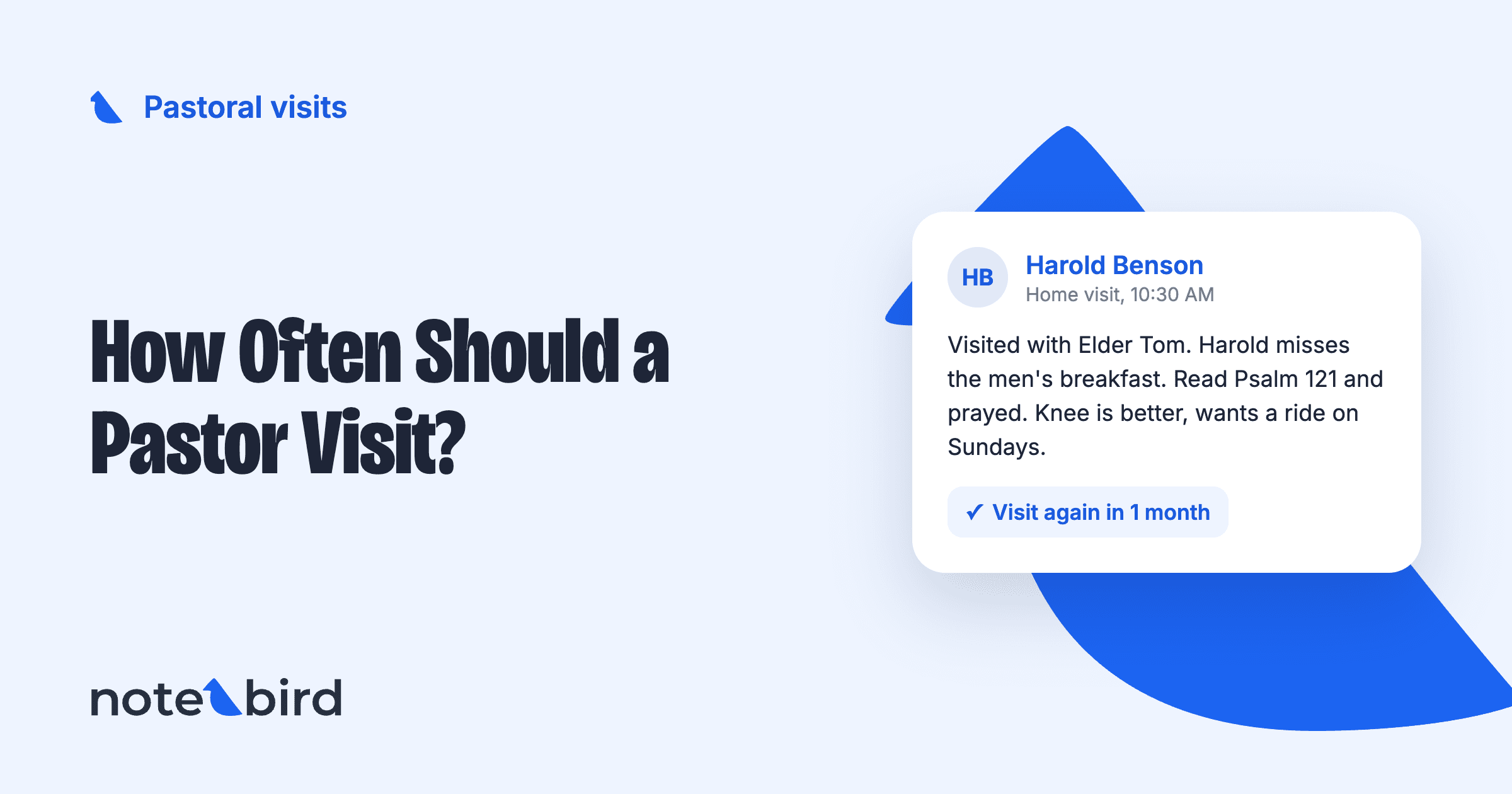
- What the next visitor should know. "Her son moved home. She misses the women's Bible study. Hearing is worse; speak up."
- Prayer requests, in plain words.
- The next step. "Call in two weeks." "Ask the deacons about a ride on Sundays."
Keep it short and kind. Write as if the person might read it someday. Leave out guesses about their spiritual state, gossip, and detailed medical facts. If they share something sensitive, such as a marriage problem, keep that note to the few people who need to know. In Notebird, a restricted update can be read only by the Organization Owner, Organization Admins and Care Admins.
Visit With a Plan, Not With Guilt
You will not visit everyone as often as you want, and no pastor does. But a clear rhythm, a fixed list for each visitor, and a short note after each visit add up. Over a year, they help each household hear from its church, not only the ones who call the office. See how churches plan and track visits in Notebird with church visitation software.