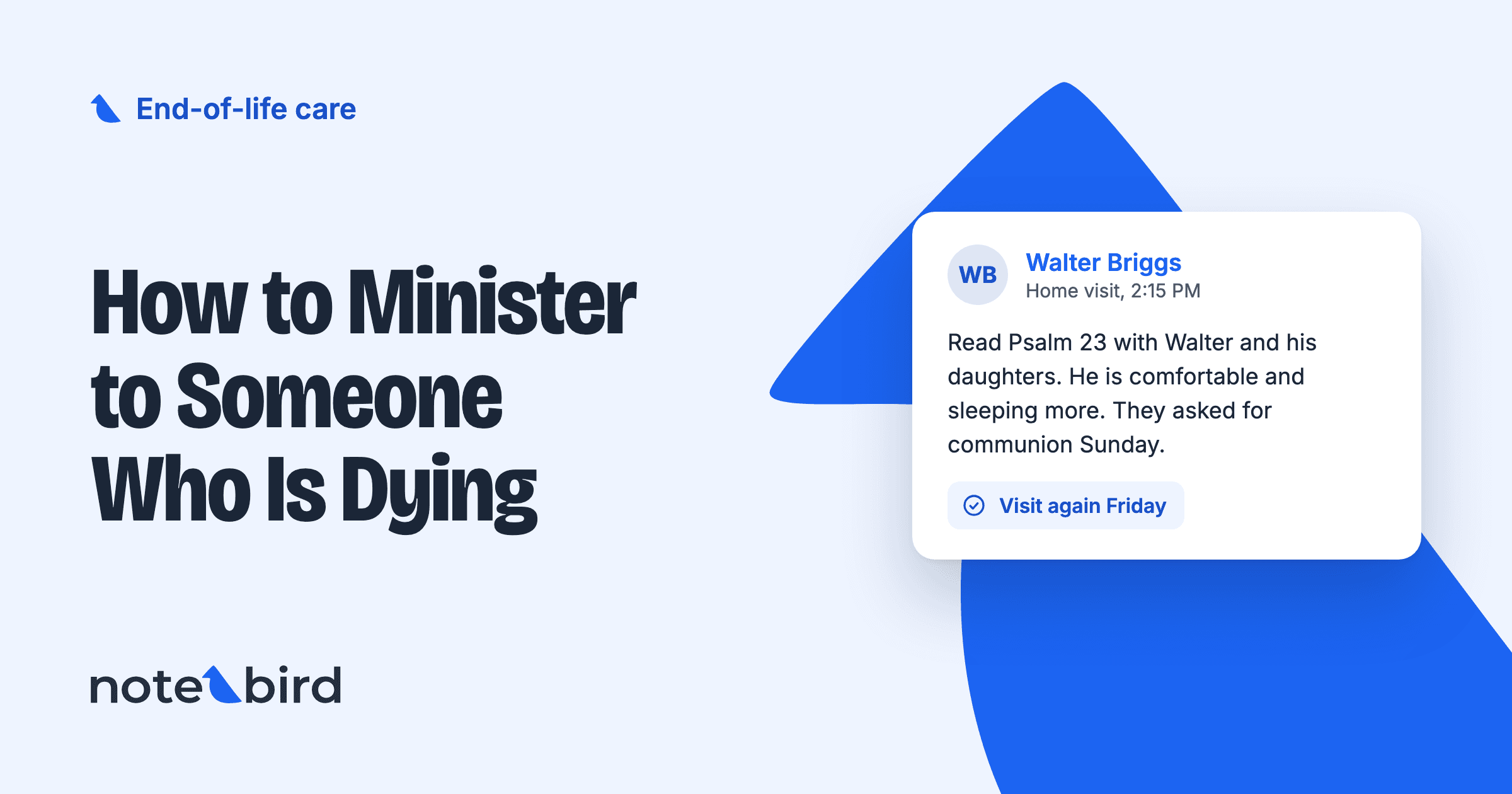
How to Minister to Someone Who Is Dying: A Guide for Care Teams
What to say to a dying person, what not to say, a bedside prayer, last rites across traditions, and a church care plan from hospice to the funeral.
By Thomas Griffin, Owner and CEO
Published
To minister to someone who is dying, go often, stay short, and listen more than you talk. Ask what they want: prayer, Scripture, a sacrament, or quiet company. Say plain, true words. Care for the family and the caregiver too. Work with the hospice team and chaplain, and keep visiting until the funeral.
This guide is for the pastor, the deacon, the elder, and the care team volunteer. It covers the weeks from hospice admission to the funeral. For manners at the bedside in a hospital, read what to say on a hospital visit. For the year after the death, use the 12-month grief care calendar. That calendar starts where this guide ends.
Why the Church Still Matters When Hospice Comes
When a member goes into hospice, a new team arrives: a nurse, an aide, a social worker, and a chaplain. Some families think the church should now step back. Ask them what they want. Unless they ask for space, stay close.
The hospice chaplain may know the person for a few weeks. The church may know them for fifty years. You know their hymns, their Sunday school class, and the friends who sat beside them in the pew. Hospice teams know this too. Federal rules for Medicare hospices say the hospice must make all reasonable efforts to "facilitate visits by local clergy" and others who can support the patient's spiritual needs.
So the hospice chaplain is your partner, not your replacement. The chaplain cares for this season. The church gives belonging, the sacraments of your tradition, the funeral, and the care that comes after.
A Care Timeline From Hospice to the Funeral
Start this plan on the day you hear that the person is in hospice. Give each row an owner.
| When | What to do | Who |
|---|---|---|
| Hospice admission (first 2 or 3 days) | Visit. Ask what the person wants from the church. Meet the main caregiver. Ask for the name of the hospice chaplain. Ask what news the family wants shared. | Pastor |
| Same week | Choose one care team lead for the family. Start a meal schedule. Get the family's permission before you share news with the prayer chain. | Care team lead |
| Weekly while in hospice | One short visit. Bring Scripture, prayer, or communion if they want it. | Pastor, elder, or deacon |
| Weekly while in hospice | Call the main caregiver. Ask "How are you?" and "What do you need this week?" Offer two hours of sitting time so they can rest. | Care team lead |
| The final days | Visit more often. Offer the prayers and rites of their tradition. Help the family plan who sits with the person, if they want that. | Pastor |
| The hour of death | If the family calls, go. Pray with them. Sit with them. Let the hospice team guide the practical steps. | Pastor or the nearest elder |
| The first 48 hours | Bring food. Make calls the family asks you to make. Write down the key dates: date of death, birthday, and a wedding anniversary if there is one. | Care team lead, meal team |
| Funeral planning | Meet the family to plan the service. Ask about hymns, Scripture, and stories. | Pastor |
| The day of the funeral | Start the grief care calendar for the family. | Care team lead |
What a Dying Person Often Needs
The National Institute on Aging describes four areas of care for a person who is dying: physical comfort, mental and emotional needs, spiritual needs, and practical tasks. The hospice team leads on physical comfort. The church can help with the other three.
- Presence. The NIA says your presence can be the greatest gift you give to a dying person. You do not need the right words. You need to come.
- Someone who listens. Let them talk about what they want to talk about: the past, the pain, the garden, or death itself.
- Unfinished business. The NIA names ending disagreements and making peace with life as common spiritual needs. Some people want to call an old friend, forgive a brother, or bless a child.
- Help with fear. People may fear the unknown, worry about the people they leave behind, or fear being alone at the end. Ask about it gently. Do not hurry to fix it.
- Room for faith questions. Many people find comfort in their faith. Others struggle with it near the end. Both are normal. A person can doubt and still belong to God and to the church.
- Life review. Ask about their life. "Tell me about the farm." "How did you meet Frank?" Stories help the person see that their life mattered.
What to Say to Someone Who Is Dying
Many people stay away from the dying because they are afraid of saying the wrong thing. You will not say it perfectly. Nobody does. Go anyway. Short, true words help most. Here are sentences you can use:
- "Hi, Ruth. It's Tom from church. I came because I wanted to see you."
- "What is on your mind today?"
- "What are you most afraid of?" (Ask this only if they start to talk about fear.)
- "Tell me about the people you love most."
- "Is there anything you want to say to someone, or anything you want to make right?"
- "Thank you for teaching my kids in Sunday school. They still talk about you."
- "Frank will not be alone. Our church will stay with him." (Say this only if your team will do it.)
- "Would you like me to pray with you, or read a psalm?"
Then stop. Silence is all right. If they cry, let them cry. If they fall asleep, sit for a few minutes, then leave a note.
If the person wants to talk about death, let them. The NIA notes that friends and family sometimes pull away because they do not know what to say. That can leave the person feeling alone. You can be the one who stays and listens.
What Not to Say to a Dying Person
These words often come from love, but they close the door:
- "You're going to beat this." If it is not true, the person must pretend with you, or correct you.
- "Don't talk like that." This tells the person their fears are not welcome.
- "Everything happens for a reason." It sounds like a lecture at the worst time.
- "I know how you feel." Only they know what this is like. Ask them instead.
- "God must have a lesson for you in this." Why God allows suffering is not yours to guess at a bedside.
- "You need to have more faith." Do not add guilt to a person who is weak and afraid.
- Grim talk in the room. Do not discuss the person, their symptoms, or the funeral plans as if they are not there.
If you cannot think of anything to say, say this: "I don't have words for this. I'm glad to be here with you."
How to Pray at the Bedside
Ask first: "Would you like me to pray with you?" Most people say yes. If they say no, say "Of course," and pray for them on your own later.
Keep the prayer short and plain. Pray about what they told you. Here is an example:
"Lord, thank you for Ruth and for her long life of faith. You know her fears. Be near her in them. Give her rest tonight and peace each day. Hold Frank and the children close. Keep Ruth in your care, now and always. Amen."
Familiar words often help more than new ones. The United Methodist Book of Worship, in its Ministry with the Dying, says: "The pastor, joined by others as they are able, may pray the Lord's Prayer or Psalm 23." Many people can still say these words with you when they cannot say much else. Old hymns help in the same way. Try "Amazing Grace," "It Is Well with My Soul," or the hymn they sang most at church. Ask the family which songs the person loves.
Always assume the person can hear you. The NIA says: "Some doctors think that dying people can still hear even if they are not conscious." A 2020 study of hospice patients in Scientific Reports found signs of hearing in patients who could no longer respond. The authors wrote: "Hearing may indeed be one of the last senses to lose function as humans die." So say your name when you come in, speak to the person, not about them, and pray aloud.
Sacraments and Last Rites Across Traditions
Ask the person and the family what their tradition offers, and what they want. Offer options. Do not push. Then call the right person early. Do not wait for the last hour.
- Catholic: Anointing of the Sick and Viaticum. A priest gives these. The Catechism says the Anointing of the Sick "is not a sacrament for those only who are at the point of death" (CCC 1514). So call the parish priest soon after hospice begins. The Church also gives Holy Communion to the dying as Viaticum (CCC 1524).
- Orthodox: Holy Unction and prayers at death. The Orthodox Church in America says Holy Unction is for the sick and is not kept only for the moment of death. The Church also has special prayers for the end of earthly life. Call the person's priest.
- Protestant: communion and prayer. Many churches bring communion to the home or the bedside. The United Methodist rite for the dying includes Holy Communion, prayer, and a commendation with the pastor's hand on the person's head. Ask your denomination what it offers. Our homebound ministry guide has more on home communion.
- Jewish: the Viddui. The Viddui is a confession said near death. My Jewish Learning explains that it may be said by the dying person, by family members, or by a rabbi, and others may say it for the person if they cannot. Many families also say the Shema. Call the rabbi, and see our synagogue caring committee guide.
If the person is from a tradition you do not know, ask the hospice chaplain to help you find the right clergy.
When the Person Cannot Speak or Has Dementia
Go anyway. These visits matter, even when you get no answer.
- Say who you are each time you come in.
- Talk to the person, not over them. The NIA gives the same advice.
- Hold their hand if the family says it is welcome.
- Read a psalm, say the Lord's Prayer, or sing one verse of a hymn they know.
- If a confused person seems to see or talk to someone who is not there, do not correct them. The NIA advises families to give the person space to have their own experience.
- Leave a short note so the family knows you came.
For more tips on visits with a person who has dementia, see what to say on a hospital visit.
Care for the Family and Caregivers
The main caregiver is often a tired spouse or an adult child. They may not sleep well for weeks. The church can carry part of the load.
- Meals. One person runs the meal schedule. Ask about diets and how many people eat at the house.
- Rest. Offer two hours: "Would you like to go out for an hour or two? I can sit with your mother." The NIA suggests this kind of offer.
- Small jobs. The NIA lists tasks like getting the mail, a load of laundry, feeding the pet, and picking up medicine. Offer one specific task, not "anything."
- News. Caregivers get tired of the same phone call. Ask if one family member or the care team lead can send updates for them.
- Children. Ask the parents what the children know and how they want to include them. A drawing, a card, or a short visit can be a way for a child to say goodbye, if the parents agree. The hospice social worker can help the parents.
- Vigil shifts. Some families want someone with the person at all times. The NIA says this can be tiring, and that you do not need to stay all the time unless your tradition asks for it. If the family wants a vigil, help them make a schedule.
Working With the Hospice Team and Chaplain
Treat the hospice team as partners. A few habits make this work:
- Introduce yourself. Ask the family to tell the hospice that the pastor will visit. Give the chaplain your phone number.
- Ask the chaplain good questions. When is the best time to visit? What has the person said about faith, fear, or wishes?
- Divide the work. The chaplain may visit on Tuesdays. The pastor can visit on Fridays. The person gets care through the week.
- Respect privacy. Share only what the family allows. Keep medical details out of the prayer chain.
- Leave medical questions to the nurse. If the family asks about pain, breathing, or medicine, help them call the hospice nurse. Do not guess.
Care for the Care Team
This is hard work. Sitting with death, week after week, takes a lot from a person. Your care team will love this member, and they will grieve too.
- Do not let one person carry it alone. Rotate the visits.
- After a death, meet as a team. Talk about what was hard. Pray for each other.
- Thank people by name.
- Watch for volunteers who look worn out. Give them a break before they burn out.
- Pastors need care too. Have one person you can call after a hard night.
When to Refer
You are not the doctor, the lawyer, or the counselor. Know who to call:
- Pain, breathing, or other symptoms: the hospice nurse.
- Money, legal papers, or family conflict: the hospice social worker.
- Sacraments from another tradition: the person's priest, rabbi, or the hospice chaplain.
- A child who is struggling: the hospice social worker or a grief program for children.
- A caregiver who seems overwhelmed or very depressed: their doctor or a counselor.
- Anyone who talks about suicide: do not wait. Stay with them and get help that day. In the United States, call or text 988.
Referral does not mean you stop. Keep visiting.
Keep Going After the Funeral
When the funeral is over, most people go home. The family's hardest months are still ahead. On the day of the funeral, start the 12-month grief care calendar and give each date an owner. If your team wants one place to log each visit and plan the next one, see how Notebird helps churches with visitation.
The person you sat with is gone. The family you sat beside still needs you.