How to Store Confidential Pastoral Counseling Notes Safely
Where a church should keep pastoral counseling notes, what to write and leave out, who should read them, how long to keep them, and the limits of privacy.
By Thomas Griffin, Owner and CEO
Published
Pastoral care notes are not automatically confidential under the law. Some states protect private talks with clergy, but written notes can be asked for in court, and mandatory reporting comes first. The safest way to store counseling notes is to write less, keep them in one place the church controls, and let only the pastors who need them read them.
A woman sits in your office and tells you her husband drinks. A teenager tells the youth pastor he cut himself last week. A deacon's wife asks for prayer about a debt she has hidden for a year. Each of them took a risk when they spoke. What you write down afterward, and where you keep it, decides whether that risk was safe.
This guide covers what to write, where to keep it, who should read it, and how long to keep it. It is general information, not legal advice. Laws differ from state to state, so ask your attorney about your own church.
Are Pastoral Care Notes Legally Confidential?
The short answer: they are private by your promise and your policy, but the law protects them only in part.
- HIPAA almost never applies. Most churches are not HIPAA covered entities. Our guide does HIPAA apply to churches explains why, and the exceptions to watch for. This guide does not repeat it.
- Clergy privilege is limited. Most states have a clergy-penitent privilege that can keep some private talks with clergy out of court. It often covers only an ordained minister acting as a spiritual adviser, in a talk meant to stay private. A lay counselor or a deacon may not be covered.
- Notes can be asked for. In a lawsuit or an investigation, a court can order a church to hand over records. A privilege that protects a spoken talk may not protect a written note in the same way.
- Mandatory reporting comes first. Many states name clergy as mandatory reporters of child abuse. Many also require reports of abuse of older or dependent adults.
The Lutheran archives guide to pastoral care files puts it plainly: these files "must be kept locked and in strictest confidence as they involve a relationship at the highest level of trust." It also says to have the person sign a release before any information leaves the file, and to consult an attorney in your state.
So the working rule is simple: write every note as if the person, their family, or a judge could read it one day.
What to Write in a Counseling Note, and What to Leave Out
The safest note is the one you did not need to write. The second safest is short, factual, and useful to the next conversation.
| Write this | Not this | Why |
|---|---|---|
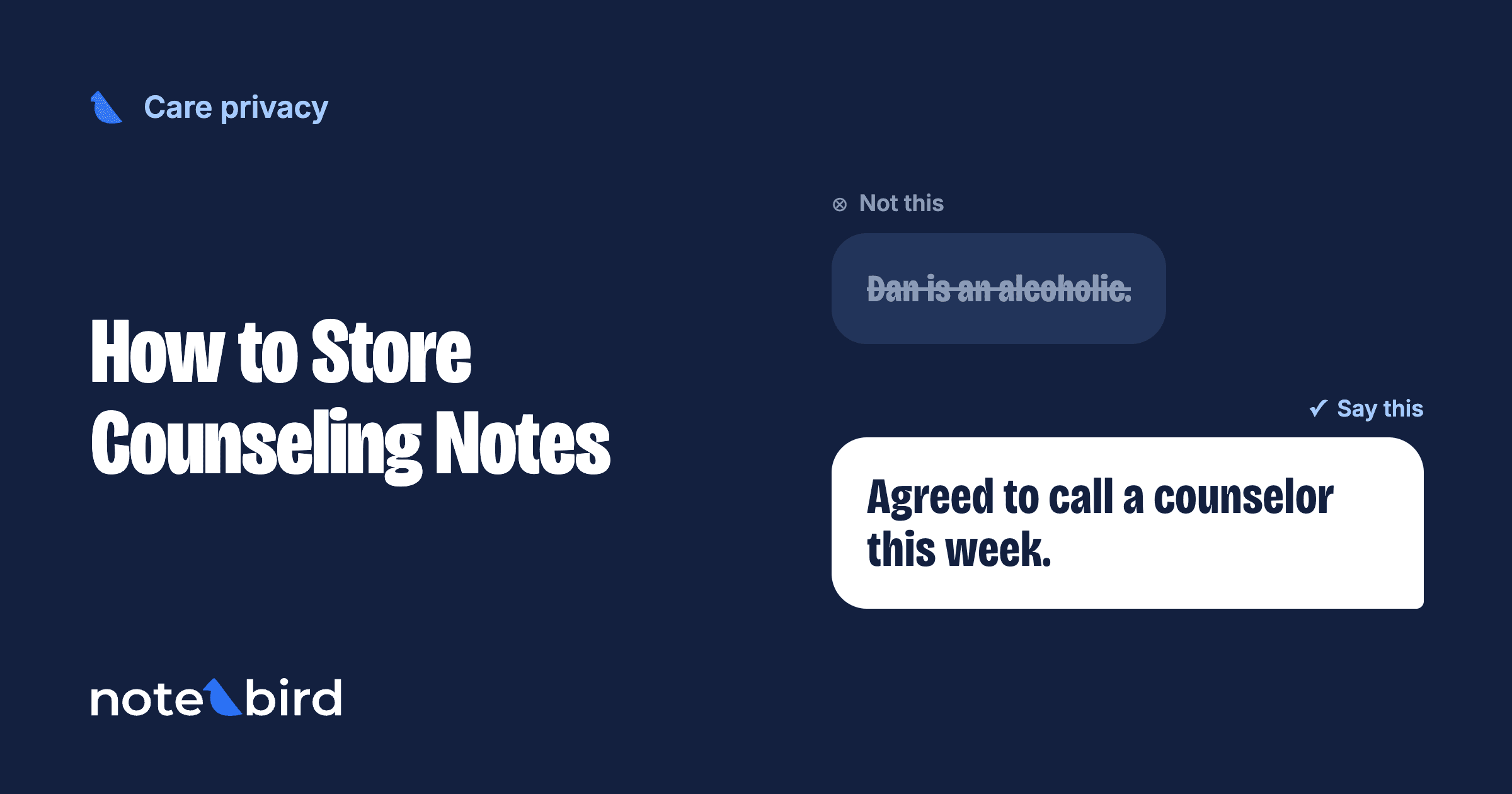
| "Met with Dan. Talked about stress at home and his drinking. He agreed to call a counselor this week." | "Dan is an alcoholic and his marriage is failing." | A label is a diagnosis. You are not qualified to make it, and it can harm him if it is read. |
| "Said she has not slept well since the funeral." | "She seems unstable." | Facts help the next person. Opinions follow a person for years. |
| "Gave the names of two licensed counselors. Follow up on 3/14." | Pages of what each spouse said about the other | A full record of a conflict helps no one and hurts both. |
| "Asked for prayer for a family matter." | The details of the family matter | Write the minimum the next step needs. |
| "Shared a concern for a child's safety. Reported to the state hotline on 3/2, per policy." | Nothing at all | Some things must be recorded. Ask your attorney what your church should keep about a report. |
A few more rules:
- Write after the meeting, not during it. Most people relax when you put the pen down.
- Use their words for health. If they say "my heart thing," write that. Do not add a diagnosis.
- Leave out gossip and anything you heard secondhand.
- Write the next step. "Call Friday." "Meet again in two weeks." "Referred to Dr. Lee."
- Never write down a confession. Many traditions treat confession as sacred. Even where they do not, a list of sins helps no one.
Where to Store Counseling Notes: Five Options
Most churches use one of these. Each has a place, and each has a risk.
| Where | Who can read it | Main risk | Good for |
|---|---|---|---|
| A personal notebook, phone, or email | The pastor, and anyone who finds it | Leaves with the pastor. Lost if the pastor dies or the phone is stolen. | Nothing. Move these notes. |
| Paper in a locked cabinet | Whoever has the key | One copy. No history for the next pastor. Hard to keep a policy. | A small church with one pastor and few notes |
| A shared drive or shared document | Anyone with the link or folder access | Links get forwarded. Access is hard to check and easy to forget when staff change. | General church files, not counseling notes |
| A note category in your church database | Often any staff with access to the person's record | Office staff and volunteers may see more than you want. | Contact details and attendance |
| A pastoral care app with restricted notes | Only the roles you choose | You still need a policy, and you must remove access when people leave. | A team that shares care |
The main question is not "paper or software." It is "Can I name everyone who can read this note, and does each of them need to?" If you cannot answer that for a shared drive, the shared drive is the wrong place.
Who Should See What
Share each fact with the fewest people who need it to give care. Most churches can use a simple split:
| Person | Everyday care notes (visits, calls, meals) | Counseling and sensitive notes |
|---|---|---|
| Senior pastor | Yes | Yes |
| Counseling or care pastor | Yes | Yes |
| One named leader (for example the elder chair) | Yes | Only if your policy names them |
| Other staff | The people they serve | No |
| Deacons, elders, and care volunteers | Only the people they are assigned to | No |
| Office staff and administrators | Contact details only | No |
Two habits make this work. Decide the privacy of each note at the moment you write it, not later. And when a volunteer hears something sensitive, they tell the pastor in person, and the pastor decides what to write. The volunteer does not write it down.
How Long to Keep Counseling Notes
No single rule applies to every church. Write a policy, follow it, and ask your attorney or insurer about records that touch abuse or safety. Our HIPAA and privacy guide has a sample retention table.
For counseling notes in particular:
- Keep fewer notes. A note that was never needed does not need to be kept.
- Review once a year. Delete notes on people who left the church long ago, as your policy allows.
- Never delete after you learn of a lawsuit or an investigation. Ask your attorney first.
- Keep reports of abuse or safety incidents as long as your attorney or insurer says.
What Happens to Notes When a Pastor Leaves
This is where most churches lose control of their notes. A pastor retires, moves, or dies suddenly. If the notes are in a personal notebook or email, two bad things happen: the next pastor has no history, and private notes are now with someone who no longer serves, or with no one at all.
Plan for it now:
- No counseling notes in personal accounts. Make this a written rule for every pastor and staff member.
- Name who holds the notes if the senior pastor dies or cannot serve. Often this is the elder chair or an associate pastor.
- Remove access on the last day. Turn off the account the day a person leaves their role.
- Hand over open care in person. For each person in active counseling, the departing pastor and the new pastor agree who calls them, and when.
- Collect and shred paper the church does not need to keep.
Our guide on handing over pastoral care when a pastor leaves has a full checklist.
Mandatory Reporting: Do Not Promise Total Secrecy
This section is a caution, not legal advice. Ask your attorney what your state requires.
Many states require clergy to report suspected abuse or neglect of a child. Some make every adult a reporter. States differ on whether a confession is exempt. The Child Welfare Information Gateway keeps a state-by-state summary, Clergy as Mandatory Reporters of Child Abuse and Neglect. Read your state's entry before you need it.
Because of these laws, never promise anyone total secrecy. Say this at the start of a hard conversation, not halfway through, so no one feels tricked:
"What you tell me stays private. The one exception is if a child or someone else is in danger. Then I may have to get help."
If someone may harm themselves, stay with them, and call or text 988 in the United States, or 911 if they are in immediate danger. Then tell the senior pastor the same day.
A Simple Counseling Notes Policy
Put these rules on one page. Have every pastor and staff member sign it.
- Counseling notes are written by pastors, not volunteers.
- Notes are short and factual: date, topic in plain words, next step, referral.
- No diagnoses, no confessions, no gossip.
- Notes are kept only in the church's system, never in personal email, phones, or notebooks.
- Only the senior pastor, the counseling pastor, and these named leaders can read them: ____.
- Access ends on the day a person leaves their role.
- Notes are reviewed once a year and deleted as this policy allows, unless a lawsuit or investigation is pending.
- Suspected abuse is reported as state law requires. Ask our attorney: ____.
To build a full care policy around this, start from our pastoral care policy template.
What Is the Safest Software for Church Counseling Notes?
Look for these things, in this order:
- A restricted level for sensitive notes that only a few named leaders can read.
- Role-based access so a volunteer sees only the people they serve.
- Access checked on the server, not only hidden on the screen, so no one can go around the app.
- Two-step sign-in, so a stolen password is not enough.
- Your data stays yours. You can export it, and you know what happens when you cancel.
- Plain limits. The company says what the software is not built for.
Here is how Notebird, pastoral care software for churches, meets that list, including its limits:
- Restricted updates. Only the Organization Owner, Organization Admins, and Care Admins can read a restricted update, its files, and its comments. This is the one privacy level. There are no notes that only the author can see.
- Volunteers see only their groups. A team member with the Group Member role sees only the people in their assigned groups. They cannot read or write restricted updates.
- Server-side rules. Access is checked by security rules on Google Cloud through Firebase, where data is encrypted in transit and at rest.
- Two-step sign-in by text message, for each user who turns it on.
- Export. Download any report as a CSV file, or print it.
- No view log. Notebird does not keep a record of who opened each note.
- Not for HIPAA records. Notebird does not sign Business Associate Agreements, and its Terms ask customers not to store health information that HIPAA protects.
Read the details on our security and privacy page.
When Counseling Notes Belong Somewhere Else
Pastoral counseling is usually short-term care: listening, prayer, wisdom from Scripture, and a referral when someone needs more. If your church runs a counseling center with licensed therapists who bill insurance, those records are clinical records. Keep them in a system built for that work, apart from pastoral care notes.
And when a person needs more help than a pastor should give, refer them. Our guide on when to refer someone to a counselor shows how to do it well.
Guard What They Gave You
People bring the church their hardest days. When what they told you stays with you, they come back with the next hard thing, and they tell their friends the church is a safe place to bring it. Write less, keep it in one place, and let only the right people read it.
If your team shares care and you want sensitive notes kept with the pastors, see how Notebird helps churches follow up without spreading private details, or try it free for 14 days. No credit card is needed.