Pastoral Transition Checklist: How to Hand Over Care
What to hand over when a pastor leaves: people in care, homebound, grief dates, confidential matters with consent, a 30-day timeline, and interim care.
By Thomas Griffin, Owner and CEO
Published
When a pastor leaves, much of what they know about people's care leaves too, unless it is written down. Start a handover at least 30 days before the last Sunday. List everyone in active care, the homebound, grief anniversaries and open follow-ups. Give each person a named carer, and share confidential matters only with consent.
A pastor who has served for years carries a map in their head. They know which widow dreads March, which family is caring for a parent with dementia, and which man asked for prayer about his drinking. On the day the pastor leaves, that map leaves too. A new pastor, sometimes a year later, starts from zero.
If you are the pastor who is leaving, this work can hurt. Each name on the list is also a goodbye. Writing it down is one last way to care for the people you have loved.
This guide shows what knowledge leaves with a pastor, a handover checklist, a 30-day timeline, how to handle confidential matters, and how an interim pastor and the lay team keep care going in the gap.
What Knowledge Leaves With a Pastor
Most churches have the membership list in a database. That is not the hard part. The hard part is everything the pastor knows that is not in the database:
- Who is in active care right now. The man in chemotherapy, the couple whose marriage is in trouble, the teen in a mental health crisis.
- Promises. "I will visit you after your surgery." "I will call on the anniversary."
- Grief dates. The first anniversary of a death, a stillbirth, a child's birthday after a loss.
- The homebound and the hidden. Members in care homes who have not been to worship in years.
- Context. Family tensions, past hurts with the church, who should not be asked to serve together.
- Relationships with outside helpers. Hospital chaplains, funeral directors, a trusted counselor, the care home activities director.
- Who on the care team does what. Which deacon visits which family, and who is faithful with cards.
Without a handover, the people in the middle of a hard season lose their pastor and their care at the same time. The youth ministry sees the same thing with students. See when a youth pastor leaves.
Who Is Most at Risk in a Pastoral Transition
Watch these people closely in the months before and after a pastor leaves:
- People in a current crisis: a new diagnosis, a recent death, a divorce, a job loss.
- The recently bereaved. Their grief can feel new again when the pastor who led the funeral leaves.
- Homebound and care home members. They depended on the pastor's visits and may not hear the news at all.
- People who trusted only the pastor. Someone who shared a secret with one person may not share it again.
- People on the edge. Newer members and occasional attenders can drift during a transition, and in a busy season no one notices.
The Pastoral Care Handover Checklist
Work through this list with the departing pastor, a care team lead, and an elder or deacon. Write the answers down in one place.
People in active care
- Each person in active care, with a one-line summary and the next step.
- A named carer for each person for the next 90 days.
- Any promise the pastor made that is not yet kept.
Homebound and care homes
- Every homebound and care home member, with address, contact person, and visit rhythm.
- Who brings communion, and how often. See our homebound ministry guide.
Grief and milestones
- Every death in the last 12 months, with the date and the closest family members.
- Grief anniversaries in the next year, each with an owner. Our grief care calendar shows what to do each month.
- Upcoming weddings, baptisms, and funerals already planned.
Open follow-ups
- Every open task, call, or visit, with a name and a date.
- Members who stopped coming in the last six months.
Outside contacts
- Hospital chaplains, funeral homes, care homes, and counselors the pastor uses.
- Denominational contacts for crisis and pastoral emergencies.
Confidential matters (only with consent)
- A list of people the pastor has asked for consent to share, and their answers.
- For those who said no, only a note that they would welcome a visit.
The care team and the records
- Who is on the care team, deacon board, or visitation team, and their lists.
- Where care records live, who can access them, and who owns the logins.
- How members ask for care in the gap: one phone number or email.
How to Handle Confidential Matters
Some of the most important care is the most private. A departing pastor may know about an affair, an addiction, a mental health crisis, or a family secret. That knowledge does not belong to the church. It belongs to the person who shared it.
Ask for consent, one person at a time. A short visit or call works:
"As you know, I am leaving at the end of next month. I want to make sure you keep getting care. May I tell the next pastor, or our care team lead, about what you are going through? I will share only what you are OK with."
Then follow these rules:
- If they say yes, ask what to share and with whom. Write it down plainly and keep it with the people who need it.
- If they say no, respect that. Hand over only that this person "would welcome a visit from the new pastor."
- If you cannot reach them, do not share. Name a carer for a general check-in.
- Legal duties do not wait. Suspected abuse of a child or a vulnerable adult must be reported under the law and your church policy, before or during any transition.
- Do not pass along impressions. "I think he is drinking again" is a rumor, not a handover.
If your church keeps care notes in software, keep these notes in a restricted area. In Notebird, a restricted update can be read only by the Organization Owner, Organization Admins and Care Admins.
A 30-Day Handover Timeline
Thirty days is enough for a good handover if you start on time. Give each row an owner the week the pastor resigns.
| When | What to do | Who |
|---|---|---|
| Day 30 (or the week of the announcement) | Name a handover lead. Start the checklist. Decide who covers crises in the gap. | Elders or board, departing pastor |
| Day 25 | List everyone in active care, the homebound, and the last 12 months of deaths. | Departing pastor, care team lead |
| Day 21 | Ask for consent on confidential matters, one person at a time. | Departing pastor |
| Day 14 | Give each person in active care a named carer. Introduce the carer by phone or in a joint visit. | Departing pastor, care team |
| Day 10 | Visit or call the homebound and the recently bereaved. Tell them who will care for them next. | Departing pastor |
| Day 7 | Put every grief anniversary and open follow-up on a calendar or task list with an owner. | Care team lead |
| Last Sunday | Tell the congregation who to call for care, by name and number. Pray for the people in care. | Elders, departing pastor |
| Week after | Interim or lay team calls everyone in active care. "I am your contact now." | Interim, care team |
| Day 30 after | Review the list. Did each person get a call? Who has slipped? | Care team lead, elders |
If the pastor leaves suddenly, for example after a health crisis or a dismissal, start at day 25 the same week. The care team lead and an elder can rebuild most of the list from records, the prayer list, and the funeral records.
How an Interim Pastor and the Lay Team Cover Care
The gap between pastors can be long. A Lifeway article on transitional ministry says the average church goes "between 6 and 18 months" without a pastor. That is too long for care to wait.
A simple split works in many churches:
| Care need | Who covers it in the gap |
|---|---|
| Crisis visits, deaths, hospital calls | Interim pastor, or a nearby pastor until the interim starts |
| Funerals and weddings | Interim pastor, or a retired pastor in the church's tradition |
| Homebound visits and communion | Deacons or the visitation team, with the interim each quarter |
| Grief calls and anniversaries | Care team, from the written calendar |
| Members who stopped coming | Group leaders and the care team |
| Weekly check on the whole list | Care team lead, 20 minutes each week |
Meet as a care team every two weeks in the first three months. Ask three questions: Who is in active care? Who has not heard from anyone? What does the interim need to know?
The interim pastor also carries a quieter care need: the congregation's grief over the departing pastor. Make room for it. A farewell service, a time to say thank you, and an interim who names the loss from the pulpit help people grieve, and then make room for someone new.
What the Departing Pastor Should Not Do After Leaving
Care also needs a clean ending. Many denominations ask former pastors to step back so members can bond with the next pastor. The Episcopal Diocese of Minnesota's priest leavetaking guidance asks a departing priest to "accept no further requests from members and former members of the congregation" for pastoral services for at least one year, and to redirect anyone who asks to the current priest.
That can feel harsh to a family who wants their old pastor at a funeral. Explain it with love before the last Sunday: "I love you, and that is why I am stepping back. Your new pastor needs the chance to care for you." Ask your own denomination for its guidance.
The First 90 Days for the New Pastor
When the new pastor arrives, the handover gets its real test. Help them start with people, not programs:
- Read the care history for everyone in active care before the first Sunday.
- Visit the most vulnerable first: the homebound, the recently bereaved, anyone in crisis.
- Meet the care team and learn who covers whom.
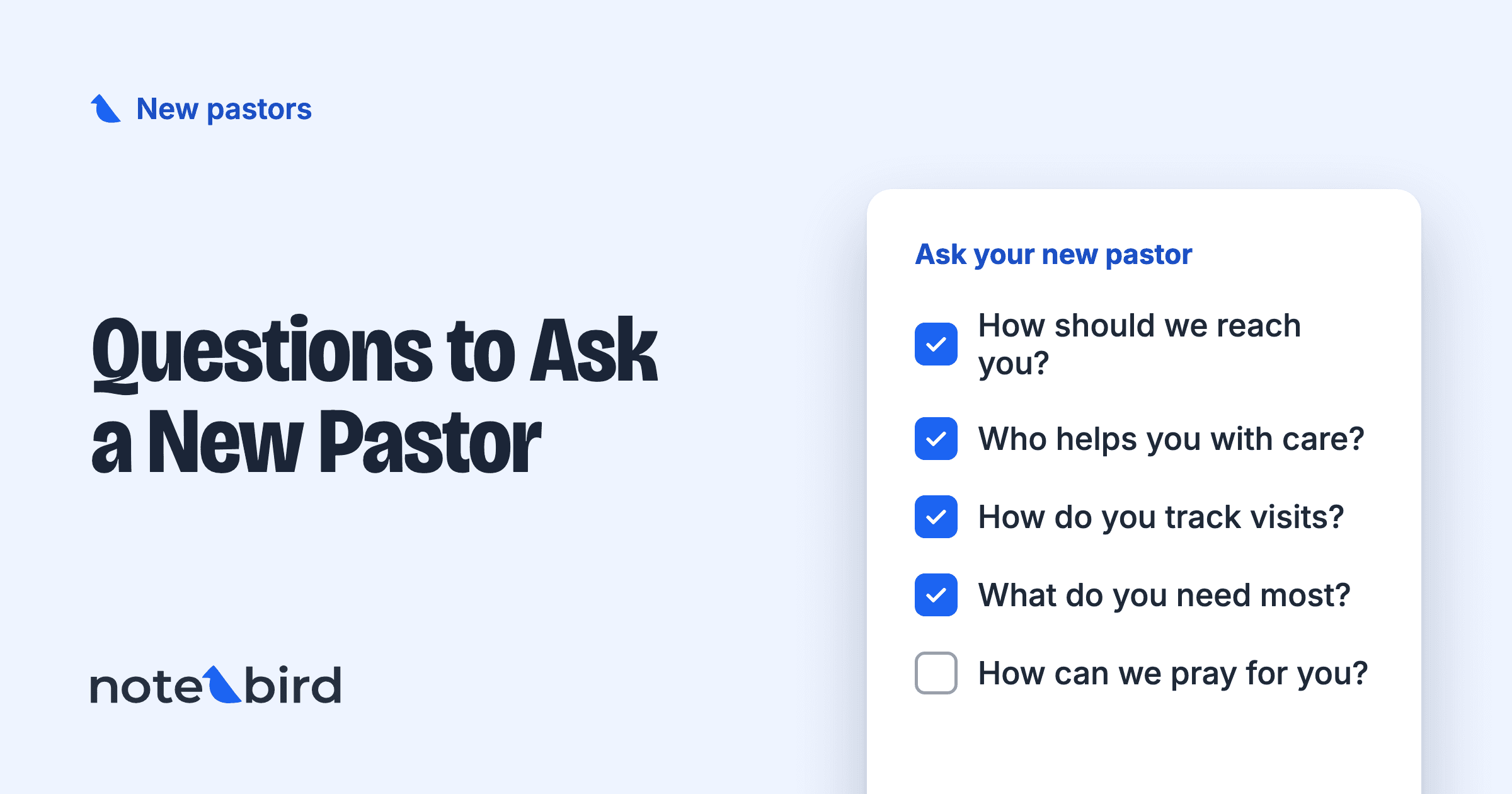
- Ask the four care questions. Our guide 4 pastoral care questions to ask lists what a new pastor should ask in the first month.
- Keep the grief calendar going. A widow should not spend the first anniversary of her husband's death wondering if the new pastor even knows his name.
A Written Care History Keeps Care Going
Pastors come and go. The people in their care stay. A church that writes care down, as it happens, does not need a frantic handover month. The history is already there for the next pastor, the interim, and the deacon who covers the gap. To see how churches keep one shared care history with Notebird, read about church follow-up software, or see how to build a pastoral care team that can carry care through a change.