Elder Shepherding Plan: How to Assign and Track Every Household
Organize elder shepherding lists: 15 to 25 households per elder, a monthly contact rhythm, what to record, a report to the board, and a printable list.
By Thomas Griffin, Owner and CEO
Published
To organize elder shepherding in a 300-member church, count households, not people, and give each elder 15 to 25 households. Each elder contacts every household once a month, writes a short note, and brings needs to the elder meeting. A care app such as Notebird gives each elder their own list, a monthly reminder, and a record of each contact.
Many elder boards start with good intentions and a spreadsheet. Six months later, nobody is sure who called the Martins, and one elder has carried 40 families while another has 8. This guide shows how to build lists that last: how to divide the church, what each elder does each month, what they write down, how they report, and what to do when an elder is away.
Why Elders Shepherd
The New Testament gives elders a plain charge. Peter writes to elders: "Be shepherds of God's flock that is under your care, watching over them," and "not lording it over those entrusted to you, but being examples to the flock" (1 Peter 5:2-3). Hebrews says that church leaders "keep watch over you as those who must give an account" (Hebrews 13:17).
You cannot give an account for people you do not know. A shepherding list turns "the elders care for the church" into "Elder Tom cares for these 18 households, by name." Every member knows who their elder is, and every elder knows who is theirs.
Many elders also carry a heavy feeling: the sense that someone is slipping away and nobody noticed. A clear list does not remove that weight, but it shares it, and it shows where the gaps are.
Count Households, Not People
Start with households. One call to the Garcia home reaches Ana, Luis, and the two teenagers. If you count people, a 300-member church looks like a load no elder board can carry. Count households, and the work gets smaller and clearer.
A church of 300 members might have about 110 to 140 households, depending on how many families and how many people who live alone. Count your own from your church directory. Then sort them:
- Families with children at home. Contact a parent. Ask about each child by name.
- Couples. Contact both when you can.
- People who live alone. Widows, widowers, single adults, and college students away from home. They often need contact the most and get it the least.
- Homebound members and those in care homes. These need visits, not only calls.
- Regular attenders who are not members. Decide as a board whether elders shepherd them too. Many churches include them.
How Many Households Should Each Elder Have?
Most elders can care well for 15 to 25 households. At 20 households, one call each month is about one call each weekday evening for a month, or two hours on a Saturday. Past about 25, monthly contact starts to slip.
For a church of about 120 households:
| Number of elders | Households per elder | Is it workable? |
|---|---|---|
| 4 | 30 | Too many. Add elders or helpers. |
| 5 | 24 | Workable for experienced elders with stable lists |
| 6 | 20 | A good fit for most churches |
| 8 | 15 | Room for high-need households and new elders |
Bob Johnson, a pastor in Michigan, describes in a 9Marks article how his church first gave each elder 75 to 80 members, found it was too many, and added elders until each had about 50 to 55 (Not Satisfied with Our Shepherding Yet). Fifty members is close to 20 households for many churches. The lesson is the same: start smaller than you think, and add shepherds before you add households.
If you do not have enough elders, do not spread them thin. Some churches pair each elder with a trained helper, often a deacon or a mature member, who makes half the monthly calls. Our guide to deacon care ministry shows how deacons can share the load.
How to Assign Households to Elders
The elders can do this in one long meeting.
- Print the household list. Use your church directory or management system. One line per household.
- Mark the high-need households. Homebound, widowed in the last two years, serious illness, a recent death, new members, and anyone who has stopped coming.
- Spread the high-need households first. No elder should get all the widows or all the hard cases. Two or three high-need households per elder is enough.
- Use friendships. Give each elder households they already know from a small group, a Sunday school class, or the neighborhood. A known face makes the first call easier.
- Think about distance for the homebound and the care homes.
- Avoid conflicts. Do not assign an elder to their own relatives, their employer, or a family in conflict with them.
- Name a partner elder for each elder, who covers the list when they are away.
- Tell each household. In the first month, each elder calls or writes: "Hi, this is Tom Reyes. I am one of the elders, and I will be praying for your family by name this year. If you ever need anything, call me. How can I pray for you this week?"
Many churches also post the list on a bulletin board or print it in the directory, so every member knows their elder's name and phone number.
Review the lists once a year, and when an elder joins or rotates off.
A Monthly Contact Rhythm for Elders
A steady, plain rhythm does more good than a big program that fades. Here is one month for an elder with 20 households:
| When | What to do | Who |
|---|---|---|
| Week 1 | Pray through the list by name. Check birthdays, anniversaries, and the anniversary of any death this month. | Elder |
| Weeks 1 to 3 | Call, text, or visit each household once. Visit the homebound and anyone sick or grieving. | Elder |
| Same day, any week | Tell the pastor about a death, a hospital stay, a crisis, or a safety concern. | Elder |
| Week 4 | Log any contacts not yet written down. Try a second time for anyone not reached. | Elder |
| Monthly elder meeting | Pray for needs. Look at households with no contact in 60 days. Move stuck needs to the right person. | Elder board, pastor |
| Each year | Review the lists. Thank each elder. Hear from members what helped. | Pastor, elder chair |
Most calls are short. "Hi, it is Tom from church. I was praying for your family this morning and wanted to check in. How are things?" Then listen. Most calls take five minutes. Now and then, one takes an hour, and that call is why the other nineteen matter.
Visit in person a few times a year, and always after a death, a birth, or a hospital stay. A cup of coffee at the kitchen table tells a family more than any phone call can.
What Elders Should Record After Each Contact
A short note is how the next elder, the pastor, and the board know what happened. Keep it to two or three lines:
- Date and type: "Call, Nov 3."
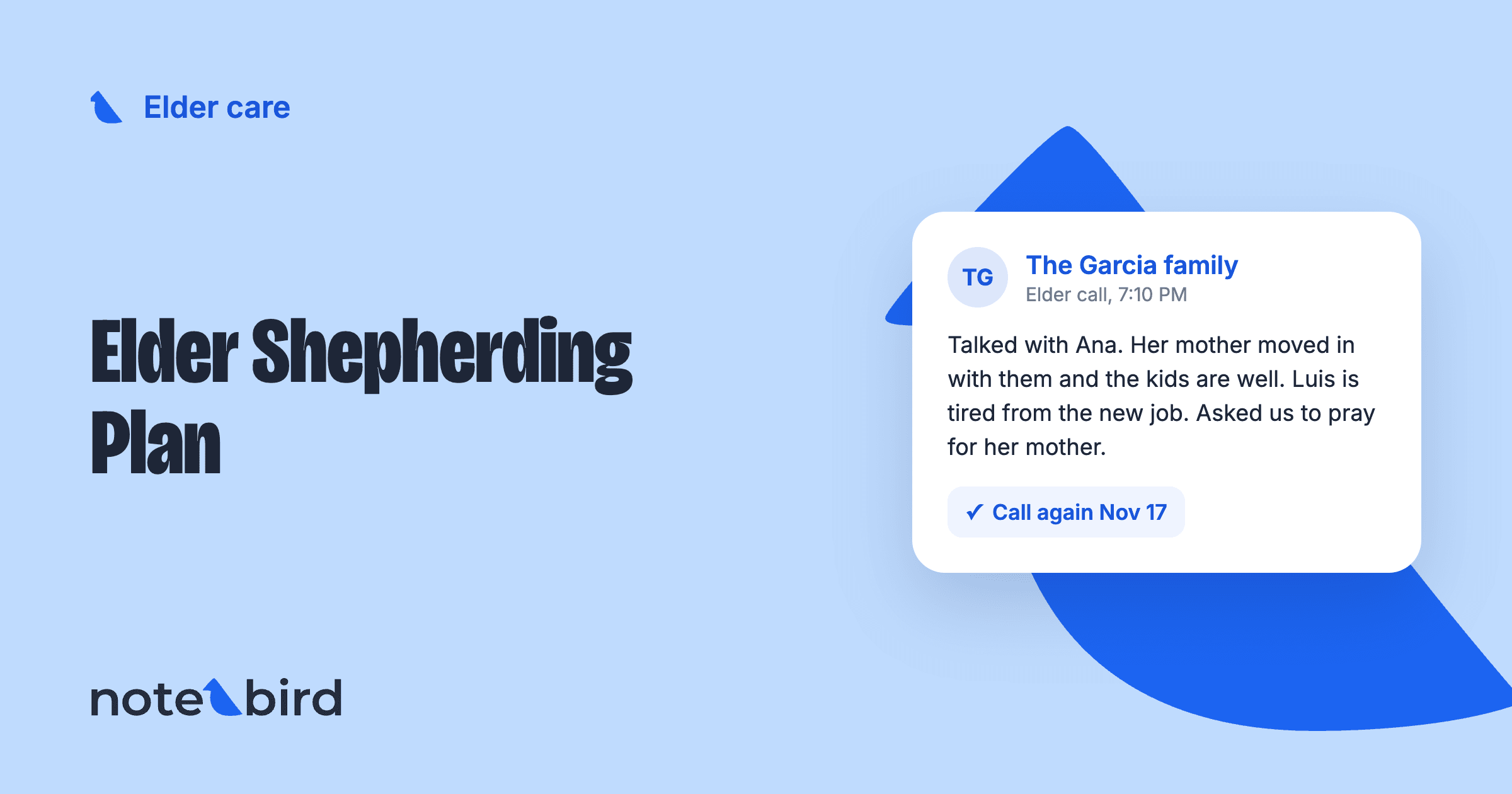
- How they are: "Ana's mother moved in with them. The kids are well. Luis is tired from the new job."
- Prayer, with permission: "Asked us to pray for her mother's health."
- Next step: "Call again in two weeks. Ask the deacons about a ride for her mother on Sundays."
Leave out gossip, guesses, and medical details the family did not offer. Write each note as if the family could read it.
Some things do not belong in an elder's note at all. Abuse, addiction, marriage trouble, thoughts of suicide, and legal trouble go to the pastor the same day, in person or by phone. If a record is needed, the pastor writes it with the right privacy. Our guide on how to store confidential pastoral counseling notes explains how.
How Elders Report to the Elder Board
Each elder brings a short report to the monthly meeting. It takes five minutes to write and keeps the board from guessing:
- Households contacted this month: 17 of 20.
- Not reached: The Parks. Two calls, no answer. Will stop by after church.
- Needs for the pastor: Ruth Ellis lost her job and may need help with rent.
- Prayer needs, with permission: Luis Garcia's new job. Grace Kim's surgery on the 14th.
- Good news: The Adeyemis joined a small group.
- Help I need: Someone to visit Harold at the care home while I travel next month.
Report counts and needs, not private details. Then spend the meeting on the households that need the board's attention, not on reading every note aloud. The question that matters most is "Who has gone 60 days or more with no contact, and who will call them this week?"
For a full monthly and yearly template, read our guide on how to report pastoral care to your board.
A Printable Elder Shepherding List
Give each elder a one-page list. A paper copy in a Bible or on the fridge gets used. Here is a format that works:
| Household | People | What to know | Last contact | Next step |
|---|---|---|---|---|
| Garcia | Luis, Ana, Sofia (15), Mateo (12) | Ana's mother moved in | Nov 3, call | Call Nov 17 |
| Ruth Ellis | Lives alone | Lost job in October | Nov 5, visit | Tell pastor about benevolence fund |
| Harold Benson | Maple Grove care home | Does not drive. Hard of hearing. | Oct 28, visit | Visit before Thanksgiving |
| Parks | Dan, Lisa | Not at church since August | Oct 2, call | Stop by after church |
| Kim | James, Grace | Grace has surgery Nov 14 | Nov 1, text | Call the day after surgery |
Print a fresh copy each month, with the last contact dates filled in. An elder who sees "Oct 2" next to a name does not need a reminder from anyone.
Keep the list private. It goes to the elder and the pastor, not to the whole board or the church.
What to Do When an Elder Is Out
Elders get sick, travel, have a new baby, or go through their own hard season. Plan for it before it happens.
- A short absence (a few weeks). The partner elder covers the list. The away elder sends a two-line note on anyone with an open need.
- A long absence (a few months). Move the households to the partner or to another elder for that time. Tell each household who their elder is for now.
- An elder rotates off. Hand over the list in person, with a short note on each household. The new elder makes the first contact within two weeks.
- An elder goes quiet. Ask privately how they are. Life gets heavy. Offer fewer households or a season off. Do not shame them in the meeting.
- An elder needs care. Elders are sheep too. Make sure someone shepherds each elder's own family.
The rule under all of these: no household goes a full month without someone who knows it is theirs.
What App Works for Elder Shepherding?
You can start with paper and a shared spreadsheet. It works for a few months with three or four elders. It breaks down when the spreadsheet has six versions, nobody updated the "last contact" column, and private notes sit in a file that anyone with the link can open.
A church management system can hold the household list, but its notes are often visible to more staff than you want, and it may not remind each elder who is due.
A pastoral care app is built for this job. Notebird is pastoral care software that many churches use for elder and deacon care. Here is how an elder shepherding plan fits:
- One group for each elder. Name it "Elder Tom: Households" and add his households to it. Give Tom the Group Member role, and he sees only the people in his group, and no one else in the church. If an elder also needs to look up other members in the directory, the Care Member role lets them do that while they manage only their own group.
- A monthly task for each household. Pick up to 20 people at once and make one call task that repeats every month. Each person gets their own repeating task, assigned to their elder.
- A morning reminder. Each elder's Early Bird Report lists the calls due today and any that are overdue. Each Monday it also suggests a few people from their group who have had no contact in 30 days or more.
- A note in a few seconds. The elder logs the call or visit from a phone, and the next elder sees the history.
- A board view. In Reports, filter the People report by an elder's group and sort by Last Updated to see who has gone longest without contact. Care reports filter by date, type, group, or who logged the update, and print or export to CSV.
- Private notes stay private. A restricted update can be read only by the Organization Owner, Organization Admins, and Care Admins. An elder with the Group Member role cannot read it, even for their own households. To let the lead pastor and the elder chair read those notes, give them the Care Admin role.
One cost to plan for: each elder who logs in is a paid user. Some churches give every elder a login. Others give logins to the pastor and the elder chair, and elders send their monthly contacts to the chair. See pricing for the current cost per user. Every feature is on every plan.
Keep Watch, Together
Shepherding is not a program. It is a promise that every household has an elder who knows their name and will notice when something changes. A clear list, a monthly rhythm, and a short note keep that promise when life gets busy.
To see how one group per elder and a monthly reminder look in practice, read about groups in Notebird, or try Notebird free for 14 days with your elders. No credit card is needed.