Who Hasn't Been Visited? How to Find Members Who Slip Through the Cracks
How to see which members nobody has visited or called lately: attendance, a last-contact date, a care rhythm by group, and a 20-minute weekly review.
By Thomas Griffin, Owner and CEO
Published
To find members who have not been visited, keep one list of your people with the date of each person's last real contact, and sort it by the oldest date. Then check attendance and each care group against a set rhythm. Review the list every week, give each name an owner, and record each contact, so the list stays true.
Pastors ask us a simple question all the time: how do you see who has not been visited recently? Most pastors cannot answer it without a long search through notes, texts, and memory. And many churches say it plainly: they feel people are falling through the cracks.
This guide shows why people slip, three simple ways to find them, a weekly habit that keeps the list short, and how to give each follow-up an owner.
Why Members Slip Through the Cracks
People seldom leave a church or synagogue in one loud moment. They drift. In a 2006 Lifeway Research study of formerly churched adults, 59 percent said they left because of "changes in life situation." Then 16 percent said "nobody contacted me after I left," and another 16 percent said "nobody seemed to care that I left."
That is a care problem, and it is a memory problem. Nobody chose to ignore those people. Each person on the team thought somebody else had called.
The people most likely to slip are often the people who need care most:
- Homebound members and people in assisted living. They do not come on Sunday, so attendance never flags them.
- The recently bereaved. The house is full for a week. After the funeral, the calls stop.
- Caregivers. They are busy caring for a spouse or a parent, and they do not ask for help.
- New members. They have no close friends yet, so nobody notices when they stop coming.
- The faithful middle. They are not in crisis and not in leadership. They are easy to forget.
The cost is real. The CDC says older adults are more at risk for social isolation, and that chronic illness, disability, and the death of a loved one raise the risk. It links isolation and loneliness to heart disease, depression, dementia, and early death. A call from someone at church can be one of the few calls a lonely person gets all week.
Three Simple Ways to Find Who Has Not Been Visited
You do not need a big system. You need one of these three views, and the habit to look at it.
1. Check Attendance
Attendance is the fastest signal for people who usually come. Each week, list anyone who has missed three Sundays in a row. A short call in week three is easy. A call in month six is awkward for both of you.
Attendance has one blind spot: it misses everyone who cannot come. Homebound members, people in the hospital, and members who moved to a care home never show up as "missed." They need the next two views.
2. Track the Last-Contact Date
Keep one date for each person: the last time someone from the church had a real contact with them. A visit counts. A phone call, a card, a text, or a meal counts. Seeing them across the room on Sunday does not count.
A spreadsheet works for a small church. Put each person on a row with columns for Name, Group, Last contact, By whom, and Next step. Sort by "Last contact," oldest first. The names at the top are your answer to "who hasn't been visited?"
The weak point is upkeep. The date is only true if every caller updates it. If your team logs care in a shared app instead, the date updates itself each time someone records a visit.
3. Set a Care Rhythm by Group
Not everyone needs the same amount of contact. A care rhythm says how often each group should hear from you. Then "overdue" has a clear meaning. Here is a starting point. Change it to fit your church.
| Group | Contact rhythm | Example |
|---|---|---|
| Homebound and care home members | Call every week, visit every month | Communion visit on the first Tuesday |
| In the hospital or after surgery | Within 48 hours, then each week until recovered | Call the day after discharge |
| Recently bereaved | Every week for the first month, then every month for a year | Call on the first anniversary of the death |
| New members | Within the first 30 days | Coffee with an elder |
| Members who missed 3 Sundays | Within one week | "You came to mind" call |
| All other members | At least every 3 to 6 months | Birthday call or card |
For more on the people who are easy to miss, read the 4 people to check in with and our homebound ministry guide.
A 20-Minute Weekly Review
A list helps only if someone looks at it. Pick a time each week, such as Monday morning, and follow these steps:
- Open your list sorted by last contact, oldest first.
- Mark the overdue names. Use your care rhythm. A homebound member with no call in 10 days is overdue. A healthy member with no contact in 5 months is overdue.
- Add the attendance names. Anyone who missed three Sundays goes on the list.
- Pick a small number. Choose 3 to 5 names for each person on the team. A short list gets done. A list of 40 does not.
- Give each name an owner and a day. "Dave calls Carol by Thursday."
- Check last week's names. Did each call happen? If not, move the name to this week and keep the same owner, or ask why it is stuck.
- Record what you learned. A new need, a prayer request, or a hospital stay goes in the person's record, with the next step.
If your team meets each week, do the review in the first 20 minutes of that meeting. If you are a solo pastor, put it on your calendar like any other appointment.
How to Assign Follow-Ups So They Get Done
Most missed care is not a missed list. It is a name that nobody owned. These rules keep each name moving:
- One name, one owner. "The deacons will call" means nobody will call. Write one person's name next to each follow-up.
- One date. "Soon" is not a date. "By Thursday" is.
- Spread the load. The pastor should not hold every call. Deacons, elders, and trained volunteers can make most check-in calls. See how to build a pastoral care team.
- Close the loop. A follow-up is done when the contact is recorded, not when it is made. Write one or two lines, so the next person knows what happened.
- Pass serious needs up. A volunteer who hears about a crisis, abuse, or thoughts of suicide should tell the pastor the same day.
For more ideas, read our list of pastoral care follow-ups.
What to Say When You Call Someone You Have Not Seen
People who have drifted often feel a little ashamed. Your first words decide if they relax or brace. Do not ask where they have been. Tell them they came to mind.
- Opening: "Hi Carol, this is Dave from church. You came to mind this week, and I wanted to see how you are doing."
- If they mention a hard season: "I am sorry. I did not know. Thank you for telling me. What has been the hardest part?"
- If they apologize for being away: "No need to apologize. We miss you, and I wanted you to know that."
- Before you hang up: "Is there anything I can pray about for you this week?"
- If there is a need: "Would it help if someone brought a meal on Thursday?" Offer one specific thing. "Let me know if you need anything" seldom gets a call back.
After the call, record the date, what they shared, and the next step. That record keeps the next caller from asking the same questions.
How Notebird Shows You Who Has Not Been Visited
A spreadsheet can work, but it depends on every caller updating it. In Notebird, the date updates itself each time someone on your team logs care. Here is what you see.
The People list, sorted by "Last updated." People with the oldest care come first, and people with no care at all are at the top. Each row shows "Last updated" with the date, or "No updates or tasks yet."
Pulse indicators. A red bar marks people who are slipping out of care. By default, the bar is faded red after 30 days without an update or task, and red after 90 days. An admin can change both numbers in Settings, under Custom time ranges, to match your care rhythm.
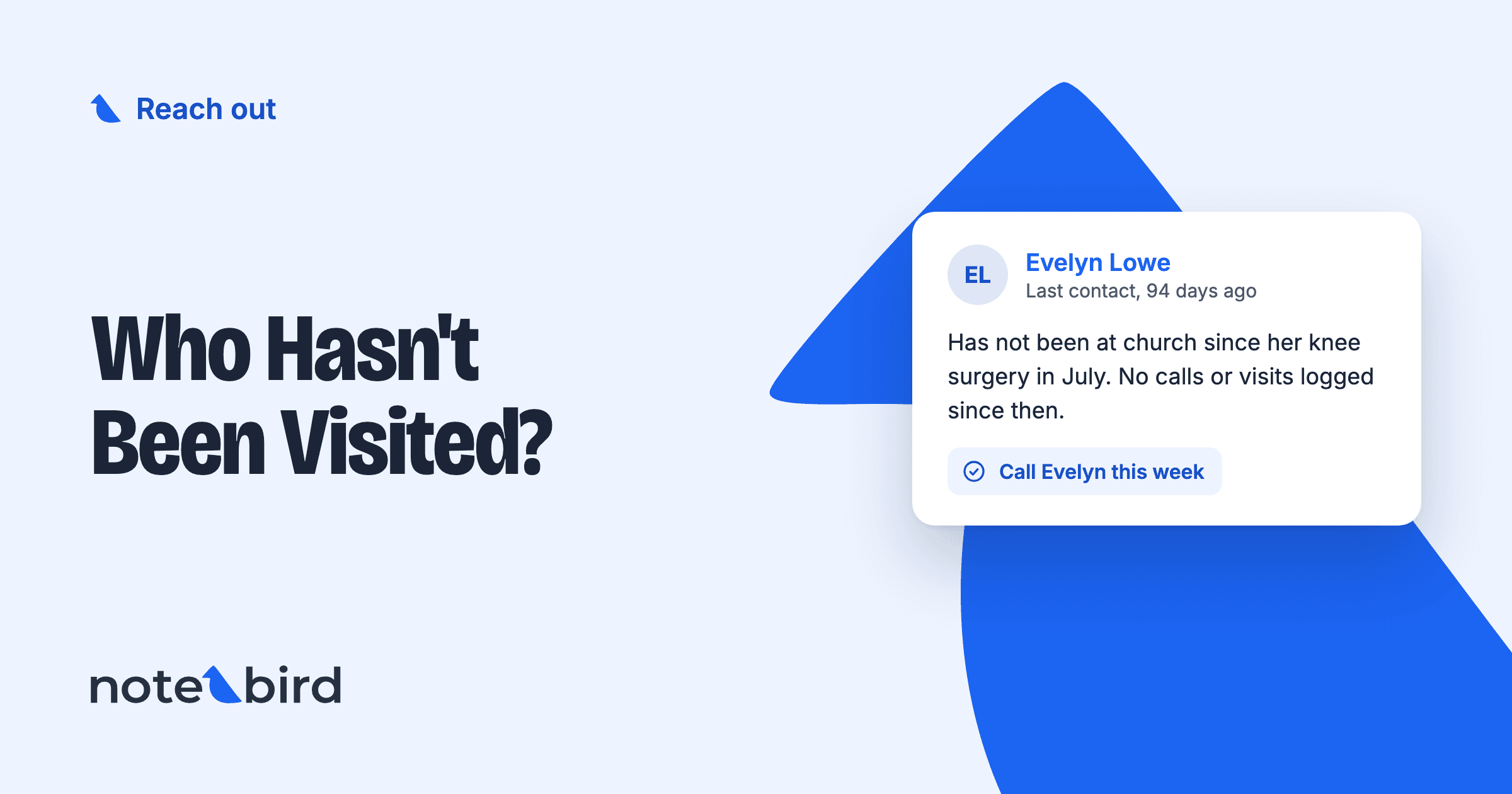
Reach out, in the Early Bird Report. Each Monday, Notebird picks a few people for each person on your team to check in with. By default it picks 3 people who had no update in 30 or more days. People you follow come first, then members and regular attenders. Each teammate gets different names. Each name has Call, Text, and Email buttons. When anyone on the team adds an update or a task for that person, the name is checked off the next morning. Admins set the number of people per week (1 to 5), how far back to look, and which groups or membership types to leave out, such as staff.
The Early Bird Report itself. Each morning, at the hour each person picks, Notebird sends a report to the app inbox, to email, or both. It shows overdue tasks, tasks due today, today's milestones, the Reach out list, and yesterday's updates. Each person sees only what they have access to.
Tasks with an owner. "Call Carol by Thursday" becomes a task with a name and a due date. It stays on that person's list, and on the Early Bird Report, until it is done.
The question "who hasn't been visited?" should take seconds to answer, not an afternoon. Start a free 14-day trial and see your own list on day one.