Parish Nurse Visit Log: What to Record and Where to Keep It
A visitation log for parish and faith community nurses: the fields to record, nursing record vs. church care log, privacy limits, and a weekly rhythm.
By Thomas Griffin, Owner and CEO
Published
A parish nurse visit log records each contact: the date, the person, the type of contact, what was done, the follow-up due, and any referral. Clinical details belong in a nursing record kept to nursing standards. Church care software, such as Notebird, can hold the pastoral side: that a visit was made and what comes next.
If you are a parish nurse, you already know that you wear two hats. You are a registered nurse with professional duties. You are also part of your church's care team, alongside the pastor, deacons, and visitors. A good log respects both. This guide shows you what to record, where each part belongs, and a weekly rhythm that keeps the log from piling up.
What Is a Faith Community Nurse?
A faith community nurse is a registered nurse who cares for the health of people in a church, synagogue, or other faith community. "Parish nurse" is the older name, and many congregations still use it. The work often includes home and hospital visits, blood pressure checks, health classes, help with medicines and appointments, and referrals to doctors and community services.
Faith community nursing is a nursing specialty. The American Nurses Association publishes Faith Community Nursing: Scope and Standards of Practice, now in its fourth edition. The Westberg Institute, which calls itself the heart of the faith community nursing movement, offers a 36.5-hour course, Foundations of Faith Community Nursing, that "fulfills the educational requirement for entry into practice in faith community nursing."
That professional status shapes how you keep records.
Why a Nurse's Log Is Different From a Pastor's Notes
When a pastor visits a member in the hospital, the pastor's note is a pastoral record. It helps the church remember and follow up. When you visit as a nurse, your record may be a nursing record, with duties that come from your license.
The Westberg Institute's position statement on documentation puts it plainly: "All nurses must document care provision to be compliant with laws and regulations governing the profession regardless of specialty or compensation (paid or unpaid)."
The same statement lists what the record should show:
- when (date and time) services were given;
- what services or care the person received;
- how the person responded;
- who provided the services;
- whether you communicated with or referred to other providers.
It also says that every faith community nursing ministry needs "a written policy that states who (health care organization or the FCN) is the custodian" of the records, and that records "should be safely stored for seven years." If a hospital or health system employs you, it keeps the records. If you serve a church without a formal health care partner, paid or unpaid, the statement says you are responsible for keeping them.
Laws differ from state to state. Check your state's nurse practice act and your employer's policy, and talk with your pastor about where the records will live before you start.
Two Records: The Nursing Record and the Church Care Log
The simplest way to stay safe is to keep two records, each with its own job.
| Nursing record | Church care log | |
|---|---|---|
| Purpose | Your professional record of nursing care | Helps the church remember who needs care and what is next |
| Who reads it | You, and others only as your policy and the law allow | The pastor and the church care team |
| What goes in | Assessment, interventions, readings, medicines, response, outcomes | Visit made, type of contact, follow-up due, prayer request, referral made |
| Where it lives | A secure system or locked file your record keeper approves | Your church's pastoral care system |
| How long it is kept | As your policy and state law say (Westberg suggests seven years) | As your church's care policy says |
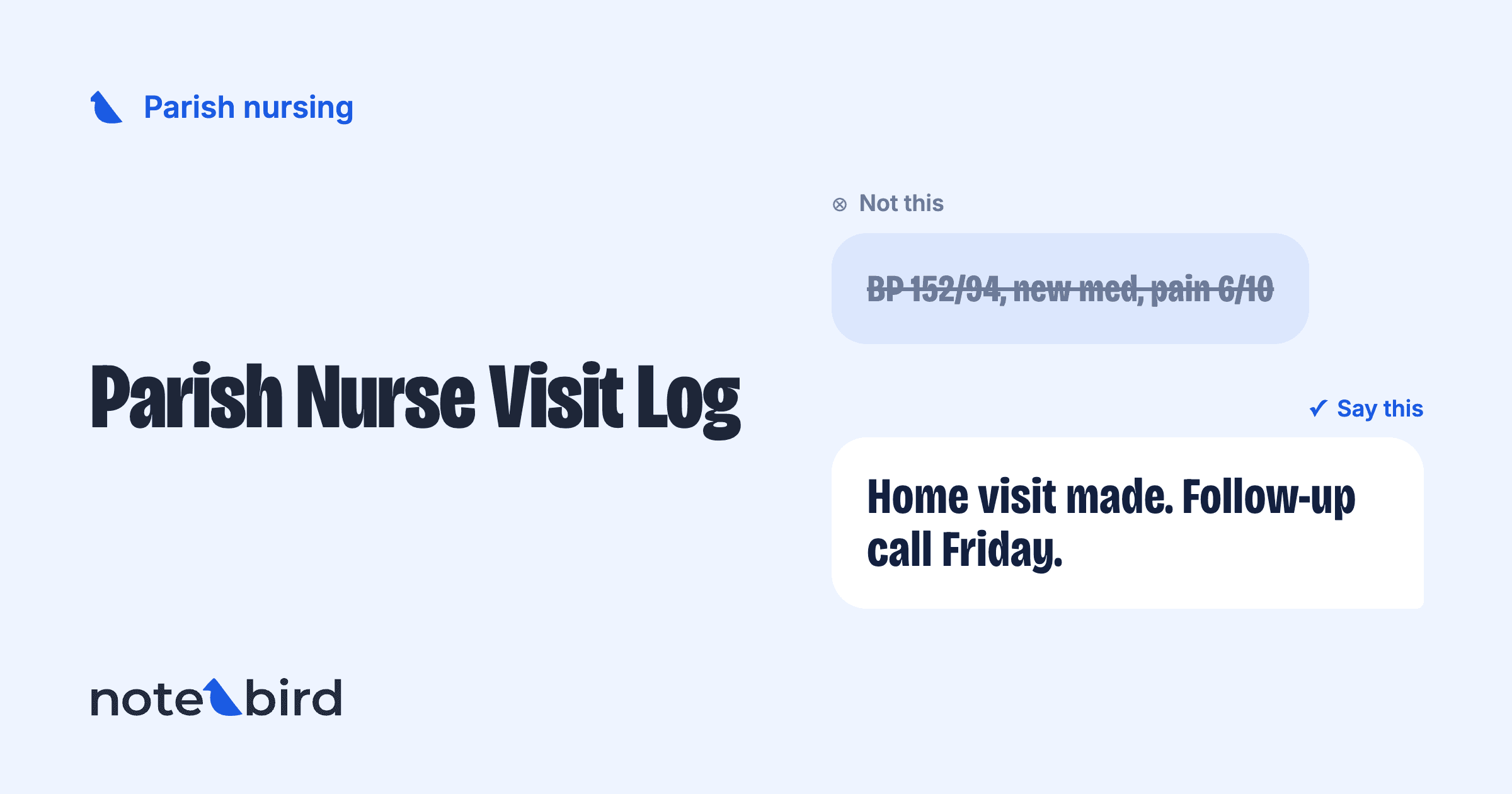
The church care log is not a smaller copy of the nursing record. It is a different record. A line like "Visited Helen at home. Follow-up call Friday. She asked for a visit from Pastor Mark." helps the pastor do their part, and it tells no one her blood pressure.
The Fields of a Parish Nurse Visit Log
Here are the fields to track for each contact, and where each one belongs.
| Field | Example | Nursing record | Church care log |
|---|---|---|---|
| Date and time | Tue, Mar 4, 10:30 AM | Yes | Date only |
| Person | Helen Ortiz | Yes | Yes |
| Type of contact | Home visit | Yes | Yes |
| Reason for the visit | Home after hip surgery | Yes, in clinical terms | In plain words, only if the person agrees |
| What you did | Assessment, teaching, medicine review | Yes | No |
| How the person responded | Readings, understanding, mood | Yes | No |
| Spiritual or emotional need | Asked for prayer, feels alone | Yes | Yes, as a prayer request or a note for the pastor |
| Follow-up due | Call Friday, visit next Tuesday | Yes | Yes |
| Referral | Home health agency, doctor, pastor, meals team | Yes | Yes, the referral only |
| Who made the contact | Nurse Joan Park, RN | Yes | Yes |
Types of contact that many parish nurses log:
- home visit;
- hospital or care facility visit;
- phone call or text;
- office visit at the church;
- blood pressure check or health screening;
- health class or support group;
- referral made;
- help at an appointment or with a form.
Use the same short names each time. It makes your monthly count easy.
What Not to Put in the Church Care Log
Your pastor and care team want to help. They do not need your clinical notes to do it. Leave these out of the church log:
- diagnoses, unless the person asks you to share them;
- medicine names and doses;
- blood pressure, blood sugar, weight, and other readings;
- test results;
- mental health or addiction details;
- anything the person told you as their nurse and did not want shared.
A fair test: if the person read this line over the pastor's shoulder, would they feel cared for, or exposed?
A Word About HIPAA
Most churches are not HIPAA covered entities, so HIPAA usually does not apply to a pastor's care notes. But a parish nurse who works for, or partners with, a hospital or clinic may be part of a covered entity, and their records may be under HIPAA. Read does HIPAA apply to churches to see where your ministry fits.
Whatever the answer, check what your church software allows. Notebird, for example, does not sign Business Associate Agreements, and its Terms of Service ask customers not to store health information that HIPAA protects. It is built for the pastoral side of care, not for clinical records. Our security page lists what Notebird is not built for.
A Weekly Rhythm for Your Visit Log
A log only helps if it stays current. A short weekly rhythm keeps it from becoming a pile of sticky notes in your car.
| When | What to do | Time |
|---|---|---|
| Monday morning | Review follow-ups due this week. Check the prayer list and any hospital admissions. Plan visits. | 20 minutes |
| After each visit | Write the nursing note the same day. Log the pastoral line in the church care log before you leave the driveway. | 5 to 10 minutes |
| Midweek | Make follow-up calls. Log each one. | 30 minutes |
| Thursday or Friday | Talk with the pastor. Share pastoral needs, with permission. Hand off anyone who needs a pastoral visit. | 15 minutes |
| Friday | Close the week: check that every visit has a note and every follow-up has a date. | 15 minutes |
| End of the month | Count contacts by type. Write a short report for the pastor or health ministry team. | 30 minutes |
The Westberg position statement notes a common gap: many faith community nurses record the number of contacts but not the outcomes. In your monthly report, add one or two lines on what changed. "Three members home from the hospital this month. All had a visit within a week, and none were readmitted" says more than "12 home visits."
Working With the Pastor and Care Team
A parish nurse sees things a pastor may miss: a member who is not eating, a caregiver who is worn out, a new walker by the door. A pastor sees things a nurse may miss: a family conflict, a crisis of faith, grief that started long before the illness.
Agree on a simple handoff:
- From nurse to pastor. "Helen would welcome a visit and communion this week. She is home from the hospital and feels low." Ask Helen first: "Would you like me to tell Pastor Mark you are home?"
- From pastor to nurse. "Bob seems confused when I visit. Could you check on him?" The pastor logs the request. You log that you followed up.
- To the care team. Meals, rides, and cards can go to the care team without any health details. "Helen is home after surgery and would welcome meals for two weeks" is enough.
Our homebound ministry guide and pastoral care before and after surgery show how these handoffs fit into wider church care.
Set Up the Church Side in Notebird
If your church uses Notebird, here is a setup that keeps the pastoral side in one place and clinical details out of it.
- Create custom update types for nurse contacts, such as "Nurse home visit," "Nurse call," and "Health screening." The updates report can filter by type, so your monthly count takes minutes, not a tally sheet.
- Write one short line per contact. Date, type, and the pastoral need. No readings or medicines.
- Use tasks for follow-ups. Give each follow-up an owner and a due date. For a member you check on every two weeks, use a repeating task.
- Use restricted updates for sensitive pastoral matters. If a person shares something the whole care team should not read, a Care Admin can mark the update restricted. Only the Organization Owner, Organization Admins, and Care Admins can read it. Restricted updates are still not a place for clinical records.
- Print a care report for your monthly meeting with the pastor or health ministry team.
The nurse can have a role that sees every person, such as Care Manager, or a role that sees only the people in their groups. Pick the one that fits how your church shares care.
Keep Both Records Simple and Current
A parish nurse's work is steady and often unseen: a visit here, a phone call there, a referral that keeps someone out of the hospital. A clear log shows that work, protects you as a nurse, and helps your church care for the whole person.
Keep the clinical record where your policy says it belongs. Keep the pastoral line where the care team can see it. If you want the church side to live in one place with the pastor's visits and the deacons' calls, see how Notebird logs church visits, or try it free for 14 days with no credit card.