GriefShare Follow-Up: How to Care for People After the Group Ends
A follow-up plan for after GriefShare: give each person an owner, call in week 14, mark holidays and the death anniversary, and keep care going all year.
By Thomas Griffin, Owner and CEO
Published
When GriefShare ends, keep care going for the rest of the first year. Give each participant one owner from your church, call within two weeks of the last session, and make one contact each month until the anniversary of the death. Mark the first holidays and the birthday of the person who died. The group ends. The grief does not.
If you lead or host a GriefShare group, you have seen it. A widow comes in week three and does not say a word. By week ten she brings cookies and asks about another member's son. On the last night, people trade phone numbers and promise to stay in touch. Then the room is empty on Thursday night, and many of them go home to a quiet house.
This guide is for the church that wants to be there after week 13. It covers what to do at the last session, who owns each person, a follow-up schedule for weeks 14 to 52, what to say, and how to tie it to your church's grief calendar.
What Happens When a GriefShare Group Ends
GriefShare is a ministry of Church Initiative. According to Church Initiative, GriefShare follows "a 13-week format," and each session has a 30-minute video, small-group discussion, and personal study.
For thirteen weeks, a grieving person has a place to go each week, people who understand, and a reason to leave the house. When the group ends, all three can stop at once.
GriefShare itself points past the last session. One of its welcome emails tells participants that "the support and comfort you receive from GriefShare don't have to end with your group," and invites them to sign up for A Season of Grief, "a year-long series of daily emails." Tell your participants about it at the last session.
But an email is not a phone call from someone who knows your name. That is the part only your church can give.
Why Follow-Up After Week 13 Matters
The U.S. Department of Veterans Affairs gives this advice in its guide to helping someone after a loss: "Many who are grieving find that they really appreciate contact months later, when most interest has dropped off. This is especially true on anniversaries, birthdays, or holidays that remind them of their loss."
Think about when people come to GriefShare. Some come a few weeks after the funeral. Others come six months later, when the casseroles have stopped and the loneliness has set in. So when your group ends, each person is at a different place in their first year. One may be close to the first anniversary. Another may not have had a first Christmas yet.
That is why your follow-up should follow the dates in each person's life, not the group's calendar.
The Last Session: Ask Permission and Write Down the Dates
Some GriefShare participants do not attend your church. Some found the group online. Some belong to another church. A few have no church at all. Ask before you add anyone to your church's follow-up.
In the last session, or in a short call before it, the facilitator can say:
"Our church would like to keep in touch after the group ends. Would it be all right if I called you now and then? And would you tell me a few dates, so we can remember them with you?"
For each person who says yes, write down:
- The name of the person who died, and how they were related.
- The date of death.
- The birthday of the person who died.
- The wedding anniversary, if they lost a spouse.
- The best way to reach them, and the best time of day.
- Their home church, if they have one. If they do, offer to let their pastor know they took GriefShare. Do not do it without their permission.
If a person says no, honor it. Thank them, and tell them they are always welcome at the next group.
Who Owns Each Person After GriefShare?
"The church will follow up" means no one will. Each person needs one name: the person who calls.
- The facilitator is often the best owner. The participant already trusts them. A facilitator can usually carry three to five people well.
- A care team member or deacon can take the rest. Ask the facilitator to introduce them by phone or in person before the group ends, so the first call is not from a stranger.
- The pastor joins for the hardest dates, such as the first anniversary of the death, and for anyone who shows signs of deep grief.
Match people with care. A widower may open up more to another widower. A mother who lost a child may want someone who will not try to fix it. If your church has a grief care calendar already, add each GriefShare participant who is a member to it and use the same owner.
A Follow-Up Schedule for Weeks 14 to 52
Start counting from the last session. Then slot in the dates from each person's own year: holidays, the birthday of the person who died, and the anniversary of the death. If a personal date falls near a scheduled contact, use the personal date instead.
| When | What to do | Who |
|---|---|---|
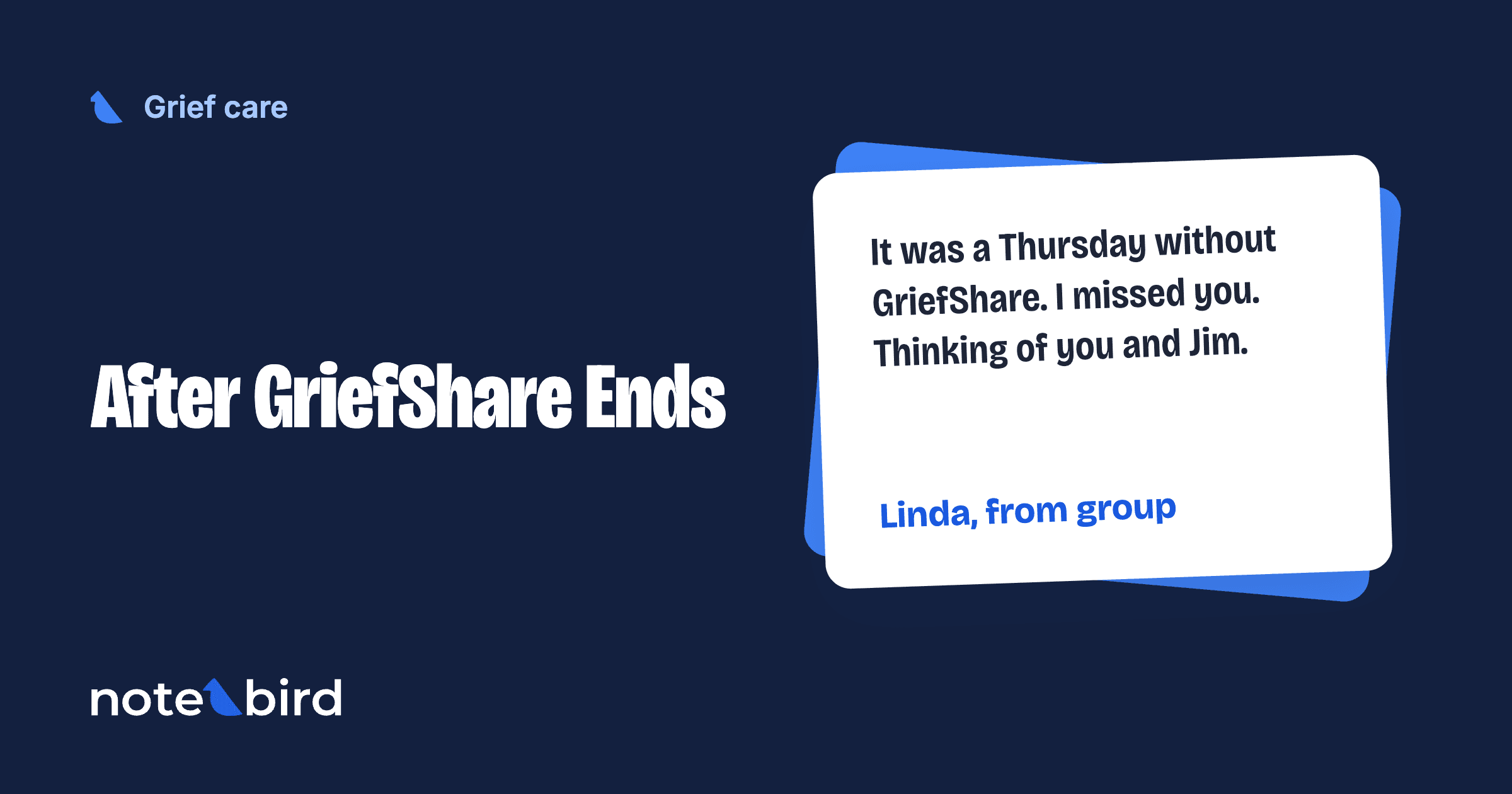
| Week 14 (first week after the group) | Short text or card: "I missed seeing you Thursday. Thinking of you." | Owner |
| Week 15 or 16 | Phone call. Ask how the first weeks without the group have been. | Owner |
| Month 4 (about a month after the group) | Invite them to coffee, a meal, or Sunday worship. | Owner |
| Month 5 | Call. Ask what has been hard and what has helped. | Owner |
| Month 6 | Visit or call. Watch for signs that grief is getting heavier, not lighter. | Owner or pastor |
| Each month after | One touch: a call, a card, or a text. | Owner |
| The week before each holiday | Call. Ask what would help this year. Invite them in. | Owner |
| Birthday of the person who died | Card or text that says the name. | Owner |
| Wedding anniversary (if a spouse died) | Card or call. | Owner |
| Week before the death anniversary | Call. "I know the date is coming." | Owner |
| Death anniversary | Visit or call. Say the name. Share a memory if you have one. | Pastor or owner |
| Next GriefShare cycle | Personal invitation to come back, or to help welcome new members. | Facilitator |
| Year 2 | Mark the death anniversary again. | Owner |
Keep each contact short. Ten minutes on the phone is enough. The point is not a long talk. The point is that someone remembered.
The First Holidays After GriefShare
Holidays are where follow-up matters most. If your group ends in the fall, the first Thanksgiving and Christmas may be only weeks away.
Call the week before, not only on the day. The days before a holiday are often harder than the day itself.
Ask, do not assume. Some people want every tradition kept. Others cannot face the tree this year. Both are normal. Ask: "What would help you this Christmas?" Then help with that one thing.
Ideas that help:
- Invite them to a holiday meal at your home, or ask a family in the church to invite them.
- Offer to sit with them at a Christmas Eve or Easter service.
- If your church holds a memorial or "Blue Christmas" service, invite them personally.
- Send a card that names the person who died.
Our guide to the first Christmas after a loss has more words and ideas for this season.
The Death Anniversary
The first anniversary of the death is often the hardest day of the year. Many people dread the whole week before it.
- The week before, call: "Hi, Carol. I know next Tuesday is one year since Jim died. I have been thinking about you. Is there anything you would like to do that day, or anything you would like me to do?"
- On the day, visit or call: "I am thinking of you and of Jim today. I remember how you told our group about his garden." Then let them talk.
- After the day, check in: "How was Tuesday? Was it what you expected?"
If you are not sure what to say, say the name of the person who died. Many grieving people fear that others will forget the person they loved. Hearing the name is a gift.
What to Say in Follow-Up Calls, Texts, and Cards
Short, plain words help most.
Texts:
- "Thinking of you this morning. No need to reply."
- "It was a Thursday without GriefShare. I missed seeing you."
- "Today I remembered something Jim said in group. Grateful for him."
Cards:
- "We have not forgotten you, and we have not forgotten Jim. You are in our prayers this week."
- "I am grateful for the 13 weeks we shared. You were brave in that room. I am still praying for you."
Calls:
- "How are you sleeping? How are you eating?"
- "What has been the hardest part of this month?"
- "Has anything helped lately?"
- "Would you like to get coffee next week? I can pick you up."
What Not to Say After the Group Ends
Some words feel kind but land hard.
- "You finished GriefShare, so you must be doing better." The group is not a cure. Finishing it does not mean grief is done.
- "Are you over it yet?" No one is "over" a death. People learn to carry it.
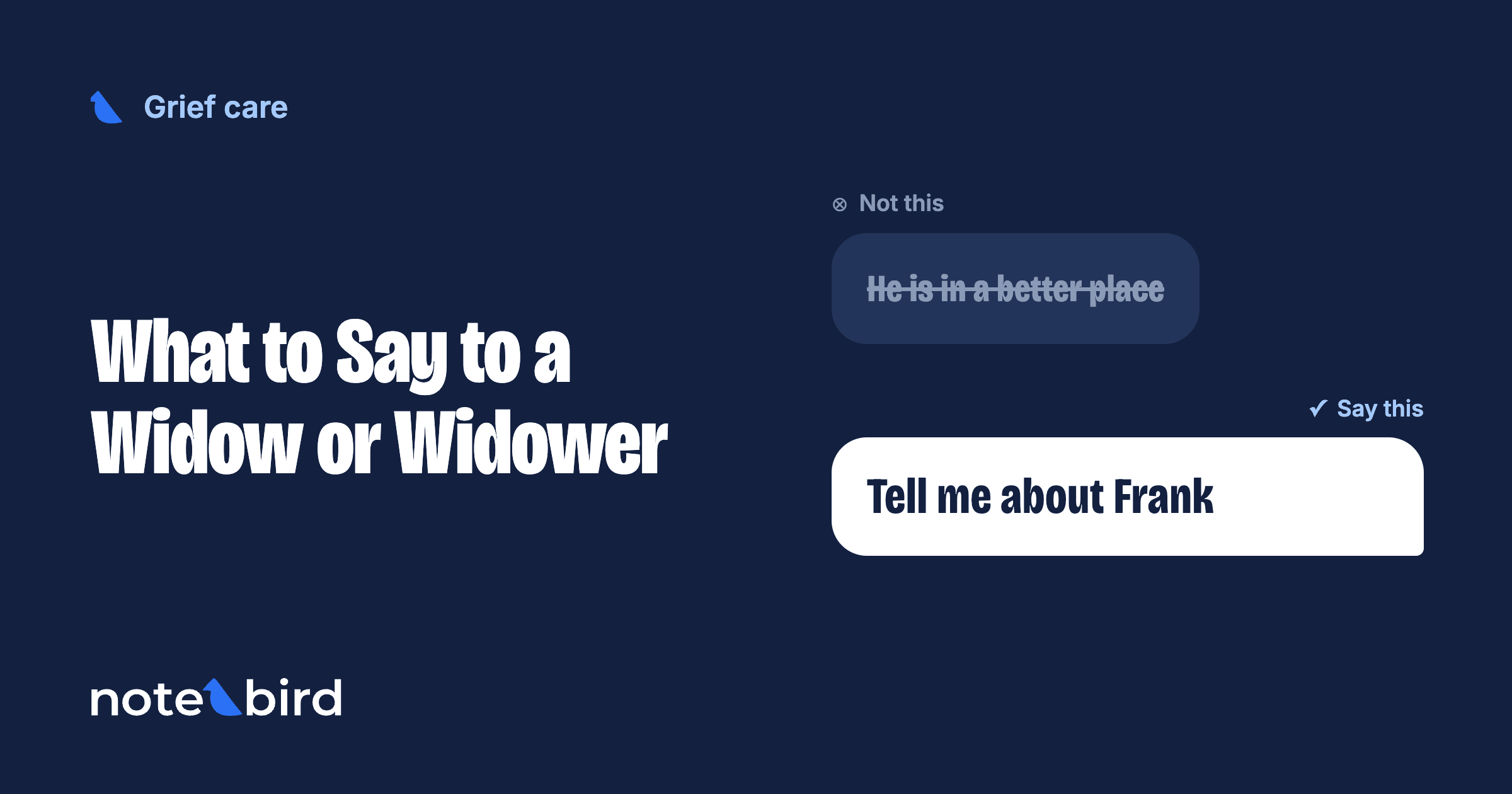
- "Call me if you need anything." Grieving people seldom call. Offer something specific: "Can I bring lunch on Saturday?"
- "At least you had so many good years." True, and still not helpful today.
- "Everything happens for a reason." Even people of deep faith often find this painful to hear.
When Someone Needs More Help
Most people need people who stay, not a counselor. But watch for signs that grief has become stuck or dangerous:
- They cannot do daily tasks (work, eat, pay bills, care for children) for a long time.
- The pain stays very strong every day, many months after the death.
- They use alcohol, drugs, or pills to cope.
- They pull away from everyone, including the people from the group.
- You feel out of your depth. That is a good reason to refer.
When you see these signs, tell your pastor, and gently suggest a grief counselor or a doctor. Our guide on when to refer someone to a counselor has words you can use.
If someone talks about suicide or wanting to die, do not wait. Stay with them and get help that day. In the United States, call or text 988, the Suicide and Crisis Lifeline.
Referral does not mean you stop. Keep calling. A counselor helps with the grief. The church helps the person know they are not alone.
Care for Your Facilitators Too
GriefShare facilitators carry a lot. Many of them lead because they lost someone too. Thirteen weeks of other people's grief can stir up their own.
- Thank them in person when a cycle ends.
- Do not hand them more follow-up names than they can carry. Three to five is plenty.
- Ask how they are doing, and mean it.
- Give them a break between cycles if they need one.
Tie GriefShare Into Your Church's Grief Care
GriefShare works best as one part of a church's grief care, not the whole of it. The same plan that follows a member after a funeral can follow a GriefShare participant after week 13: one owner, the key dates written down, and one touch each month for the first year.
If you have not set up that plan yet, start with our 12-month grief care calendar. For a widow or widower, see how to care for a widow or widower.
Keep the Chairs Warm After Week 13
The last night of GriefShare should feel like a handoff, not a goodbye. Before the room empties, ask permission, write down the dates, and give each person a name to expect a call from.
Notebird can hold that plan for your team. Each participant's death anniversary comes back in the morning report each year, and each owner sees their monthly follow-up tasks with a due date. Read more about milestones in Notebird, or try it free for 14 days with no credit card.