First Christmas After a Loss: How Churches Can Help the Grieving
What to say to someone grieving at Christmas, texts, cards, an invitation script, a Blue Christmas service outline, and a December care timeline.
By Thomas Griffin, Owner and CEO
Published
To help someone through the first Christmas after a death, call the week before, say the name of the person who died, and ask what would help. Invite them to a meal or a service, and make it easy to say no or leave early. Offer a Blue Christmas service. Then call again in January, when the decorations come down.
Why the First Christmas After a Death Is So Hard
Christmas is built on traditions, and every tradition shows who is missing. The empty chair at dinner. The stocking no one hangs. The ornament he always hung on the tree, and the carol she always sang a little too loud.
The National Center for PTSD, part of the U.S. Department of Veterans Affairs, says in its guide on helping someone after a loss that contact months later is "especially true on anniversaries, birthdays, or holidays that remind them of their loss."
Grieving people also feel pressure. The stores play cheerful music, and everyone around them seems happy. Friends ask, "Are you ready for Christmas?" Many grieving people feel they must hide their sadness so they do not spoil the season for others.
A church can give them permission to grieve and a reason to come. This guide gives you the words, the invitations, a Blue Christmas service outline, and a care timeline from late November into January. For care through the whole first year, see our 12-month grief care calendar.
Make a List Before Advent Starts
Before the first Sunday of Advent, make a list of every person in your church who had a death in their family this year. Include:
- Widows and widowers.
- Parents who lost a child, at any age, including a miscarriage or stillbirth.
- Adults who lost a parent.
- Families after a suicide loss.
- Members who lost a close friend.
Also add people with other losses this year: a divorce, a hard diagnosis, a job loss, or a first Christmas in a care home. They may not grieve a death, but the season can be hard for them too.
Give each person on the list one owner on the care team. That person makes the calls in the timeline below.
What to Say to Someone Grieving at Christmas
You do not need to make Christmas better for them, and you cannot. What you can do is show that you remember.
Picture a widow at the Christmas Eve service, in the pew where she sat for forty years, with the place beside her empty. A hand on her shoulder and her husband's name, said softly, can carry her through the first carol.
Phrases that help:
- "This is your first Christmas without your mom. I have been thinking about you."
- "I miss Frank too. Christmas Eve won't be the same without his voice in the choir."
- "How are you doing this week?" (A small question is easier to answer than "How are you?")
- "What would help you this Christmas?"
- "Do you want to keep your traditions this year, or do something different? Either is fine."
- "You don't have to be cheerful around me."
- "Can I help with cards, gifts, or the tree this year?"
Then listen. If they want to tell a story about last Christmas, let them. If they cry, stay with them. You do not need to stop the tears.
What Not to Say at the Holidays
- "Merry Christmas." It is not wrong, but it should not be the only thing you say. Add "I know this one is hard."
- "Try to focus on the good things." It asks them to set the grief aside so others feel better.
- "She would want you to be happy." It may be true. It still tells them their sadness is wrong.
- "At least you have the grandkids this year." The grandkids are a gift. They do not fill the empty chair, and "at least" asks them to.
- "It's been months. Are you doing better?" Grief does not follow the calendar.
- "You should get out more." Invite them to something specific instead.
- Saying nothing. Many people avoid a grieving person in December because they fear they will make it worse. Silence feels like forgetting.
Texts for the Holidays
Short texts that do not ask for a reply are a gift in a busy month.
- "Thinking of you as Christmas gets close. No need to write back."
- "I put Frank's ornament from the men's group on our tree. We miss him."
- "We sit near the back at the 7:00 service on Christmas Eve. There is room for you, if you want it."
- "Thinking of you today. I know Christmas morning was your mom's favorite."
- "I am wrapping gifts on Saturday. Want me to bring yours over and wrap them with mine?"
- "Happy New Year is a hard thing to hear this year. I'm thinking of you."
What to Write in a Christmas Card to Someone Who Is Grieving
A card may be the one thing a grieving person keeps from this December. Two or three sentences are enough.
- "We are remembering Frank this Christmas and thinking of you. His laugh is missed at our table."
- "This first Christmas without your mom must be so hard. We are holding you close in our prayers."
- "No words fix this, but we wanted you to know we remember Carlos, and we love your family."
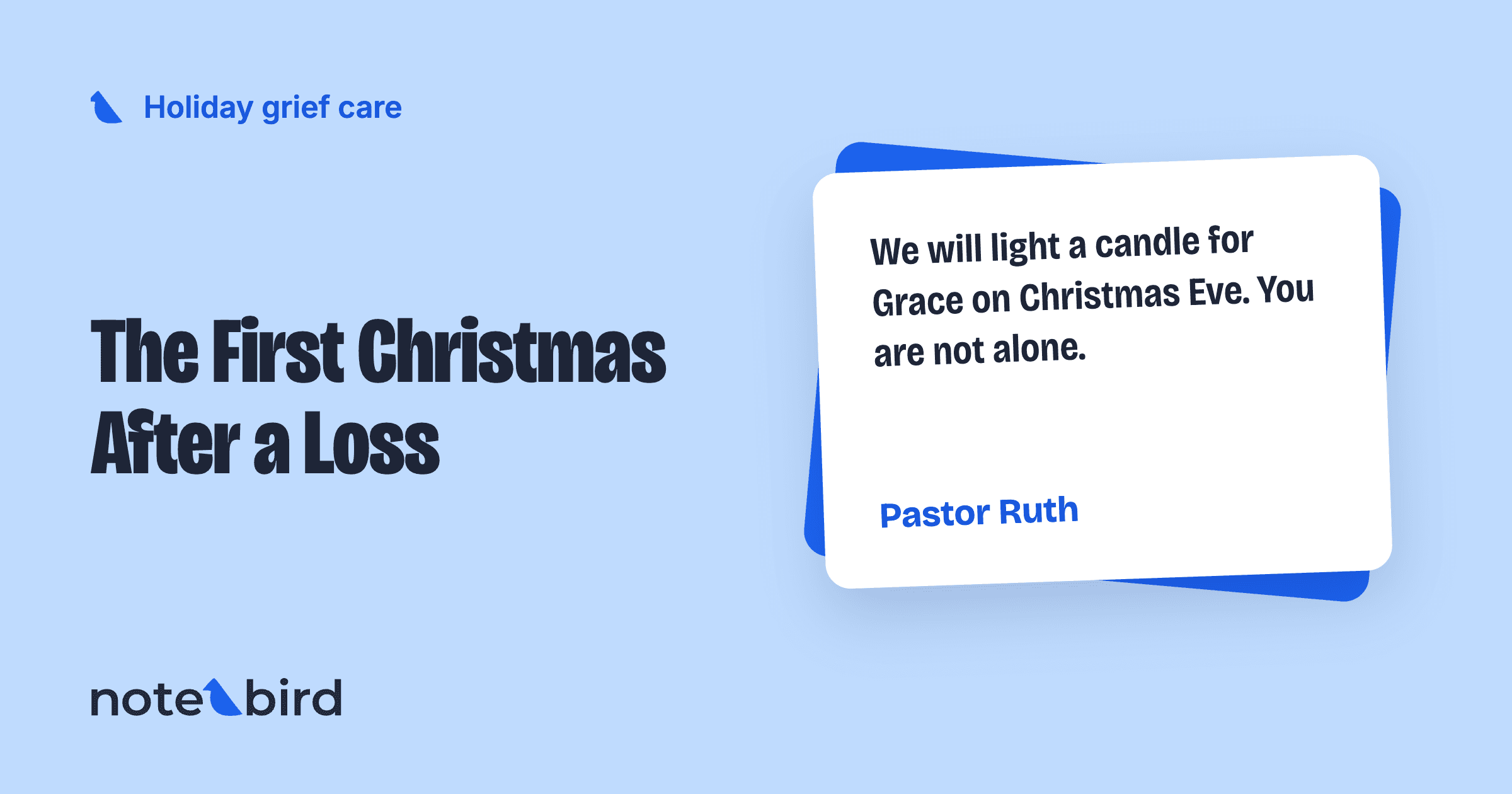
- "We will light a candle for Grace on Christmas Eve. You are not alone this season."
Avoid "Merry Christmas" as the main message. If the person does not share your faith, write "thinking of you" instead of "praying for you."
A card from a Sunday school class, a choir, or a small group, with many names, shows that a whole community remembers.
How to Invite Someone Who Is Grieving
An invitation is a kind gift, if it comes with an easy way out. Tell them who will be there, when it starts, and that they can come late or leave early.
Invitation to a family dinner:
"Ruth, we would love for you to have Christmas dinner with us. It's just our family and my sister's, at 2:00. You can come for the whole day, or just for dessert. If you'd rather have a quiet day, that is completely fine. I'll call you on Tuesday to check."
Invitation to Christmas Eve worship:
"Would you like to sit with us at the 7:00 service on Christmas Eve? We can pick you up at 6:30. If it gets to be too much, we can leave whenever you want."
Invitation to a Blue Christmas service:
"Our church is having a quiet service on December 21 for people who are grieving this year. It's short, with candles and prayer. Would you like to go together?"
If they say no, do not push. Say: "That's okay. I'll check on you that week." Then do it.
How to Plan a Blue Christmas or Longest Night Service
A Blue Christmas service is a quiet Advent service for people who grieve or find the season hard. Many churches hold it on or near December 21, the longest night of the year, so it is also called a Longest Night service. It gives people a place to bring their grief into worship without pretending to be cheerful.
Discipleship Ministries of The United Methodist Church publishes a full Service of Word and Table for Longest Night/Blue Christmas by the Rev. Robb McCoy. It says the service is "especially designed for people who have lost loved ones in the past year." It uses Psalm 80:1-7, an act of remembrance with candles, and Holy Communion.
A simple outline that any church can adapt (about 45 minutes):
- Gathering. Low light. Quiet music. Greeters hand each person a candle.
- Welcome. "Tonight you do not have to be cheerful. You are welcome here as you are."
- Opening prayer. Ask God to be near to everyone who grieves tonight.
- Scripture. Choose two or three: Psalm 80:1-7, Isaiah 9:2, Isaiah 40:1-5, Psalm 23, Matthew 5:4, John 1:5.
- Silence. Two or three minutes. Do not rush it.
- Short message. Five to eight minutes. God comes into the dark. Grief and hope can sit side by side.
- Act of remembrance. People come forward and light a candle, and say a name aloud if they want to. Some churches read the names of members who died this year. Tell each family before the service so they are not surprised.
- Prayers. Pray for those who grieve a death, a divorce, an illness, or a lost job. Pray for those who feel alone.
- Communion (if your tradition includes it).
- A quiet hymn. "O Come, O Come, Emmanuel" or "In the Bleak Midwinter" fit the mood.
- Blessing and sending. Then stay. Have care team members by the door with time to talk.
Practical tips:
- Send a personal invitation to every family on your list, not only an announcement in the bulletin.
- Hold it in the evening, and keep it under an hour.
- Ask care team members to sit among the people, not all in one row.
- Have tissues in every row.
- Offer simple refreshments after, so people who want to talk can stay.
- Write down who came. Call each person in the next week.
Thanksgiving and New Year's Day
For many families, Thanksgiving is the first holiday without the person who died, and it can set the tone for the season. Call the week before Thanksgiving. Ask about their plans, and invite them to your table if they have none.
New Year's Day can be hard in a quieter way. It is the first year the person who died will not be part of. Some people dread the date on the calendar changing. A text on New Year's Eve helps: "Thinking of you as this year ends. Your mom is part of it, and we remember her."
A December to January Care Timeline
| When | What to do | Who |
|---|---|---|
| Before Advent (mid to late November) | List every family with a death this year. Give each one an owner. | Pastor, care team lead |
| Week before Thanksgiving | Call. Ask about plans. Invite them in if they have none. | Care team member |
| First week of December | Send a card that says the name of the person who died. Mail the Blue Christmas invitation. | Card ministry, care team member |
| Second week of December | Call. Ask "What would help you this Christmas?" Offer help with cards, gifts, or the tree. | Care team member |
| On or near December 21 | Hold the Blue Christmas or Longest Night service. Write down who came. | Pastor, worship team |
| Week before Christmas | Invite them to Christmas Eve worship or a meal. Offer a ride and a seat. | Care team member |
| Christmas Eve or Christmas Day | Short text: "Thinking of you today." | Care team member |
| Between Christmas and New Year | Visit or call. Ask how the day went. | Pastor or care team member |
| New Year's Eve | A short text. | Care team member |
| Second week of January | Call. The decorations are down and the visitors are gone. This week can be the quietest of all. | Care team member |
| Late January | Check the grief care calendar. Plan the next touch, such as the next birthday or anniversary. | Care team lead |
Practical Help in December
December is full of tasks, and grief makes each one heavier. Offer to take one off their list:
- Cards. Help address Christmas cards, or tell them it is fine to skip a year.
- Gifts. Shop for the grandchildren with them, or wrap gifts together.
- The tree. Help put it up, or take it down in January. Ask first which ornaments they want out.
- Meals. Bring a dinner in the week before Christmas, when they may not want to cook.
- Travel. Rides to the airport, or to a family member's home.
- The house. Shovel snow, hang lights, or take the trash to the curb.
Some families want a way to include the person who died. Ideas you can suggest, if they want them: light a candle at dinner, hang their stocking and fill it with notes, give to a cause the person loved, or share one favorite memory at the table.
Children and the First Christmas After a Death
Children feel the empty chair too. They may also feel guilty for being excited about gifts. Tell parents that both feelings are normal.
How a church can help:
- With the parents' OK, give the children's leader a quiet word before the Christmas program. Songs and costumes can stir up big feelings.
- Let the child make an ornament or a card for the person who died, if they want to.
- Keep the routine. The children's Christmas program and the youth party still matter.
- Ask an adult the child already knows to sit with the family on Christmas Eve.
How to Pray With Someone at Christmas
Ask first: "Would you like me to pray with you?" Then keep it short and say the name.
"Lord, this is the first Christmas without Frank. You know how much Ruth misses him. Be near to her in the quiet of this season. Give her rest at night, and people around her who love her. Thank you for the years she had with Frank. Be with her on Christmas morning. Amen."
Advent itself speaks to grief. It is a season of waiting in the dark for light. Psalm 130, Isaiah 9:2, and John 1:5 can be read at a December visit.
When the Holidays Bring More Than Grief
For most people, holiday grief is sad and heavy but normal. For some, it is more. Suggest a grief counselor, a doctor, or a grief support group when the person:
- Cannot get out of bed, eat, or do daily tasks for weeks.
- Stops seeing anyone at all.
- Drinks more, or uses pills or other drugs to cope.
- Says life has no point without the person who died.
If someone talks about suicide or wanting to die, do not wait. Stay with them and get help that day. In the United States, call or text 988, the Suicide and Crisis Lifeline. It is free, confidential, and open 24 hours a day, including on holidays.
Start Your List This Week
The best time to plan grief care for Christmas is before Advent starts. Make your list, give each family an owner, and put the first call on the calendar. If a widow or widower is on your list, our guide on how to care for a widow or widower has a two-year plan.
Notebird keeps each family's dates and each call in one place, so the whole team can see who has been reached this December and who has not. See how Notebird helps churches follow up.