Pastoral Care Follow-Up Ideas: 4 Your Team Can Start This Week
Four pastoral care follow-ups your team can start this week: a gratitude call, a prayer request check-in, special occasions, and life milestones.
By Thomas Griffin, Owner and CEO
Published · Updated
Good pastoral care follow-up is a short, planned touch after a moment that mattered. Four ideas work in almost any church or synagogue: a gratitude call, a prayer request check-in, a note for special occasions, and a remembered life milestone. Give each one an owner and a date, and keep it short.
Care does not end when the visit ends. Anyone can show up for the celebration or the crisis. What people remember is who came back a week later, a month later, or a year later. That is follow-up, and it is where most churches slip. Not because they do not care, but because nobody wrote down the next step.
It is also one of the most common things care teams do. Here are four follow-up ideas, with how to do each one well.
Why Follow-Up Matters More Than You Think
Many of us hold back from reaching out. We think the call will be awkward, or that the person is too busy, or that a short text does not count. Research says we are wrong.
In 13 experiments with nearly 6,000 people, researchers found that people underestimate how much others appreciate being contacted. The gap was larger when the contact came as a surprise. A follow-up that nobody expected, like a call a month after the funeral, often means more than we think.
How to Follow Up Well: Timing, Owner, and Words
Every good follow-up has four parts.
- A reason. Name what you are following up on: "You shared a prayer request last week."
- A time. Most follow-ups belong within a week. Hospital stays, deaths, and crises need a call within a day or two, then a second touch at about one month.
- An owner. One person, by name. "The care team will call" usually means nobody calls.
- A record. Write down that it happened and what you learned. The next follow-up depends on it.
Here is a quick plan for the four ideas in this guide.
| Follow-up | When | Who | How | What to say |
|---|---|---|---|---|
| Gratitude call | Within a week of the help | Pastor or ministry leader | Phone call or handwritten note | "I saw what you did for the Smiths. Thank you. It mattered." |
| Prayer request check-in | 1 week after the request, then 1 month | The person who heard the request | Call or text | "I have been praying for you. How are things now?" |
| Special occasion | The day of, or the week after | Pastor, small group leader, or care volunteer | Card, text, or a short visit | "Congratulations. We are so glad for you." |
| Life milestone | Each year on the date | Care team volunteer | Card or call | "I know this week may be hard. We remember Tom with you." |

1. The Gratitude Call
Nothing beats a sincere "thank you" for someone who gave their time. Think of the volunteer who drove a widow to her doctor, the deacon who sat with a family all night at the hospital, or the woman who has made every funeral meal for 20 years.
A quick call makes people feel seen. It also tells them their work touched real lives. Studies back this up. In a set of experiments at the University of Chicago, people who wrote thank-you letters underestimated how positive the recipients would feel and overestimated how awkward they would feel. The receivers did not care about perfect words. They were happy because of the warmth of the gesture.
How to do it:
- Keep a short list of people who served this month. Call two or three each week.
- Be specific. "Thank you for all you do" is kind. "Thank you for visiting Ruth every Tuesday since her fall" is better.
- Tell them the result if you can share it: "She told me your visits are the best part of her week."
- Keep it under five minutes. You are not asking for anything.
Script: "Hi Jim, this is Pastor Sarah. I don't need anything. I just heard you drove the Millers to the hospital three times last week, and I wanted to say thank you. That meant a lot to them, and to me."

2. The Prayer Request Follow-Up
Prayer is at the heart of pastoral care. When someone trusts you with a prayer request, they are trusting you with a worry. Coming back to it later tells them they are not alone, and that you meant it when you said, "I'll pray for you."
When: About one week after the request. For an ongoing need, such as a job search or a long illness, check in again at one month.
How to do it:
- Write the request down the day you hear it, with the date. Memory fails after a busy Sunday.
- Follow up with the same person who heard the request, if you can. It feels more personal.
- Ask before you share. Some requests are private. Ask, "Would you like others to pray for this too?" before you put it on a prayer list.
- When a prayer is answered, celebrate it. Write that down too. Answered prayers are part of a person's story.
Script: "Hi Maria, you mentioned your son's job search last Sunday. I have been praying for him all week. How are things going? Is there anything else I can pray for?"

3. Special Occasions
Life is full of good news: a wedding, a graduation, a new job, a retirement, a move into a first home. As a church, you get to celebrate these moments with your people. A short message or a visit shows that the church family is glad with them.
When: On the day, or within a week after. For a wedding, a note at one month is a nice surprise, after the guests and the gifts are gone.
How to do it:
- Listen for good news in the lobby, in small groups, and in prayer requests. Write it down.
- Send a handwritten card for big moments. A text is fine for smaller ones.
- Let the person's small group leader or a care volunteer send it, not only the pastor. More voices means more connection.
- For new couples, ask if they would like to be part of a couples group or meet with a mentor couple.
Script for a card: "Congratulations on your graduation, Josh. We have watched you grow up in this church, and we are so proud of you. We are praying for you as you start this next step."
4. Life Milestones
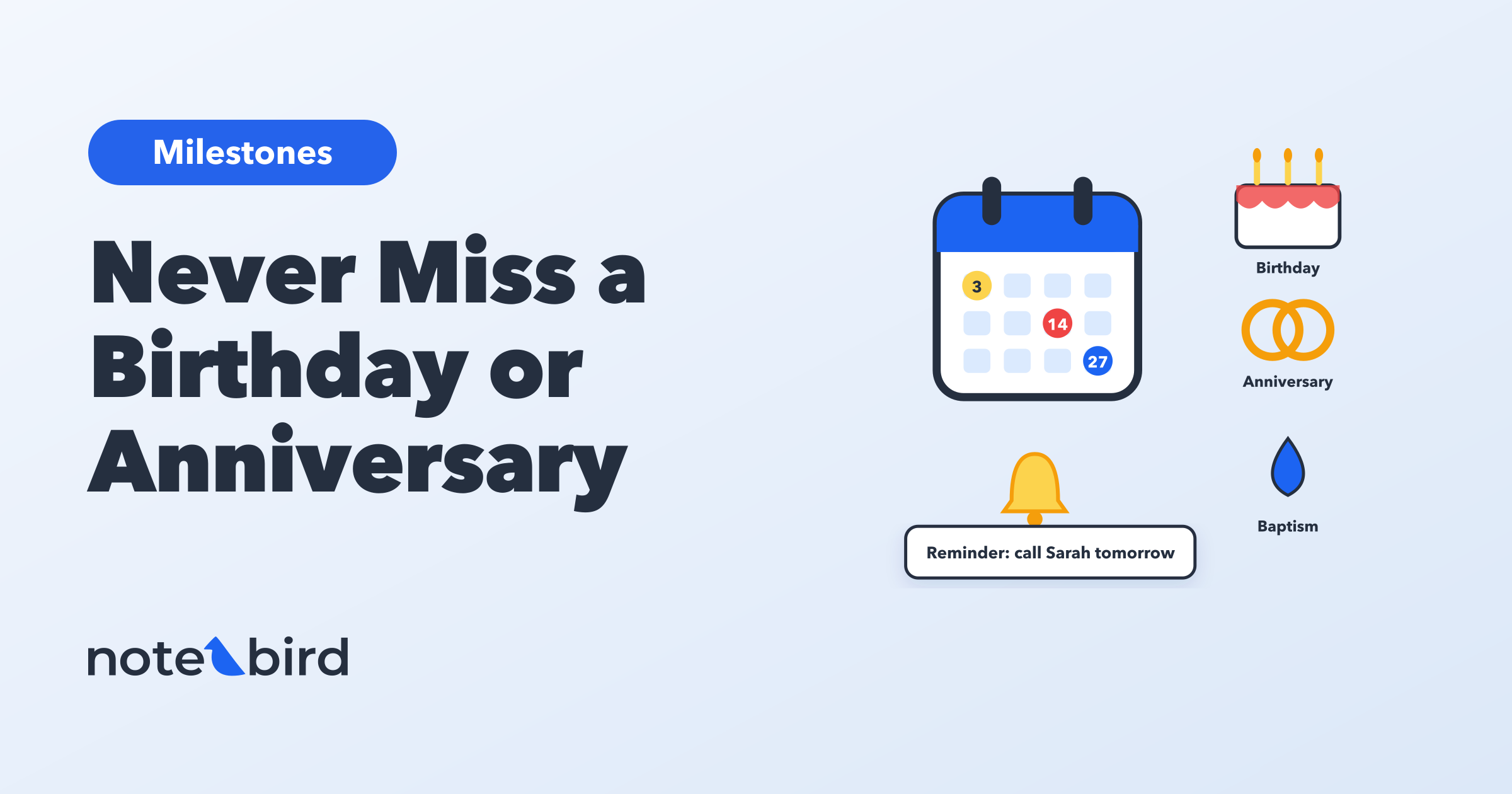
Some dates come back every year: birthdays, wedding anniversaries, the birth of a child, a baptism, and the passing of a loved one. A note on these days tells people their church family remembers, and it costs very little.
The hard dates matter most. Grief does not end at the funeral. MedlinePlus, from the U.S. National Library of Medicine, notes that "it may take a year or longer to overcome strong feelings of grief." The first anniversary of a death is often one of the hardest days of that year. A card or a call that week can mean more than any visit during the funeral rush. Our grief care calendar for churches lays out the whole first year.
When: A few days before the date, so the card arrives on time.
How to do it:
- Keep the dates in one place: births, deaths, anniversaries, and baptisms. See how churches track member milestones.
- Give each month's milestones to a care volunteer to send cards.
- Name the person who died. People love to hear the name of someone they lost.
- For new babies, offer a meal the first week, then a note at the first birthday.
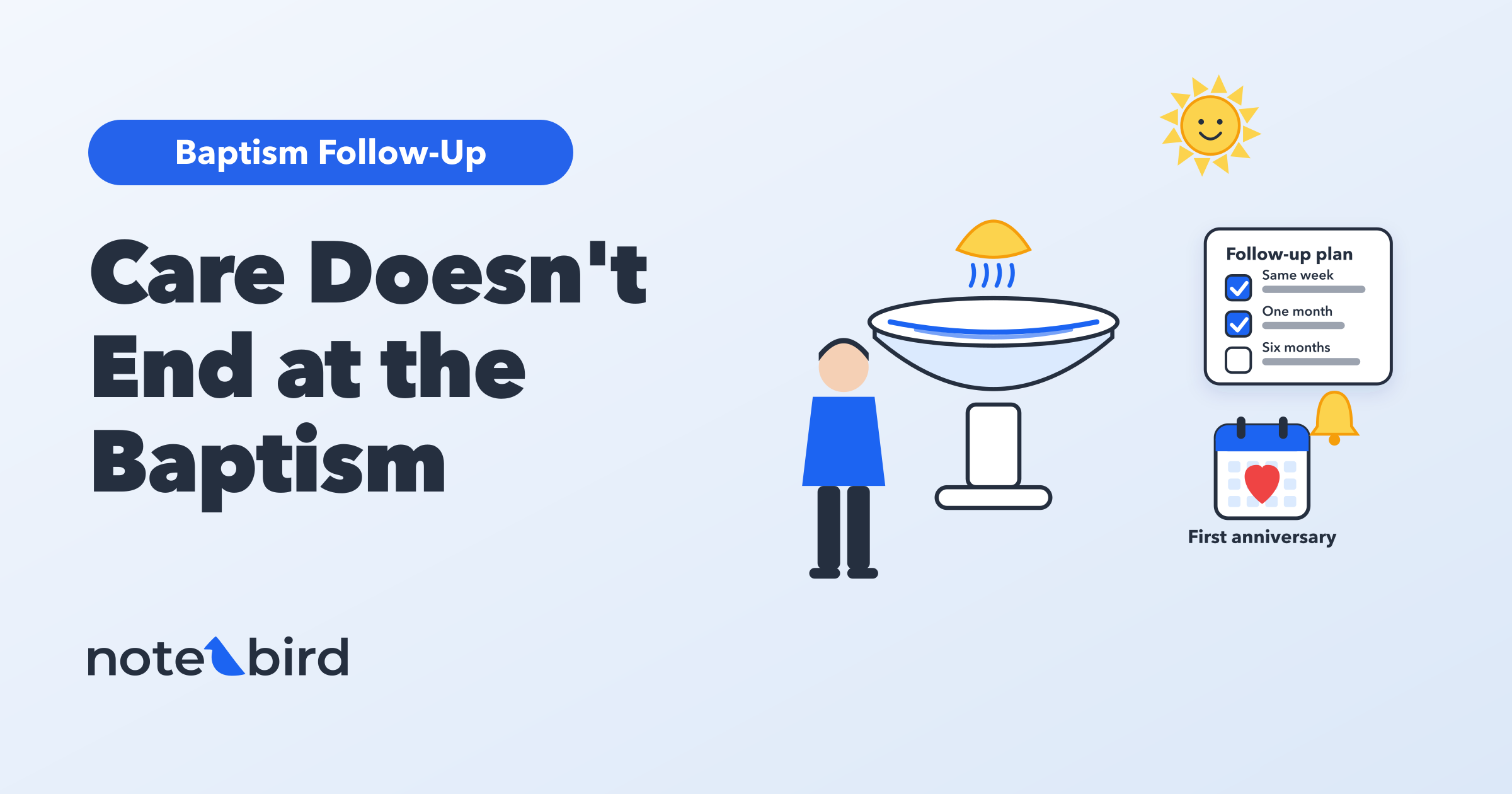
Baptisms need their own plan. If you want a step-by-step plan for the year after a baptism, use our baptism follow-up checklist.
Script for a loss anniversary: "Dear Helen, I know this week marks one year since Tom went home to the Lord. We remember him too, and we are praying for you. I would love to bring you coffee next week, if you are up for it."
Who Owns the Follow-Up?
Follow-up should not all fall on the pastor. One pastor cannot call every volunteer, check in on every prayer request, and send every birthday card. Share it.
- The pastor takes deaths, crises, and hospital stays, at least for the first contact.
- Deacons or elders take ongoing needs and second touches.
- Care team volunteers take thank-you calls, prayer check-ins, and milestone cards.
- Small group leaders take the good news in their own group.
What matters is that each follow-up has one name on it. If you are building a team to share this work, see our guide to building a pastoral care team.
How to Keep Follow-Ups From Slipping
Most missed follow-ups are not a lack of love. They are a lack of a list. A few habits fix most of it:
- Write it down right away. In the car after the visit, not at the end of the week.
- Put a date on it. "Soon" is not a date.
- Review open follow-ups once a week. A short look on Monday morning is enough.
- Close the loop. When the follow-up happens, mark it done and add a note on what you learned.
You can keep this list in a notebook or a spreadsheet when you start. As the team grows, a shared tool helps everyone see the same list. Learn how Notebird handles church follow-up, and for other ways to show care when you cannot be there in person, see 3 ways to communicate you care.