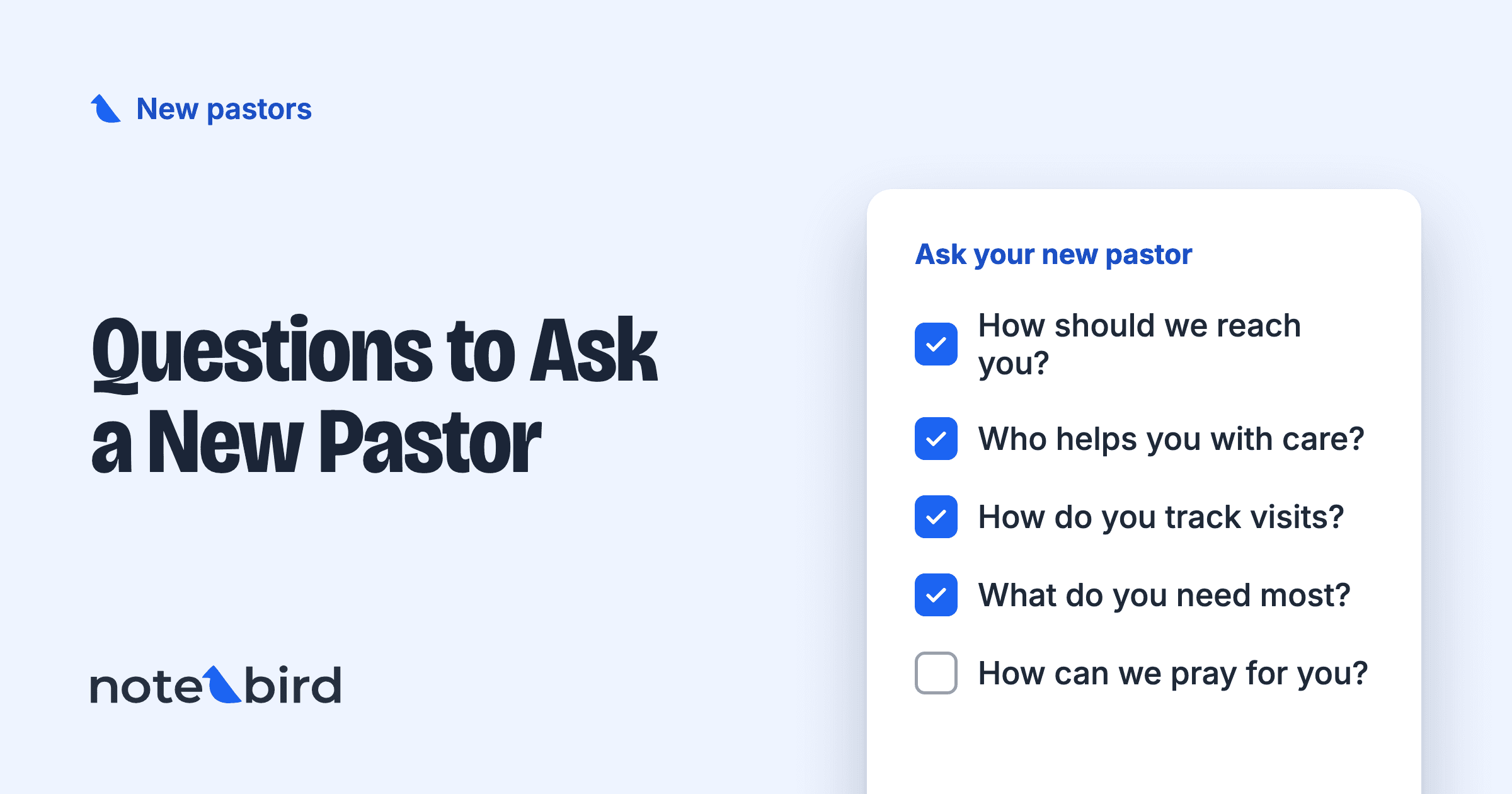
Questions to Ask a New Pastor, and 4 a New Pastor Should Ask
Questions members and search committees can ask a new pastor, and the 4 care questions a new pastor should ask the team: who needs care, who grieves, and more.
By Thomas Griffin, Owner and CEO
Published · Updated
Good questions to ask a new pastor cover calling, care, leadership, and rest: How did you come to faith? How do you care for people in a crisis? How can we pray for you? A new pastor should ask the care team four questions back: who needs care now, who is grieving, who knows everyone, and how care is tracked.
A new pastor is a big change for everyone. Members want to know who this person is. Search committees want to know if the candidate fits. And the new pastor wants to know who needs care first. This guide has questions for all three.
Questions to Ask a New Pastor When You First Meet
These questions are for members, deacons, and staff who are getting to know a pastor who just arrived. Pick two or three. A new pastor meets hundreds of people in the first month, so a short, warm conversation is better than an interview.
- What drew you to our church?
- How did you come to faith, and how did you know you were called to ministry?
- What do you hope to learn about us this first year?
- When someone is in the hospital or in a crisis, how do you want to hear about it?
- How can we pray for you and your family?
- What does a good day off look like for you?
- Who has shaped your faith the most, and how?
- What do you need from members like me?
Question 4 matters more than it looks. Many churches never tell a new pastor how care news travels. Ask it early, and the pastor will know the right way to hear about the next surgery or death.
Questions to Ask a Prospective Pastor: A Search Committee Guide
A search committee has a harder job. You are not getting to know a pastor. You are deciding if this person should lead your church for years.
Ask for stories, not opinions. Almost any candidate will say "I value pastoral care." Fewer can tell you about the last hospital visit they made and what they did after it. Stories show how a person really works.
Use this table as your interview checklist. You will not ask every question in one meeting. Spread them across a phone call, an interview, and a visit.
| Topic | Question to ask | What to listen for |
|---|---|---|
| Calling | How did you come to faith, and to ministry? | A clear, specific story, not a résumé |
| Preaching | How do you prepare a sermon each week? | A steady process and time in Scripture |
| Pastoral care | Tell us about the last hospital visit you made. | Presence, prayer, and a follow-up after the visit |
| Pastoral care | When many people need care at the same time, how do you make sure no one is missed? | A system and a team, not only memory |
| Care team | How do you train members to share pastoral care? | Shares the work and trusts lay people |
| Grief | How do you care for a family in the year after a death? | Contact after the funeral, not only before it |
| Conflict | Tell us about a conflict in your church and how you handled it. | Goes to people directly and owns their mistakes |
| Change | What would you change in your first year, and what would you leave alone? | Listens first, changes later |
| Leadership | How do you work with staff, elders, or a board? | Clear roles and regular communication |
| Rest | How do you rest, and who cares for you? | A day off, friends, a mentor or peer group |
| Fit | Why are you open to leaving your current church? | Calm, fair words about the people they serve now |
| Fit | What questions do you have about us? | Good, specific questions about your church |
Tell Candidates the Truth About Your Church
Interviews go both ways. The candidate is deciding about you, too. In a Lifeway Research survey of 734 former pastors who left the pastorate before retirement, 48 percent said the search team did not accurately describe the church before they arrived. Only 22 percent said their church had clear written expectations of its pastor.
So describe your church as it is. Name the conflict from three years ago. Share the budget. Write down what you expect in a normal week, and hand it to the finalist. A pastor who says yes to the real church is more likely to stay.
Questions a Pastoral Candidate Should Ask the Church
If you are the candidate, ask questions that show you what the next five years will feel like:
- Why did the last pastor leave, and how did the church handle the goodbye?
- What do you expect from the pastor in a normal week?
- How are decisions made, and who makes them?
- Who in the church is hurting right now?
- How does the church learn that someone is sick or grieving?
- Where are past care notes kept, and can I see them before I start?
The last two questions lead straight to the first conversations you will have with your care team.
4 Pastoral Care Questions a New Pastor Should Ask the Team
Starting a new pastoral role feels a bit like jumping into the deep end of the pool. There is excitement and nerves, and then a big splash when you start to serve your new church with all you have. Your care team can make the first months much easier. These four questions help you learn your new congregation fast.
1. Who Has an Immediate Care Need?
Start with triage. Ask your care team to name the people and families with urgent needs today: a health crisis, a hard diagnosis, deep emotional distress, or a spiritual struggle.
Then reach out to them quickly. Visit, call, and pray with them. When a new pastor shows up in a crisis during the first weeks, the whole church hears about it. It tells everyone that you will be there when they need you.
2. Who Has Lost a Loved One in the Last Year?
Grief does not end at the funeral. Some people in your church are still in the first, hardest year after a death, and they may feel that the church has moved on.
Ask your care team for a list of everyone who lost a loved one in the past 12 months, with the date of each loss. Reach out to each person. Offer your condolences and an open door. Put the one-year date on your calendar, because the first anniversary is often one of the hardest days. A grief care calendar can help your team remember the dates that matter after a loss.
3. Who Are Three Members Who Know Everybody?
Every congregation has a few people who seem to know everyone. They hear about the surgery before the office does. They notice when a family stops coming.
Ask your team to name three of them, and then go meet them. Ask for their help. These people can help you see the needs behind the scenes, welcome newcomers, and build the connections that keep a church together. Some of them may belong on your pastoral care team.
4. How Do We Track and Organize Our Pastoral Care?
Pastoral care has a lot of moving parts. How does your team keep track of who needs a call, a prayer, or a visit? Where are the notes from the last pastor? Who follows up after a hospital visit, and how do they know it is their job?
Sometimes the answer is "in the last pastor's head." That is why a good pastor handoff matters so much. If there is no system, start one now, while you are learning names. A shared record of care needs, follow-ups, and prayer requests helps you give care that is personal and keeps people from slipping through the cracks.
Start Your First Year With the Right Conversations
The right questions go both ways. Members and search committees learn who their pastor is. The pastor learns who needs care, who is grieving, who can help, and how the team works. Ask them early, write down the answers, and you give your church care it can count on.
The same questions work for any new ministry leader. If your church is changing youth pastors, see how to keep students from falling through the cracks.