How to Care for Someone After a Miscarriage or Stillbirth
What to say, what to text, and what not to say after a miscarriage or stillbirth. A church care plan from the first days to the due date and the anniversary.
By Thomas Griffin, Owner and CEO
Published
To care for someone after a miscarriage or stillbirth, say you are sorry, use the words the family uses, and offer specific help instead of advice. Do not try to explain the loss. Then remember the dates: the loss, the due date, Mother's Day and Father's Day, and the first anniversary. Most people stop asking after a week. A church can keep asking.
Why Church Support Often Fails After a Pregnancy Loss
Pregnancy loss is common. The American College of Obstetricians and Gynecologists (ACOG) says early pregnancy loss happens in about 10 of 100 known pregnancies. The March of Dimes gives a range of 10 to 20 in 100. So in most churches, someone in the pews has lived through this. Many of them never told anyone.
The church often stays silent for three reasons:
- Nobody knew. Many parents do not share a pregnancy until the second trimester. When the loss comes first, only a few people find out.
- People do not know what to say. So they say nothing, or they say something that hurts.
- There is no funeral. After a death, the funeral gathers people and starts the care. After a miscarriage, there is often no event at all. The family goes home, and the world goes on.
The result is a family who grieves alone, sometimes in the same building as people who would have helped. Your care team can change that.
Start With Privacy
Ask before you share. A pregnancy loss is private health news. Some families want the whole church to pray. Others want only the pastor to know.
Ask one plain question: "Who can I tell, and what can I say?" Then do exactly that. Do not put the news in a bulletin, a prayer chain email, or a group text without permission.
If your team writes care notes, keep this one where only the pastor and care leaders can see it.
What to Say After a Miscarriage
Short words are best. You are not there to explain. You are there so the family knows they are not alone.
Phrases that help:
- "I am so sorry."
- "I don't know what to say. I care about you, and I am here."
- "This is a real loss. It is all right to grieve."
- "How are you doing today?" (Then stop and listen.)
- "Would you like to tell me about your baby?" (Only if the family speaks of a baby.)
- "I have been praying for you. Would you like me to pray with you now?"
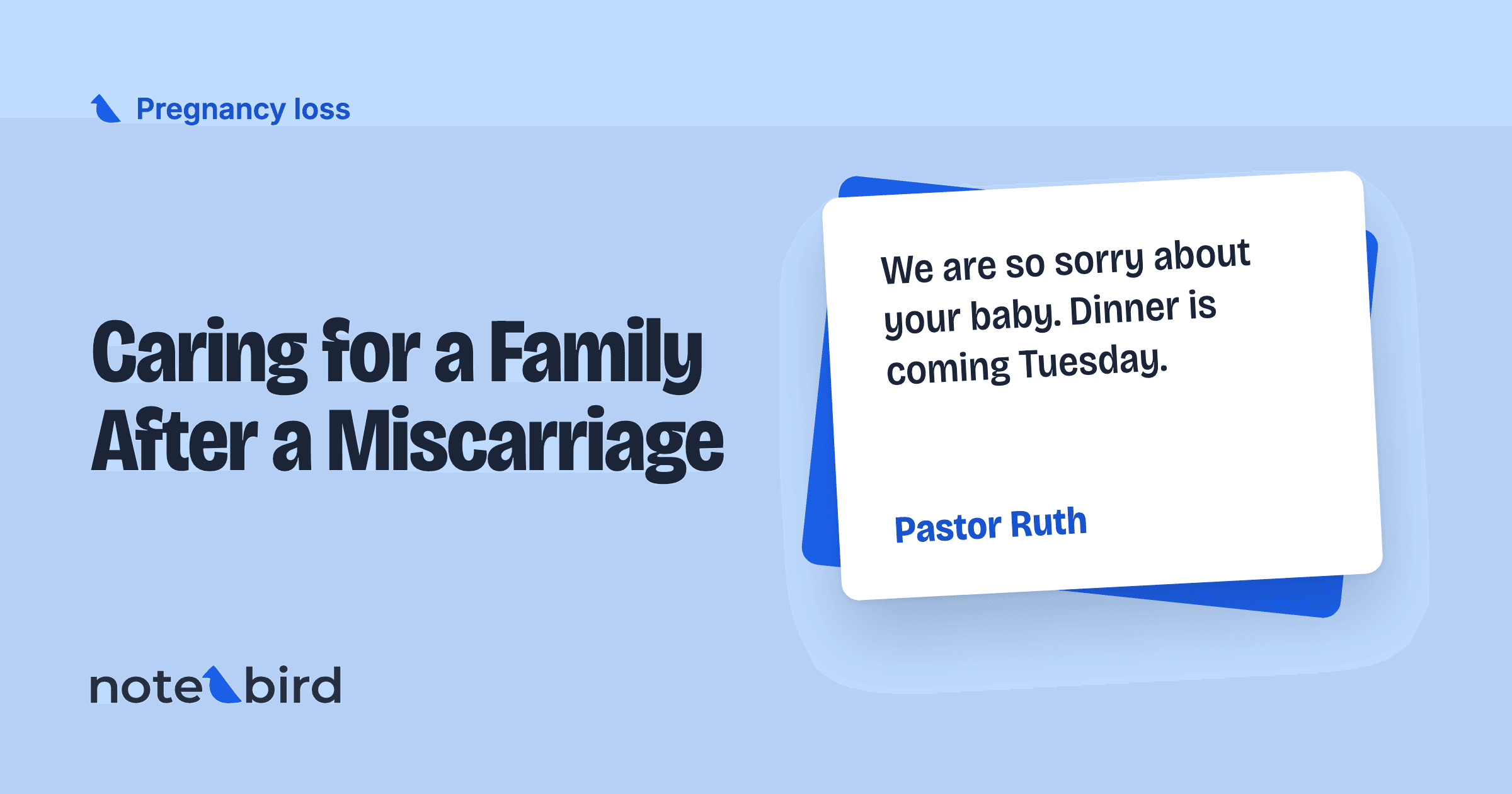
- "Can I bring dinner on Thursday?"
Follow the family's words. Some parents say "our baby" and have a name. Some say "the pregnancy." Both are all right. Use the words they use, and use the name if they share one. The March of Dimes tells grieving parents they can ask friends to do this: "If you want them to, ask them to use your baby's name and to remember your baby."
If you visit in the hospital, the same rules apply as any bedside visit. Keep it short, ask, and listen. See what to say on a hospital visit for more phrases.
What Not to Say, and Why
Most hurtful words come from a good heart. People want to make the pain smaller. But a grieving parent hears, "Your loss does not count."
- "At least you can try again." This baby was not a practice run. A future child does not replace this one.
- "At least it was early." For many parents, the love started with the first positive test. The length of the pregnancy does not set the size of the grief.
- "At least you have other children." It may be true, but it does not help. No child takes the place of another.
- "It was God's plan" or "Everything happens for a reason." Your church may teach that God is sovereign over all things. But in the first days, these words can sound like God did this to them, and they end the conversation. The family needs comfort first. Questions about God can come later, when the family asks them.
- "God needed another angel." It turns a child into a reason, and it gives no comfort.
- "Was it something you did?" or "Were you exercising?" Never ask what caused the loss. ACOG says it plainly: "In almost every case, miscarriage is not a woman's fault." Many mothers already blame themselves. Do not add to it.
- "I know how you feel." Even if you had a loss too, their loss is their own. You can share your story later, and only if it helps them.
- "Call me if you need anything." Grieving people seldom call. Offer something specific.
Fathers and Partners Grieve Too
Most care goes to the mother, and it should. She carried the baby and may still be healing in her body. But the father or partner lost a child too.
Partners often grieve in a different way. ACOG tells couples that each partner's grief may not look the same. Some partners go back to work fast and stay busy. People then assume they are fine. Many are not.
Do not assume the parents are married, or that both come to your church. Care for the parent you know, and ask about the other.
Ways to care for a father or partner:
- Ask them directly: "How are you doing? I mean you."
- Send them their own card or text.
- Ask a friend they trust to take them to lunch.
- Remember them on Father's Day.
Siblings and Grandparents
Older children feel the loss, even when they do not understand it. The March of Dimes notes that older children may be afraid, act out, or even think the death was their fault. Offer practical help: a ride to school, an afternoon at the park, a children's ministry leader who knows what happened and watches for hard days.
Grandparents grieve twice. They lost a grandchild, and they watch their own child suffer. They are often the ones who cook, clean, and care for the older kids, and nobody asks how they are. If grandparents attend your church, call them too.
What to Text and Write in a Card
A text is often the best first contact. It asks nothing, and the family can read it when they are ready.
Texts you can send:
- "I heard about your loss. I am so sorry. I am thinking of you and praying for you. No need to reply."
- "I am bringing dinner Thursday at 5:30. I will leave it at the door. Tell me if you want something different."
- "Thinking of you and Noah today." (Only if the family named the baby.)
- "I know this week would have been your due date. I am remembering with you."
Words for a card:
- "We are so sorry for the loss of your baby. We love you and we are praying for you."
- "There are no right words. We want you to know you are not alone."
- "We will remember [name] with you."
Sign it by hand. A short card that comes in week three can mean more than ten cards in week one.
Specific Help That Works
The March of Dimes suggests parents tell friends what they need, such as a meal, groceries, laundry, or taking older children out. Your team can offer those before the family has to ask:
- Meals for the first week or two. Use a meal schedule and drop food at the door.
- Childcare for older children during doctor visits.
- Rides to appointments if the mother cannot drive.
- Errands and groceries. One less trip to a store full of baby aisles matters.
- A quiet return to church. Offer to save them a seat near the back, or to sit with them.
- Help with baby items. If there is a nursery, some parents want help packing it up. Others want it left alone for now. Let them decide when.
A Care Timeline After a Miscarriage or Stillbirth
Write down two dates on the first day: the date of the loss and the due date. Then give each row an owner.
| When | What to do | Who |
|---|---|---|
| First days | Call or visit if they want it. Ask who can know. Offer specific help. Pray if they want prayer. | Pastor |
| First week | Bring meals. Help with childcare. Send a card. Offer a memorial or naming service. | Care team, meal team |
| Weeks 2 to 4 | Call or text: "How are you doing?" Watch for signs of depression. | Care team member |
| Return to church | Greet them quietly, the same as any Sunday. Offer to sit with them. Warn them about any baby events that day. | Pastor or a trusted friend |
| The due date | Text, call, or send a card the day before or the day of. Say the name if there is one. | Care team member |
| Mother's Day and Father's Day | A short card or text to each parent. Plan the service with them in mind. | Card ministry, pastor |
| First anniversary of the loss | Call or visit. "I remember. How are you?" | Pastor |
| A later pregnancy | Be glad with them, and know that fear and grief may come too. Do not say "Now you can move on." | Care team member |
For a longer, month-by-month plan after a death, see the 12-month grief care calendar.
Memorial and Naming Options Across Traditions
Some families want a service. Some want to name the baby. Some want nothing public. Offer the options, and let the family choose. Here is what some traditions provide:
- Catholic. The U.S. Conference of Catholic Bishops publishes a Blessing of Parents after a Miscarriage or Stillbirth. It opens with this line: "In times of death and grief the Christian turns to the Lord for consolation and strength."
- Orthodox. The Orthodox Church in America has a Service after a Miscarriage or Stillbirth. It is "A general Service of Prayer celebrated at the time of loss or thereafter," so it can help months later as well as on the day.
- Protestant. Practice differs by denomination and by church. As one example, the Church of Ireland has two services for miscarriage, stillbirth and neonatal death: a Service of Prayer and Naming and a Funeral Service, with a Certificate of Naming. Check your own denomination's worship book. Where there is no written service, a pastor can offer a short graveside service, a memorial at home, or a time of prayer and naming.
- Jewish. Practice differs by movement and by community. My Jewish Learning explains the long-held view that the formal mourning rites do not apply to a baby who does not live 31 days. This is a rule about ritual. It does not measure the loss. The article also explains that the Conservative movement accepted a 1992 responsum that allows full mourning rites for a full-term infant who dies after birth. For a baby born early, views differ, and the rabbi and parents decide together. Ask the family's rabbi how the community can help them mark the loss. For how a caring committee can help, see our synagogue caring committee guide.
Whatever the tradition, a few things almost always help: say the name if there is one, mark the date, and let the parents know the church remembers.
Care Around Church Events
Some of the hardest moments come at church. Plan ahead for these:
- Baby dedications and baptisms. Tell the family before the Sunday a baby is dedicated or baptized, so they can choose to come or stay home. Do not make them find out in the pew.
- Mother's Day services. If you ask all mothers to stand, a woman who lost her only pregnancy must choose between standing and sitting. Both hurt. Consider a prayer that names mothers who are grieving, women who long to be mothers, and anyone for whom the day is hard.
- Father's Day. Do the same for fathers who lost a child.
- Baby showers and nursery requests. Leave the family off group invites for a while unless they ask to be included.
- Christmas. Services about a newborn can be hard. A short text the week before helps.
None of this means hiding good news from the church. It means the grieving family gets a warning and a choice.
When to Refer for More Help
Grief after a pregnancy loss is normal. Depression is also a real risk. Postpartum Support International says pregnancy and infant loss "is associated with an increased risk of depression, anxiety, and PTSD symptoms."
The March of Dimes tells parents to talk to their provider if they have intense sadness for more than two weeks that keeps them from normal life. Suggest a doctor or counselor when you see:
- Deep sadness that does not lift after two weeks.
- No sleep, or sleep all day, for a long time.
- Not eating, or not caring for themselves or other children.
- Strong guilt that does not ease, or panic attacks.
- Use of alcohol or drugs to cope.
Resources you can share:
- Postpartum Support International HelpLine: call or text 1-800-944-4773. PSI also runs support groups for families after loss.
- Star Legacy Foundation: support for families after stillbirth and pregnancy loss, including online support groups.
- Suicide and Crisis Lifeline: If someone talks about suicide or wanting to die, do not wait. Stay with them and get help that day. In the United States, call or text 988.
A referral does not end your care. Keep the timeline going. A counselor helps with the grief. The church helps the family know they are not alone.
Remember the Dates So the Family Does Not Remember Alone
The family will never forget the due date or the day of the loss. The question is whether anyone else remembers. A pastor with fifty families on their heart cannot hold every date in memory. A written plan can.
For more ways to keep dates in one place, see how churches track member milestones, birthdays and anniversaries.
Write down the dates on the first day, and put the first call on the calendar for next week. A year from now, on a hard morning, a short text from someone at church can tell this family that they are not the only ones who remember.