Bikur Cholim Committee Guide: How to Start and Run One
Start a bikur cholim committee: the mitzvah of visiting the sick, roles, intake and privacy, visit guidelines, the Mi Sheberach, and records.
By Thomas Griffin, Owner and CEO
Published
A bikur cholim committee organizes the mitzvah of visiting the sick for a synagogue. To start one, ask the rabbi to sponsor it, name a coordinator, recruit a few trained visitors, and set one way for members to ask for a visit. Visitors call first, keep visits short, listen, pray if welcome, and record the next step.
This guide is for synagogues that want a committee focused on the sick: people at home after surgery, in the hospital, in rehab, or homebound. If your synagogue has a wider caring committee that also covers meals, shiva, and the year of mourning, our synagogue caring committee guide covers that structure. This guide stays with bikur cholim itself.
The Mitzvah of Visiting the Sick
Bikur cholim is one of the acts of loving-kindness that Jewish tradition asks of everyone. The Talmud discusses it at length in Nedarim 39b-40a, and the Shulchan Aruch gives its laws in Yoreh De'ah 335. A few teachings shape how a committee works:
- The mitzvah has no fixed measure. Abaye explains that even a prominent person visits a humble one. Rava adds that one may visit even a hundred times a day. The Shulchan Aruch adds a limit: visit often, "provided he does not trouble him."
- A visit lifts part of the burden. Rav Aha bar Hanina taught that a visitor takes away one-sixtieth of the sick person's suffering.
- Not visiting can do harm. Rabbi Akiva visited a sick student whom no one else had visited. The student said that Rabbi Akiva had saved his life. Rabbi Akiva then taught that one who does not visit the sick is like one who sheds blood. The Talmud explains why: without visitors, no one knows what the sick person needs.
- The visit leads to prayer. Rav Dimi taught that a visitor asks God for mercy for the sick person. A gloss on the Shulchan Aruch says that one who visits and does not pray has not fulfilled the mitzvah.
- God is present at the bedside. The Talmud teaches that the Divine Presence rests above the bed of a sick person, so a visitor should not sit higher than the patient.
A visit is not a box to check. It is how a community learns what a person needs, keeps them company, and prays for them.
Why a Committee Helps
Most members want to visit when someone is ill. But without a plan, kindness lands unevenly. Popular members get ten visits, and quiet members get none. Families tell the same hard story again and again. And a homebound widow can go two months without a visitor, each person sure that someone else has called.
A committee gives each sick member one coordinator who knows the whole picture, a few trained visitors, and a monthly check that no one is missed.
How to Start a Bikur Cholim Committee
You can start with five people and one meeting:
- Meet with the rabbi. Agree on what the committee does, what the rabbi does, and how you pass news to each other.
- Name a coordinator. One person takes in requests and assigns visitors. Give them a backup.
- Recruit four to eight visitors. Look for good listeners, not good talkers. Retired nurses, social workers, and people who were once seriously ill often make the best visitors.
- Write a short privacy promise. Every volunteer agrees to it (see below).
- Hold one training. Cover the visit guidelines in this guide, what not to say, and when to call the rabbi.
- Make one way to ask for a visit. A phone number or an email address that goes to the coordinator. Print it in every bulletin.
- Start with the people you know. Ask the rabbi and the office for members who are ill, in rehab, or homebound. Ask each one if they would like visits.
- Meet each month. Review every person on the list. Who has not had a visit or a call this month?
Roles on a Bikur Cholim Committee
A committee focused on the sick needs these roles:
| Role | What they do | Good fit |
|---|---|---|
| Coordinator | Takes requests, asks the family what is welcome, assigns visitors, tracks next steps | An organized person who answers the phone |
| Clergy liaison | Passes news between the rabbi and the committee in both directions | A board member or staff member |
| Visitors | Visit at home, in the hospital, or in rehab | Calm listeners who can give one hour a week |
| Callers | Call members who cannot have visits, or who prefer calls | People who cannot drive or have little time |
| Card writers | Send cards on a set rhythm and for hard dates | Members who like to write, including teens |
| Drivers | Take members to medical visits and to services | People with a flexible schedule |
| Mi Sheberach list keeper | Keeps the list of names for the prayer for healing, with consent and an end date | Someone close to the gabbai or the rabbi |
How the Synagogue Learns Someone Is Ill
Hospitals do not call the synagogue. Families are busy and often forget to tell anyone. Your committee needs more than one way to hear the news:
- A request line. One phone number or email address, in every bulletin and newsletter.
- The Mi Sheberach list. When a name is added to the prayer for healing, the gabbai tells the coordinator.
- The rabbi and the office. When either hears of an illness, they tell the coordinator the same day.
- Members who notice. Ask the congregation: "If you know someone who is ill, tell the coordinator, not the whole kiddush."
Privacy at Intake
News of an illness belongs to the person who is ill. Before anyone else hears the details, the coordinator asks the member or their family:
- "Would you like visits, calls, or cards? Or would you like privacy for now?"
- "Who on the committee may know about this?"
- "May we add your name to the Mi Sheberach? Which name should we use?"
- "Is there anything you do not want shared?"
Then share only what each volunteer needs. A driver needs an address and a time. A visitor needs to know the person is tired after treatment. Neither needs the diagnosis unless the member chose to share it. Each volunteer agrees not to repeat what they hear on a visit.
When to Visit
The Shulchan Aruch (335:1) teaches that relatives and close friends may visit right away, and others after three days. If the illness comes on suddenly, everyone may visit right away. Many committees use the spirit of this rule: let the family have the first days, then begin.
The Talmud also advises against visits in the first three hours or the last three hours of the day. The reason is about prayer: in the morning the patient may seem better, so the visitor may not pray. In the evening the patient may seem worse, so the visitor may lose hope. Commentators call this good advice rather than a strict law. The lesson still holds: visit when the person can receive you, and pray whatever you see.
Practical timing:
- Call first. Ask the person or the family when a visit is welcome.
- Avoid meals, treatments, and rest times. In a hospital, ask the nurse if now is a good time.
- Keep it short. Fifteen to twenty minutes is often right. Leave before the person is tired.
- Do not visit if you are sick, even with a cold.
- Shabbat and holidays. Some observant visitors walk on Shabbat, so they visit nearby members. A traditional Shabbat greeting for the sick says that it is Shabbat, when we do not cry out, and that healing will come soon.
What to Say on a Bikur Cholim Visit
The visit is presence more than words. You do not need wise answers. Pull up a chair, look the person in the eye, and listen. For someone who has stared at the same ceiling tiles for days, a familiar face from shul can mean more than anything you say.
When you arrive:
- "Shalom. I am glad to see you."
- "How are you feeling today?"
- "Would you like company for a few minutes, or would you rather rest?"
While you listen:
- "What has been the hardest part?"
- "What has helped?"
- "Tell me about your grandchildren." (Many people want one talk that is not about illness.)
Before you leave:
- "Is there anything you need this week? A meal, a ride, a call to someone?"
- "Would you like me to say a Mi Sheberach for you?"
- "I will call you on Thursday."
What not to say, and why:
- "I know how you feel." You do not. Ask instead.
- "My cousin had that, and..." Other people's stories, good or bad, add weight.
- "Have you tried...?" Leave medical advice to the doctors.
- "Everything happens for a reason." It is not our place to explain why a person is sick.
- "You look terrible" or "You look great." Comments on looks make people feel watched.
Sit at the person's eye level. The tradition says not to sit higher than a patient who lies on the ground. In a hospital, pull a chair to the bed so you are not standing over them.
Praying With the Person and the Mi Sheberach
The Mi Sheberach is the prayer for healing. My Jewish Learning's guide to the Mi Sheberach explains that it is said in synagogue when the Torah is read, with the name of the person who is ill and the names of their parents. It asks for "healing of the soul and healing of the body." Today it is also said at the bedside, before surgery, and at discharge.
Customs differ across communities:
- Many traditional communities use the person's Hebrew name and their mother's Hebrew name.
- Many Reform and Conservative congregations use the names of both parents, and some use English names.
- Some congregations read the names aloud. Others invite people to say names they hold in their hearts.
Follow your rabbi's practice. At the bedside, ask first: "Would you like me to say a prayer for you?" The Shulchan Aruch (335:5) teaches that in the sick person's presence, you may pray in any language. Keep it short. Ask for strength, rest, and healing of body and spirit. Do not promise an outcome.
Give the Mi Sheberach list an end date, such as 30 days, and ask the family before you renew it. That keeps the list current and gives the coordinator a reason to call.
Phone Calls, Video Calls, and Cards
Not every visit happens in a room. The Shulchan Aruch (335:8) says that when a person is very sick and talk would harm them, the visitor should not go in. Instead, the visitor may ask about them in the next room, find out what they need, and pray for them. Many rabbis see phone calls in the same spirit, especially when a visit would tire the person. Ask your rabbi how your community sees phone and video visits.
Use calls and cards when:
- The person is too tired or too ill for visitors.
- The person has an illness that could spread.
- The person prefers privacy.
- The visitor lives far away or cannot drive.
A good bikur cholim call:
- "Hi Ruth, it is Sarah from the bikur cholim committee. I will not keep you long. How are you feeling today?"
- Listen. Then: "Is there anything you need this week?"
- End with the next step: "I will call again on Monday. Refuah shleimah."
A good card has two or three plain sentences: "We are thinking of you and saying your name at the Mi Sheberach each Shabbat. We hope to see you back at services soon. With love from the bikur cholim committee." If the person is in hospice care, leave out "get well soon."
Hospital Visits and Home Visits
In the hospital:
- Call the family first. If the hospital will not tell you a room number, the patient may have chosen privacy. Respect that.
- Wash or sanitize your hands when you go in and when you leave.
- Knock, and introduce yourself even if you think they know you.
- Watch the person, not the machines. Leave if the doctor comes in.
- Ask the family how they are doing. They carry a heavy load.
Our guide on what to say on a hospital visit has more scripts that work in any faith.
At home:
- Call before you come. Do not drop in.
- If you bring food, ask about kashrut and diet first, and label it meat, dairy, or pareve.
- Ask one practical question: "Can I take the trash out, or walk the dog?"
- Look for needs the person may not mention: no food in the house, mail piling up, a fall risk.
- For members who are homebound for months or years, a steady rhythm matters more than long visits. Our homebound ministry guide shows how to set one.
The Shulchan Aruch (335:9) also teaches visiting non-Jewish sick people "in the interests of peace." Many committees include the non-Jewish spouse or parent of a member when they are ill.
A Bikur Cholim Timeline
| When | What to do | Who |
|---|---|---|
| The day the committee hears | Coordinator calls the family. Asks what is welcome and what may be shared. Tells the rabbi. | Coordinator |
| First days of illness | Family and close friends visit. The committee offers practical help. Name goes on the Mi Sheberach, with consent. | Coordinator, list keeper |
| After the first few days | First committee visit or call. Record the next step. | Visitor |
| Each week of a hospital or rehab stay | One visit or call. Check on the family. | Visitor |
| Coming home | Call the first day home. Offer meals, rides, or errands. | Coordinator |
| Every 2 weeks while recovering | Visit or call. Send a card each month. | Visitor, card writer |
| Every 30 days | Ask the family whether to keep the name on the Mi Sheberach. | List keeper |
| When the person returns to services | Greet them. Note it, and ask if they still want calls. | Visitor |
| If the illness becomes terminal | Tell the rabbi right away. Visit more often if welcome. | Coordinator, rabbi |
Working With the Rabbi
The committee and the rabbi do different work. The rabbi gives pastoral counsel, leads prayer, and helps with hard questions about illness and death. The committee makes sure the visits, calls, and practical help happen.
Agree on these points before your first visit:
- When the rabbi needs to know at once: a new serious diagnosis, a turn for the worse, a request for the rabbi, a family in crisis, or any talk of suicide or abuse.
- How news travels: the clergy liaison sends the rabbi a short summary each week.
- What the rabbi passes to the committee: members the rabbi hears are ill, with the family's consent.
- End-of-life care: when an illness becomes terminal, the rabbi leads. The committee supports the family and follows the rabbi's guidance on the vidui (the confession before death) and other rituals.
Records That Protect Privacy
Good records keep members from being missed. They also hold private information, so keep them small:
- Write what the next visitor needs. The date, the type of visit, how the person is in one line, and the next step.
- Leave out details that are not yours to share. Diagnoses, family conflict, and money trouble stay out unless the person asked you to share them.
- Keep one record. Not group texts, not personal notebooks.
- Limit who sees what. A driver does not need visit notes.
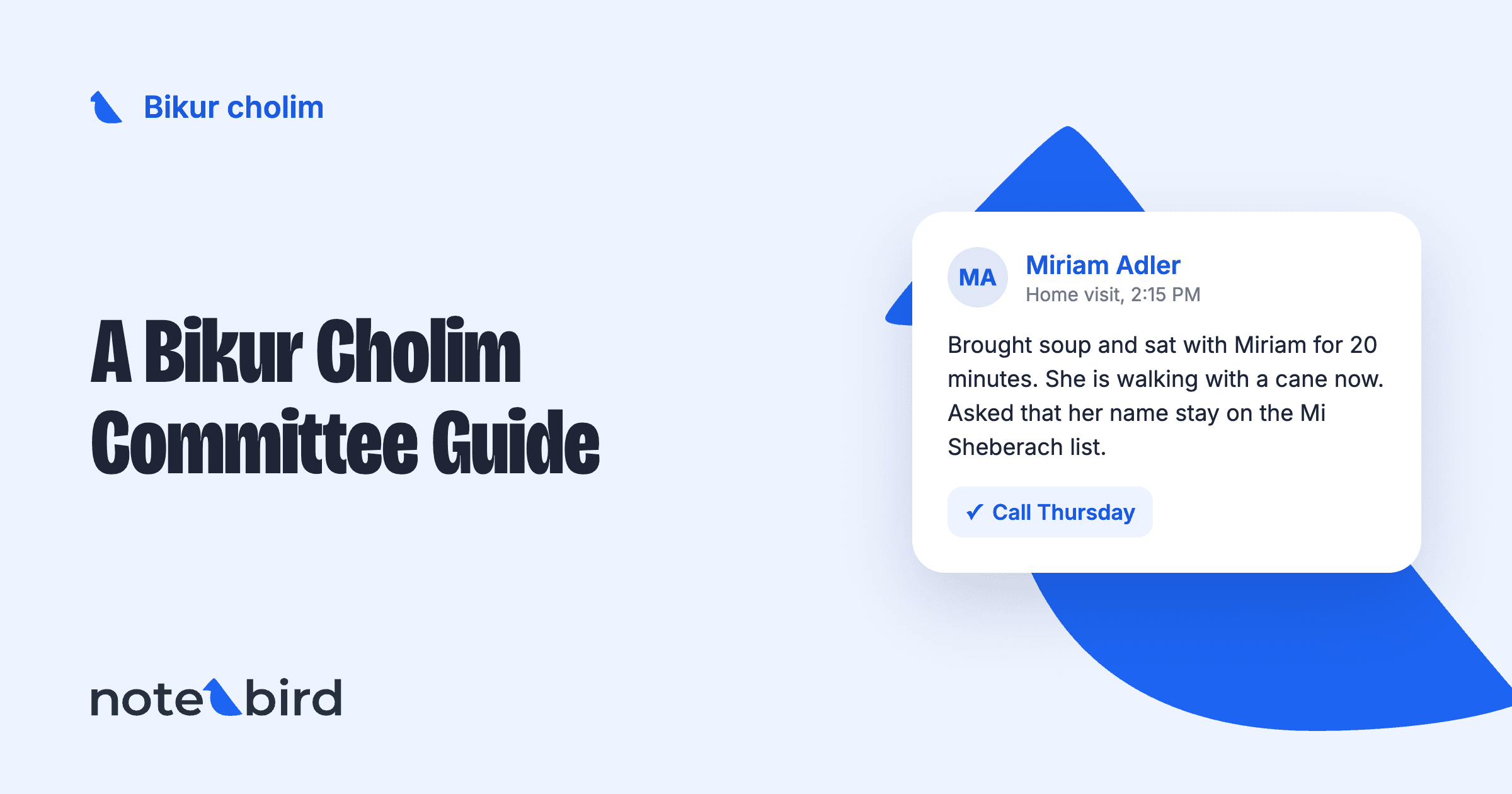
A good note: "Visited Miriam at home, 20 minutes. Walking with a cane now. Asked to stay on the Mi Sheberach list. Next: call Thursday."
Using ShulCloud and Notebird for Bikur Cholim
Many synagogues keep membership in ShulCloud. Notebird is where the committee records care. The free Notebird Synagogue Exporter, a Chrome extension, brings people, Hebrew names, birthdays, anniversaries, b'nai mitzvah dates, and yahrzeits from ShulCloud into Notebird. The connection is one way: ShulCloud stays your system of record. Hebrew names come in with each person, so the Mi Sheberach list keeper has them at hand. See how the ShulCloud integration works.
In Notebird, put members who are ill in a care group. A volunteer with the Group Member role sees only the people in the groups they serve. A sensitive note can be restricted, so only the Organization Owner, Organization Admins, and Care Admins can read it. Learn more about Notebird for synagogues.
Start With One Visit
You do not need a large committee to begin. Talk with the rabbi, name a coordinator, and make one call this week to a member who is ill. Then write down the next step. One call, made on the day you promised, tells a person in a hospital bed that their community has not forgotten them.